CD1-restricted T cells: are unconventional allies the key to future TB vaccines?
Matthew Milton, Salah Mansour

TL;DR
This review explores how CD1-restricted T cells, which recognize lipid antigens, could lead to new tuberculosis vaccines.
Contribution
The paper highlights the potential of CD1-restricted T cells for universally protective TB vaccines.
Findings
CD1-restricted T cells recognize lipid antigens from Mtb's cell wall.
These T cells offer donor-unrestricted immune responses, which could be harnessed for universal vaccines.
Mtb uses immune evasion strategies against CD1-mediated responses.
Abstract
CD1-restricted T cells constitute an unconventional arm of immunity that recognises lipid antigens, a feature particularly pertinent to Mycobacterium tuberculosis (Mtb), a pathogen with a lipid-rich cell wall. Unlike classical MHC-restricted responses, CD1-mediated lipid antigen presentation includes donor-unrestricted T cell responses, offering a promising pathway for universally protective tuberculosis (TB) vaccines. This review explores the biology of CD1 isoforms, the functional diversity of CD1-restricted T cell subsets, and their roles in TB immunity. We discuss Mtb’s lipid antigens, mechanisms of CD1 trafficking and antigen presentation, immune evasion strategies, and emerging translational insights. By highlighting key knowledge gaps and future directions, we argue that harnessing CD1-restricted T cells could unlock novel vaccine strategies against the world’s leading infectious…
Genes, proteins, chemicals, diseases, species, mutations and cell lines named across the full text — each resolved to its canonical identifier and authoritative record.
Click any figure to enlarge with its caption.
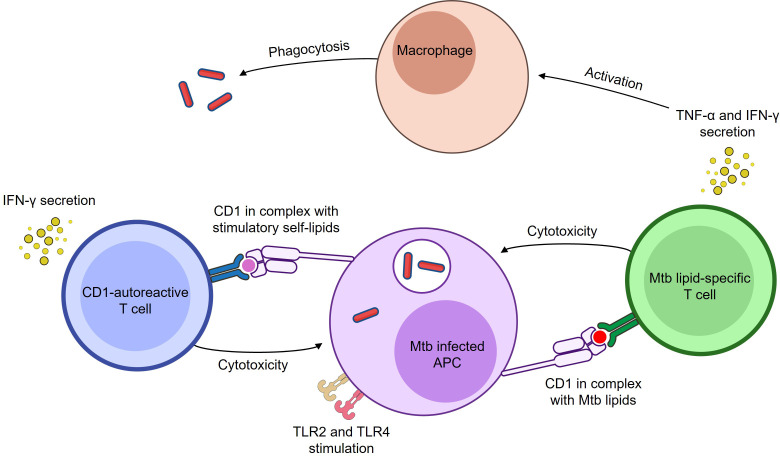 Figure 1
Peer Reviews
No public reviews on file for this paper yet. If you reviewed it on a platform where reviews are public (OpenReview, ICLR, NeurIPS, ICML), you can paste yours below so the community can read it here.
Videos
No videos yet. Explain this paper in a talk, walkthrough, or lecture? Add one.
Taxonomy
TopicsTuberculosis Research and Epidemiology · Immune Cell Function and Interaction · Immunodeficiency and Autoimmune Disorders