Evaluating the Rate and Causes of Non-candidacy After Laser-Assisted in Situ Keratomileusis (LASIK) Screening
Muhammed Jaafar, Kenneth D Han, Mina M Sitto, Preston B Willey, Walker C Kay, Nathan Olson, Kayvon A Moin, Michael T Christensen, Phillip Hoopes, Majid Moshirfar

TL;DR
This study examines why most people who get evaluated for LASIK eye surgery are not eligible, finding that reasons vary by age group.
Contribution
The study provides updated insights into LASIK non-candidacy rates and reasons, highlighting age-related differences in corneal and refractive factors.
Findings
The overall LASIK non-candidacy rate was 69.4%, with presbyopia and abnormal topography being the main causes.
Younger patients (<45) were often excluded due to corneal thinning and severe myopia, while older patients (≥45) were excluded due to presbyopia.
Diagnostic advancements and surgical alternatives have increased the non-candidacy rate but improved patient outcomes.
Abstract
Purpose To provide an updated characterization of the reasons for laser-assisted in situ keratomileusis (LASIK) non-candidacy. Methods A retrospective chart review was conducted on 648 patients (648 right eyes) who presented for LASIK evaluation at a refractive surgery center in Draper, UT, between November 2022 and April 2023. Age, spherical equivalent (SEQ), and keratometry measurements were compared between LASIK candidates and non-candidates. The overall rate of non-candidacy and reasons for exclusion were documented. Subgroup analyses were performed based on age groups, stratifying patients into two cohorts: patients younger than 45 years and those 45 years or older. Results The overall LASIK non-candidacy rate was 69.4%, primarily due to emmetropic presbyopia (36.9%), abnormal topography (31.3%), and hyperopic presbyopia (25.6%). Among patients < 45 years, non-candidacy was…
Genes, proteins, chemicals, diseases, species, mutations and cell lines named across the full text — each resolved to its canonical identifier and authoritative record.
Click any figure to enlarge with its caption.
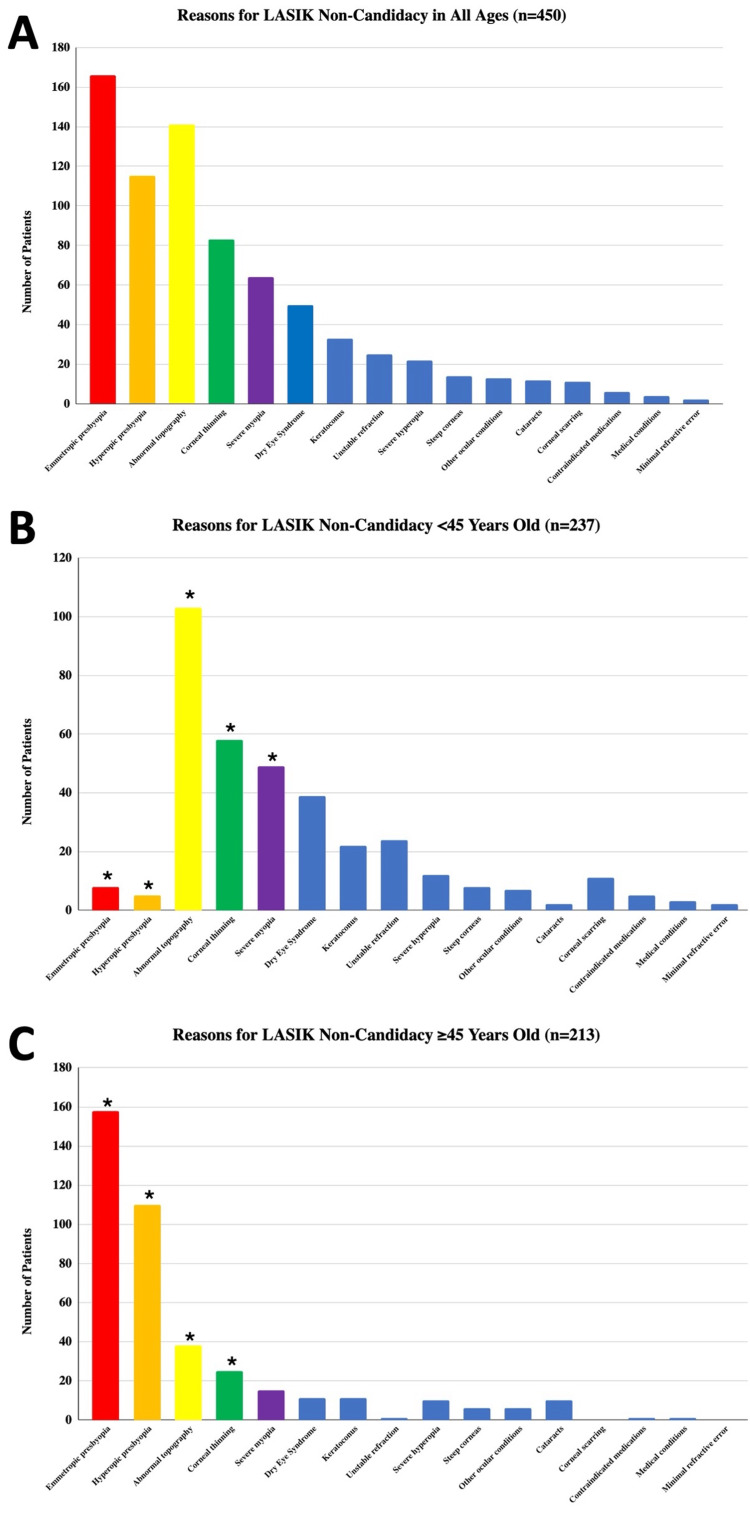 Figure 1
Peer Reviews
No public reviews on file for this paper yet. If you reviewed it on a platform where reviews are public (OpenReview, ICLR, NeurIPS, ICML), you can paste yours below so the community can read it here.
Videos
No videos yet. Explain this paper in a talk, walkthrough, or lecture? Add one.
Taxonomy
TopicsCorneal surgery and disorders · Corneal Surgery and Treatments · Ocular Surface and Contact Lens