Evaluating the Readability of Pediatric Neurocutaneous Syndromes–Related Patient Education Material Created by a Custom GPT With Retrieval Augmentation
Nneka Ede, Robyn Okereke

TL;DR
This study shows that a custom GPT can create patient education materials about neurocutaneous syndromes that are easier to read.
Contribution
The novel use of retrieval augmentation in a GPT to improve readability without explicit prompts for reading level.
Findings
A custom GPT with retrieval augmentation can generate patient education materials for neurocutaneous syndromes.
The generated materials have improved readability compared to standard outputs.
The system does not require explicit instructions for a specific reading level.
Abstract
In our study, we developed a GPT assistant with a custom knowledge base for neurocutaneous diseases, tested its ability to answer common patient questions, and showed that a GPT using retrieval augmentation generation can improve the readability of patient educational material without being prompted for a specific reading level.
Genes, proteins, chemicals, diseases, species, mutations and cell lines named across the full text — each resolved to its canonical identifier and authoritative record.
Click any figure to enlarge with its caption.
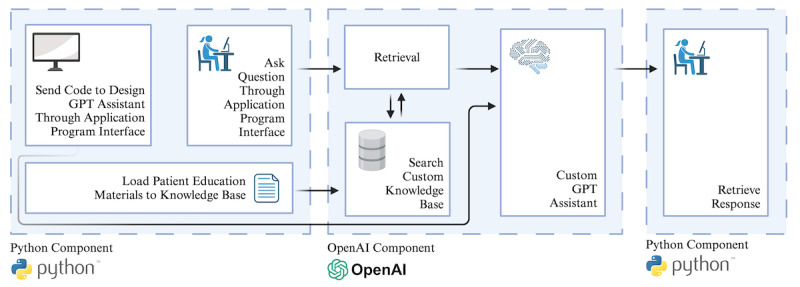 Figure 1
Peer Reviews
No public reviews on file for this paper yet. If you reviewed it on a platform where reviews are public (OpenReview, ICLR, NeurIPS, ICML), you can paste yours below so the community can read it here.
Videos
No videos yet. Explain this paper in a talk, walkthrough, or lecture? Add one.
Taxonomy
TopicsText Readability and Simplification