Radiomics analysis for the early diagnosis of common sexually transmitted infections and skin lesions
Jiajun Sun, Zhen Yu, Yingping Li, Janet M. Towns, Lin Zhang, Jason J. Ong, Zongyuan Ge, Christopher K. Fairley, Lei Zhang, Hisham Al-Obaidi, Fiona Kolbinger, Hisham Al-Obaidi, Fiona Kolbinger

TL;DR
An AI tool using radiomics and machine learning can help identify STIs from skin lesion images, with accuracy improving when infection location is considered.
Contribution
A novel AI method combining radiomics and machine learning for early STI diagnosis from skin lesion images, with performance improvements when anatomical site data is included.
Findings
Including infection site information improved model performance by 22.3% for anal infections and 3.8% for skin infections.
Lesion texture and statistical radiomics features were most predictive for STIs.
The best model achieved an average AUC of 0.681 when infection site information was unspecified.
Abstract
Early identification of sexually transmitted infection (STI) symptoms can prevent subsequent complications and improve STI control. We analysed 597 images from STIAtlas and categorised the images into four typical STIs and two skin lesions by the anatomical sites of infections. We first applied nine image filters and 11 machine-learning image classifiers to the images. We then extracted radiomics features from the filtered images and trained them with 99 models that combined image filters and classifiers. Model performance was evaluated by area under curve (AUC) and permutation importance. When the information of infection sites was unspecified, a combined Gradient-Boosted Decision Trees (GBDT) classifier and Laplacian of Gaussian (LoG) filter model achieved the best overall performance with an average AUC of 0.681 (95% CI 0.628-0.734). This model predicted best for lichen sclerosus…
Genes, proteins, chemicals, diseases, species, mutations and cell lines named across the full text — each resolved to its canonical identifier and authoritative record.
Click any figure to enlarge with its caption.
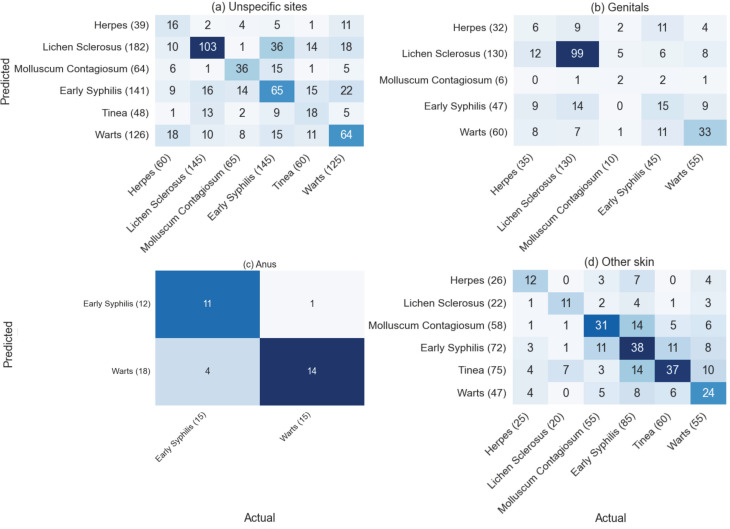 Figure 1
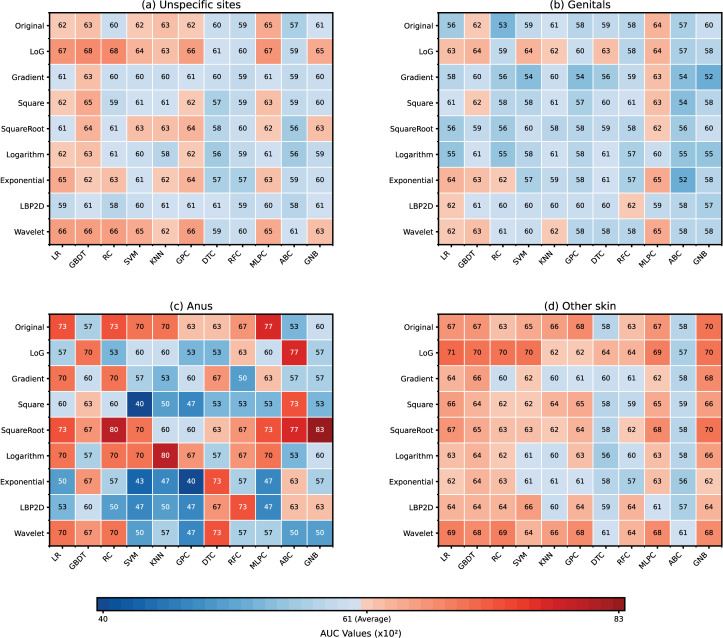 Figure 2
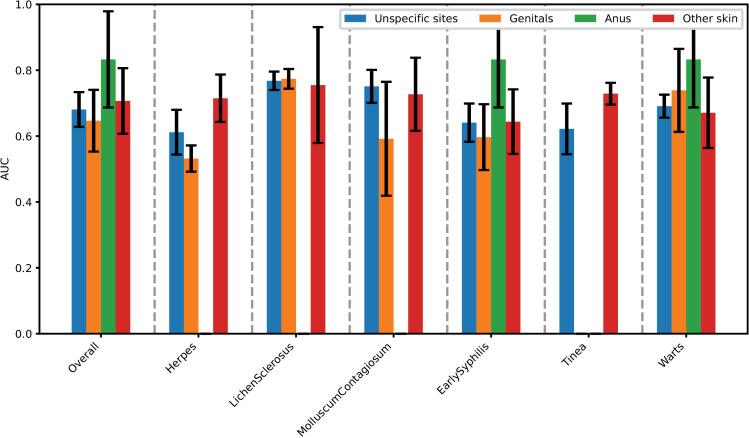 Figure 3
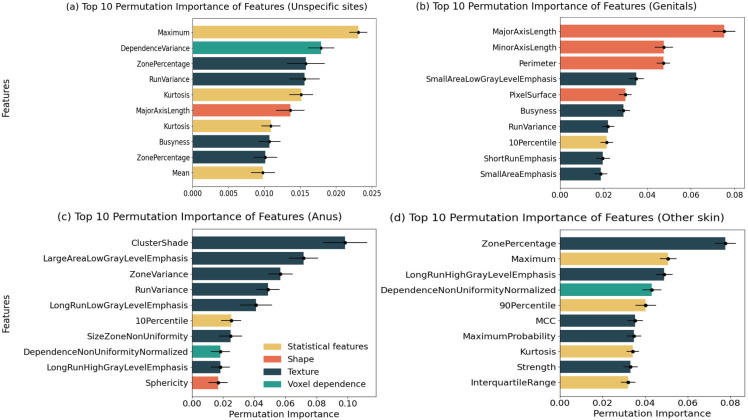 Figure 4
Peer Reviews
No public reviews on file for this paper yet. If you reviewed it on a platform where reviews are public (OpenReview, ICLR, NeurIPS, ICML), you can paste yours below so the community can read it here.
Videos
No videos yet. Explain this paper in a talk, walkthrough, or lecture? Add one.
Taxonomy
TopicsGenital Health and Disease · Radiomics and Machine Learning in Medical Imaging · Hematological disorders and diagnostics