Sleep Deprivation in Rats Causes Dissociation of the Synaptic NMDA Receptor/D1 Dopamine Receptor Heterocomplex
Natalia Kiknadze, Nana Narmania, Maia Sepashvili, Tamar Barbakadze, Elene Zhuravliova, Tamar Shetekauri, Nino Tkemaladze, Nikoloz Oniani, David Mikeladze

TL;DR
Sleep deprivation in rats disrupts specific receptor complexes in the brain, affecting synaptic plasticity and actin structures.
Contribution
This study reveals that sleep deprivation causes dissociation of a specific synaptic receptor complex involving NMDA, D1 dopamine, and Homer proteins.
Findings
Sleep deprivation reduces Homer in the GluN2A/mGluR1/D1R complex but not in GluN2B/mGluR1/D2R.
SD decreases the Homer/IP3R interaction, indicating dissociation of the Homer/mGluR1/IP3R supercomplex.
Sleep deprivation increases synaptic GluA1 and alters actin filament assembly via cofilin dephosphorylation.
Abstract
Glutamate and dopamine receptors play a crucial role in regulating synaptic plasticity throughout the sleep–wake cycle. These receptors form various heterocomplexes in synaptic areas; however, the role of this protein interactome in sleep–wake cycles remains unclear. Co-immunoprecipitation experiments were conducted to observe the complexation of the NMDA glutamate receptor (NMDAR) subunits GluN2A and GluN2B, metabotropic glutamate receptors mGluR1/5, and dopamine receptors (D1R and D2R) with the scaffold protein Homer in the synaptic membranes of the hippocampus after six hours of sleep deprivation (SD) in rats. Our findings indicate that the level of Homer in the GluN2A/mGluR1/D1R interactome decreased during SD, while the content of Homer remained unchanged in the GluN2B/mGluR1/D2R heterocomplex. Moreover, Homer immunoprecipitated a reduced amount of inositol trisphosphate receptor…
Genes, proteins, chemicals, diseases, species, mutations and cell lines named across the full text — each resolved to its canonical identifier and authoritative record.
Click any figure to enlarge with its caption.
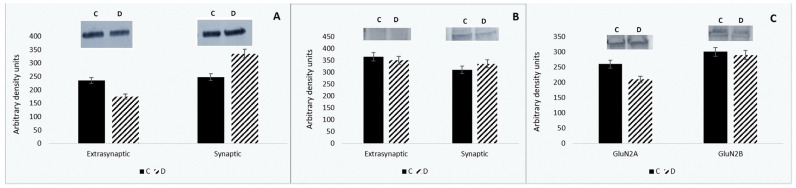 Figure 1
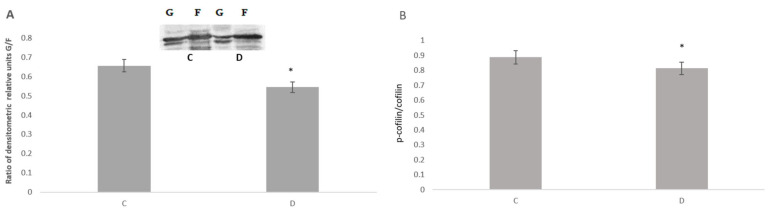 Figure 2
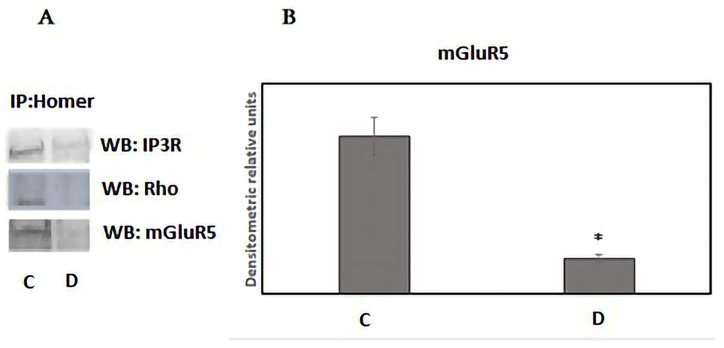 Figure 3
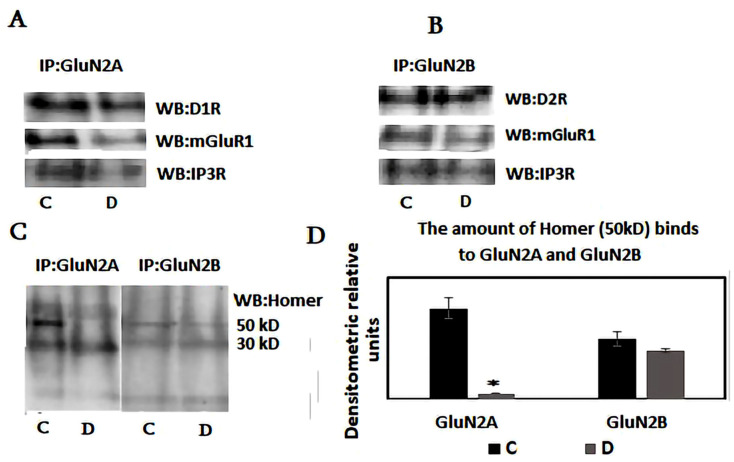 Figure 4
Peer Reviews
No public reviews on file for this paper yet. If you reviewed it on a platform where reviews are public (OpenReview, ICLR, NeurIPS, ICML), you can paste yours below so the community can read it here.
Videos
No videos yet. Explain this paper in a talk, walkthrough, or lecture? Add one.
Taxonomy
TopicsSleep and Wakefulness Research · Neuroscience and Neuropharmacology Research · Memory and Neural Mechanisms