The Owls Are Not What They Seem: Health, Mood, and Sleep Problems Reported by Morning and Evening Types with Atypical Timing of Weekend Sleep
Arcady A. Putilov, Evgeniy G. Verevkin, Dmitry S. Sveshnikov, Zarina V. Bakaeva, Elena B. Yakunina, Olga V. Mankaeva, Vladimir I. Torshin, Elena A. Trutneva, Michael M. Lapkin, Zhanna N. Lopatskaya, Roman O. Budkevich, Elena V. Budkevich, Natalya V. Ligun, Alexandra N. Puchkova

TL;DR
This study shows that weekend sleep timing can affect how morning or evening people are classified, influencing their health and mood outcomes.
Contribution
The study introduces a multidimensional chronotyping approach to better understand sleep patterns and their health impacts.
Findings
Conflicting assessments of morningness-eveningness were found in 141 students.
Evening types with early weekend sleep were more likely to be classified as lethargic or napping types.
Model simulations suggest bedtime procrastination disrupts biological clock signals.
Abstract
Morningness-eveningness is usually assessed as either a trait or a state using either a morning–evening preference scale or sleep timing reported for free days, respectively. These assessments were implemented in numerous studies exploring the associations between morningness-eveningness and health, mood, and sleep problems. Evening types almost always had more problems than morning types. We examined these associations in university students with conflicting results of trait and state assessments of morningness-eveningness and tried to confirm their chronotype using a multidimensional chronotyping approach that recognizes four types other than morning and evening (lethargic, vigilant, napping, and afternoon). The conflicting trait and state assessments of morningness-eveningness were found in 141 of 1582 students. Multidimensional chronotyping supported morningness of morning types…
Genes, proteins, chemicals, diseases, species, mutations and cell lines named across the full text — each resolved to its canonical identifier and authoritative record.
Click any figure to enlarge with its caption.
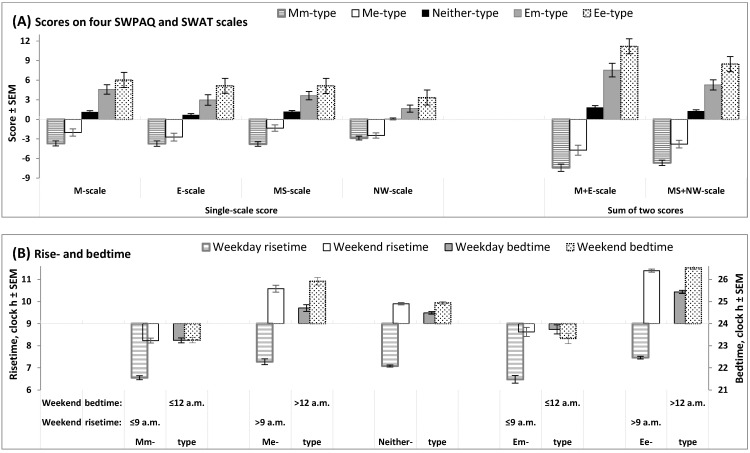 Figure 1
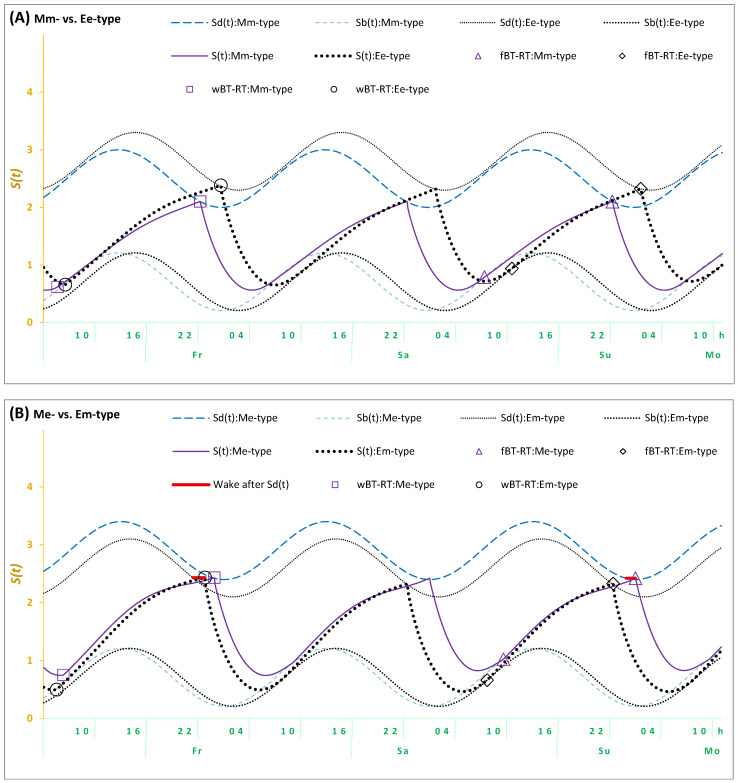 Figure 2
Peer Reviews
No public reviews on file for this paper yet. If you reviewed it on a platform where reviews are public (OpenReview, ICLR, NeurIPS, ICML), you can paste yours below so the community can read it here.
Videos
No videos yet. Explain this paper in a talk, walkthrough, or lecture? Add one.
Taxonomy
TopicsSleep and related disorders · Circadian rhythm and melatonin · Sleep and Wakefulness Research