Psychometric Properties of the European Evaluation of Vertigo Scale (EEV) for a Spanish-Speaking Population: A Validation Study
María Alharilla Montilla-Ibáñez, Rafael Lomas-Vega, María del Carmen López-Ruiz, Ángeles Díaz-Fernández, Alfonso Javier Ibáñez-Vera, Ana Belén Peinado-Rubia, Esteban Obrero-Gaitán, Ana Sedeño-Vidal

TL;DR
This study validates the Spanish version of the European Evaluation of Vertigo scale, showing it is reliable and accurate for assessing vestibular symptoms.
Contribution
The study provides validation of the Spanish version of the EEV scale for use in a Spanish-speaking population.
Findings
The EEV test–retest reliability was nearly perfect with a Kappa index of 0.97.
The scale showed good discriminant validity with AUC values ranging from 0.731 to 0.846 for predicting disability and BPPV.
A cut-off score of 12 predicted disability and fall risk, while 11 predicted BPPV.
Abstract
Background/Objectives: The objective of this study was to validate the Spanish version of the European Evaluation of Vertigo (EEV) and analyse its test–retest reliability, standard error of measurement (SEM), minimum detectable change (MDC), concurrent validity, and discriminant validity. Methods: A cross-sectional validation study was designed. Subjects were recruited from the Otolaryngology Service of the University Hospital of Jaen. Psychometric properties of the EEV were analysed, including the concurrent validity, the SEM, and the MDC. Discriminant validity was calculated using the receiver operating characteristic (ROC) curve. Results: The EEV test–retest reliability was nearly perfect (Kappa index = 0.97). The SEM and the MDC were set at 0.56 and 1.10, respectively. Regarding the discriminant validity, the area under the curve (AUC) was 0.831 (95% CI; 0.743–0.899) for the BPPV…
Genes, proteins, chemicals, diseases, species, mutations and cell lines named across the full text — each resolved to its canonical identifier and authoritative record.
Click any figure to enlarge with its caption.
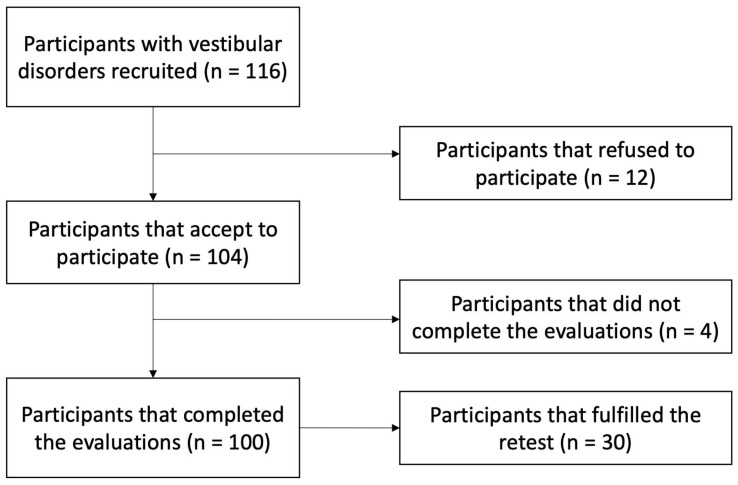 Figure 1
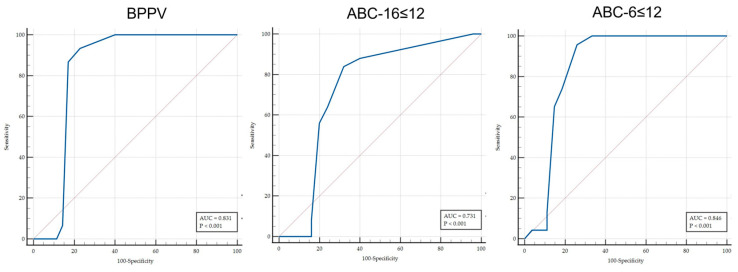 Figure 2
Peer Reviews
No public reviews on file for this paper yet. If you reviewed it on a platform where reviews are public (OpenReview, ICLR, NeurIPS, ICML), you can paste yours below so the community can read it here.
Videos
No videos yet. Explain this paper in a talk, walkthrough, or lecture? Add one.
Taxonomy
TopicsVestibular and auditory disorders