Prenatal Alcohol Exposure and Congenital Heart Defects: Retinoic Acid Deficiency as a Potential Mechanism in Dextro-Type Transposition of the Great Arteries
Roberto Paparella, Carolina Putotto, Marco Fiore, Fiorenza Colloridi, Paolo Versacci, Mauro Ceccanti, Bruno Marino, Luigi Tarani

TL;DR
This paper explores how alcohol exposure during pregnancy may cause heart defects in babies by reducing a key chemical called retinoic acid.
Contribution
The paper proposes a new mechanism linking alcohol exposure to d-TGA through retinoic acid deficiency.
Findings
Prenatal alcohol exposure is associated with dextro-type transposition of the great arteries.
Ethanol may interfere with retinoic acid biosynthesis, leading to developmental heart defects.
Abstract
Fetal alcohol spectrum disorder (FASD) is a preventable cause of developmental disabilities linked to prenatal alcohol exposure (PAE). Congenital heart defects (CHDs) are frequently observed in FASD, with a notable association between PAE and dextro-type transposition of the great arteries (d-TGA). A potential pathogenetic mechanism of d-TGA in FASD, involving retinoic acid (RA) deficiency due to the interference of ethanol with RA biosynthesis, is proposed. Further investigation is required to understand the timing and impact of alcohol exposure on congenital anomalies, particularly in the context of CHDs.
Genes, proteins, chemicals, diseases, species, mutations and cell lines named across the full text — each resolved to its canonical identifier and authoritative record.
Click any figure to enlarge with its caption.
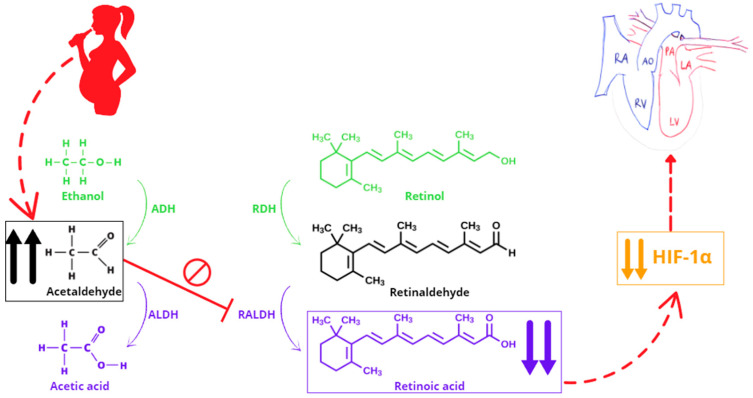 Figure 1
Peer Reviews
No public reviews on file for this paper yet. If you reviewed it on a platform where reviews are public (OpenReview, ICLR, NeurIPS, ICML), you can paste yours below so the community can read it here.
Videos
No videos yet. Explain this paper in a talk, walkthrough, or lecture? Add one.
Taxonomy
TopicsPrenatal Substance Exposure Effects · Folate and B Vitamins Research · Birth, Development, and Health