Psychotic Disorder Secondary to Cerebral Venous Thrombosis Caused by Primary Thrombophilia in a Pediatric Patient with Protein S Deficiency and an MTHFR p.Ala222Val Variant: A Case Report
Darío Martínez-Pascual, Alejandra Dennise Solis-Mendoza, Jacqueline Calderon-García, Bettina Sommer, Eduardo Calixto, María E. Martinez-Enriquez, Arnoldo Aquino-Gálvez, Hector Solis-Chagoyan, Luis M. Montaño, Bianca S. Romero-Martinez, Ruth Jaimez, Edgar Flores-Soto

TL;DR
A 17-year-old patient with a psychotic disorder was found to have cerebral venous thrombosis caused by genetic and protein deficiencies, highlighting a link between psychiatric and thrombotic conditions.
Contribution
This case report is the first to link MTHFR p.Ala222Val mutation and protein S deficiency to a psychotic disorder via cerebral venous thrombosis in a pediatric patient.
Findings
Cerebral venous thrombosis was identified as the cause of a psychotic disorder in a 17-year-old female.
The thrombosis was linked to primary thrombophilia from MTHFR p.Ala222Val mutation and protein S deficiency.
Anticoagulation treatment improved the patient's psychiatric symptoms, confirming the thrombotic origin.
Abstract
Background and Clinical Significance: Herein, we describe the clinical case of a 17-year-old patient with psychotic disorder secondary to cerebral venous thrombosis due to primary thrombophilia, which was related to protein S deficiency and a heterozygous MTHFR gene mutation with the p.Ala222Val variant. Case presentation: A 17-year-old female, with no history of previous illnesses, was admitted to the emergency service department due to a psychotic break. Psychiatric evaluation detected disorganized thought, euphoria, ideas that were fleeting and loosely associated, psychomotor excitement, and deviant judgment. On the fifth day, an inflammatory process in the parotid gland was detected, pointing out a probable viral meningoencephalitis, prompting antiviral and antimicrobial treatment. One week after antiviral and steroidal anti-inflammatory treatments, the symptoms’ improvement was…
Genes, proteins, chemicals, diseases, species, mutations and cell lines named across the full text — each resolved to its canonical identifier and authoritative record.
Click any figure to enlarge with its caption.
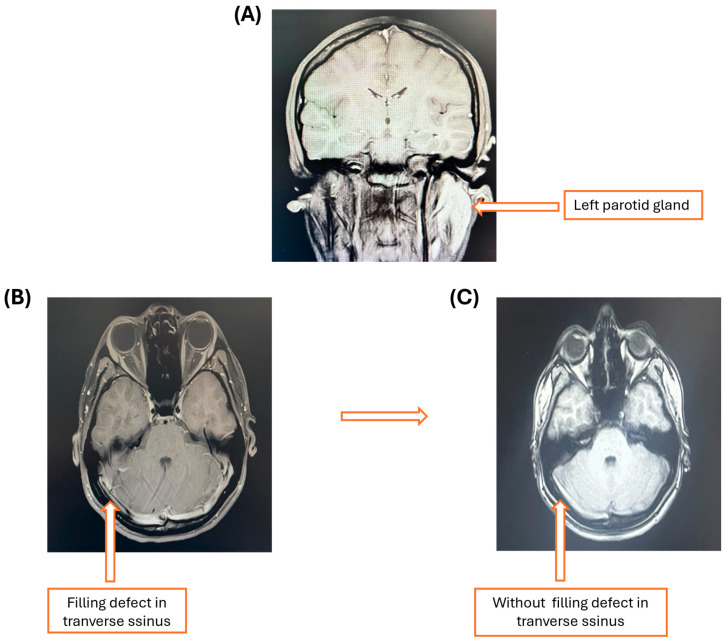 Figure 1
Peer Reviews
No public reviews on file for this paper yet. If you reviewed it on a platform where reviews are public (OpenReview, ICLR, NeurIPS, ICML), you can paste yours below so the community can read it here.
Videos
No videos yet. Explain this paper in a talk, walkthrough, or lecture? Add one.
Taxonomy
TopicsBlood Coagulation and Thrombosis Mechanisms · Cerebral Venous Sinus Thrombosis · Venous Thromboembolism Diagnosis and Management