Investigating the Accuracy of Ultrasound Imaging in Measuring Fetal Weight in Comparison with the Actual Postpartum Weight
Sultan Abdulwadoud Alshoabi, Abdulhadi M. Tarshun, Ziyad O. Alnoman, Fahad H. Aljohani, Fadwa M. Alahmadi, Awatif M. Omer, Osamah M. Abdulaal, Awadia Gareeballah, Abdulaziz A. Qurashi, Fahad H. Alhazmi, Kamal D. Alsultan, Moawia Gameraddin

TL;DR
This study shows that ultrasound estimates of fetal weight are highly accurate when compared to actual birth weights, with strong correlations across different weight groups.
Contribution
The study provides empirical validation of ultrasound accuracy in estimating fetal weight across a wide range of birth weights.
Findings
Ultrasound estimates of fetal weight showed strong correlation with actual birth weight (r = 0.82, p < 0.001).
Compatibility between estimated and actual weights was highest in the normal weight range (86.8%).
Ultrasonography slightly overestimates fetal weight but remains clinically valuable for obstetric planning.
Abstract
Background: Antenatal ultrasonography measurements of the estimated fetal weight (EFW) are a critical point in the decision-making process of obstetric planning and management to preserve the safety of both the newborn and the mother. This study aims to investigate the accuracy of ultrasonography to measure the EFW in comparison with the actual birth weight (BW) measured immediately after delivery. Methods: In this retrospective study, electronic records of 270 newborns who fulfilled the inclusion criteria were retrieved. A structured data sheet was used to collect the EFW, calculated by the Hadlock A formula using real-time ultrasound imaging on the day of delivery or the day before, and the actual BW immediately after delivery. Results: Out of 270 fetuses, 53.7% (145) were female, and 46.3% (125) were male. The mean BW was 2918.1 ± 652.81 g (range: 880 to 5100). The mean EFW was…
Genes, proteins, chemicals, diseases, species, mutations and cell lines named across the full text — each resolved to its canonical identifier and authoritative record.
Click any figure to enlarge with its caption.
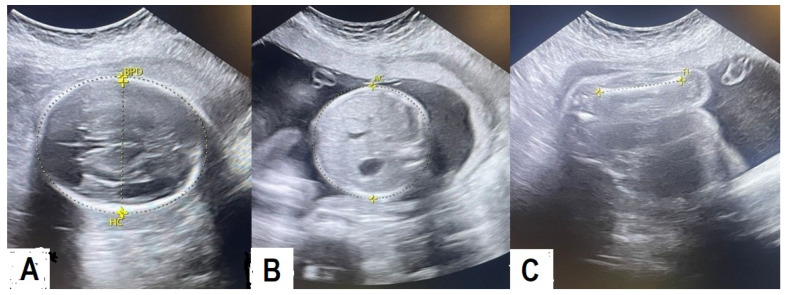 Figure 1
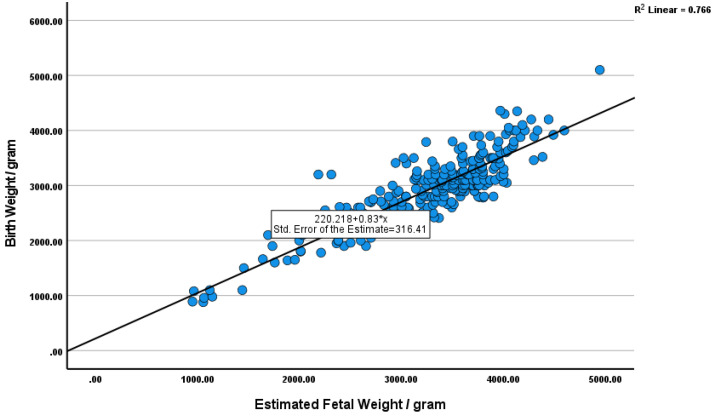 Figure 2
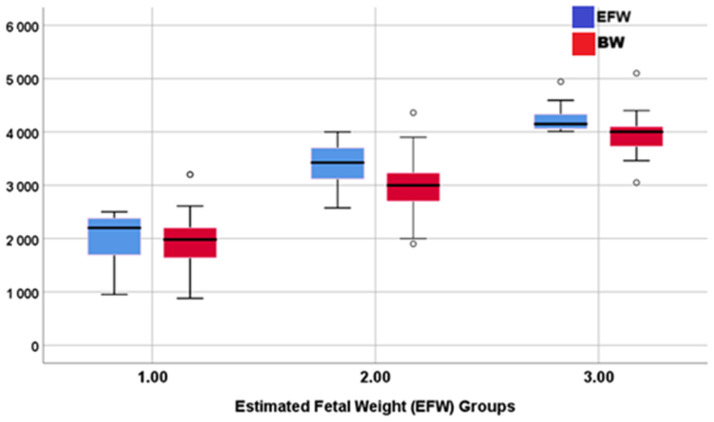 Figure 3
Peer Reviews
No public reviews on file for this paper yet. If you reviewed it on a platform where reviews are public (OpenReview, ICLR, NeurIPS, ICML), you can paste yours below so the community can read it here.
Videos
No videos yet. Explain this paper in a talk, walkthrough, or lecture? Add one.
Taxonomy
TopicsPregnancy and preeclampsia studies · Gestational Diabetes Research and Management · Birth, Development, and Health