‘It causes me to minimise myself’: impostor phenomenon in simulation educators
Kirsty J. Freeman, Debra Nestel, Stephen Houghton, Sandra E. Carr

TL;DR
This study explores how healthcare simulation educators experience impostor phenomenon, a feeling of being unqualified despite success, and suggests ways to support them.
Contribution
The study provides new insights into impostor phenomenon among simulation educators using qualitative analysis of lived experiences.
Findings
Impostor phenomenon among simulation educators is cyclical and impacts self-perception and professional behavior.
Educators described both positive and negative effects of impostor phenomenon on their work.
Themes included the need for external validation and self-minimisation in professional settings.
Abstract
Impostor phenomenon (IP) is a common experience among healthcare professionals, characterised by persistent feelings of inadequacy, fear of being exposed as a fraud, and self-doubt, despite external evidence of competence. In healthcare simulation, where educators frequently transition between roles and responsibilities, little is known about how simulation educators experience and navigate IP throughout their careers. This study aims to explore the lived experiences of IP among healthcare simulation educators. The study builds on our earlier work in which simulation educators used the Clance Impostor Phenomenon Scale for identifying self-reported IP. Participants were recruited through professional networks. Using a hermeneutic phenomenological approach, we explored the lived experiences of 20 simulation educators. Semi-structured interviews were conducted, audio-recorded, and…
Genes, proteins, chemicals, diseases, species, mutations and cell lines named across the full text — each resolved to its canonical identifier and authoritative record.
Click any figure to enlarge with its caption.
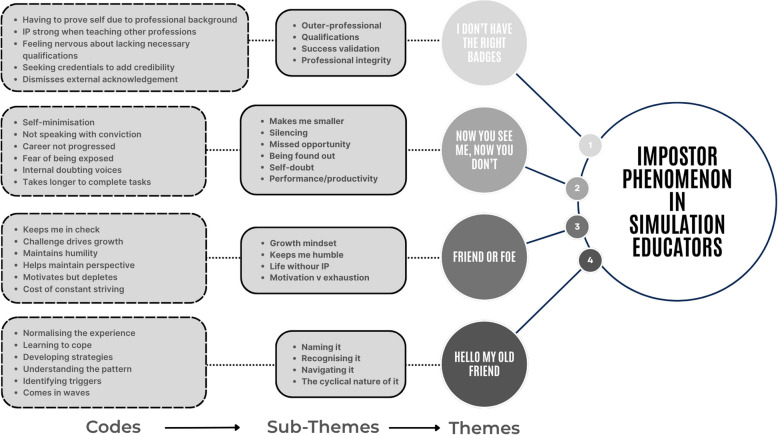 Figure 1
Peer Reviews
No public reviews on file for this paper yet. If you reviewed it on a platform where reviews are public (OpenReview, ICLR, NeurIPS, ICML), you can paste yours below so the community can read it here.
Videos
No videos yet. Explain this paper in a talk, walkthrough, or lecture? Add one.
Taxonomy
TopicsPerfectionism, Procrastination, Anxiety Studies · Family and Patient Care in Intensive Care Units · Healthcare professionals’ stress and burnout