The impact of sensor application site on continuous noninvasive haemoglobin trends
Audrius Andrijauskas, Povilas Andrijauskas, Darius Dilijonas, Ieva Jovaisiene, Arūnas Valaika, Axel Kerroum, Karolis Urbonas, Nadezda Scupakova, Lina Puodžiukaite, Vaidotas Marozas, Edgaras Stankevicius, Mindaugas Budra, Gintaras Kalinauskas, Darius Cincikas, Edvin Vasilevski

TL;DR
This study shows that placing sensors on different fingers can lead to variations in noninvasive hemoglobin measurements during heart surgery.
Contribution
The study demonstrates that sensor placement affects measurement accuracy and suggests averaging multiple readings improves reliability.
Findings
SpHb values from three sensors on different fingers showed strong correlation but significant differences from the average.
Averaging SpHb from three sensors improved accuracy and precision compared to individual sensors.
Sensor placement impacts noninvasive hemoglobin measurement reliability during cardiac surgery.
Abstract
This prospective observational clinical study investigated discrepancy between noninvasive continuous haemoglobin (SpHb, Masimo Corp., Irvine, CA) measurements with sensors placed on three fingertips during elective cardiac surgery. The study included 12 adult patients who underwent elective coronary artery bypass grafting (CABG) under cardiopulmonary bypass (CPB). Three identical versions of SpHb sensors were placed on the fingers of the same hand and connected to dedicated Masimo Radical-7 monitors. Data were continuously recorded throughout the surgery. Multiple group comparison tests—Kruskal—Wallis and Alexander—Govern tests—were used to compare three sets of SpHb data (trends). Bland—Altman and Giavarina plots were used to compare the SpHb data with invasive arterial haemoglobin (Lab-Hb) data obtained at clinically relevant time points chosen at the discretion of the cardiac…
Genes, proteins, chemicals, diseases, species, mutations and cell lines named across the full text — each resolved to its canonical identifier and authoritative record.
Click any figure to enlarge with its caption.
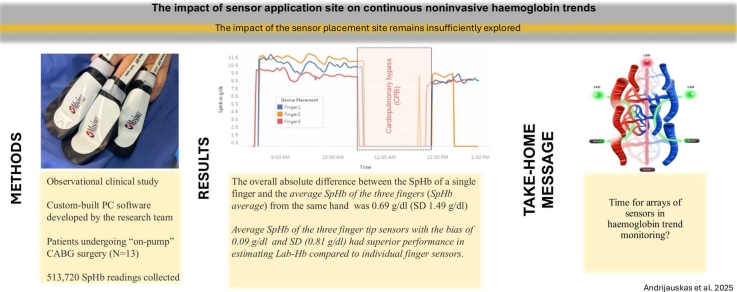 Figure 1
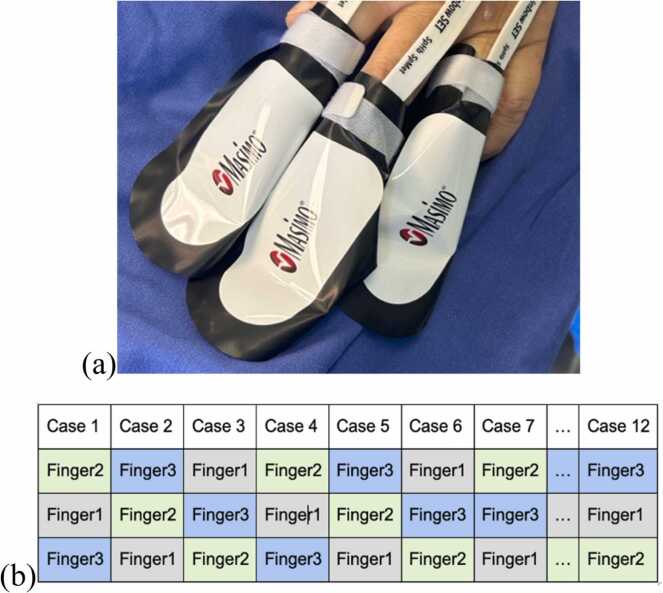 Figure 2
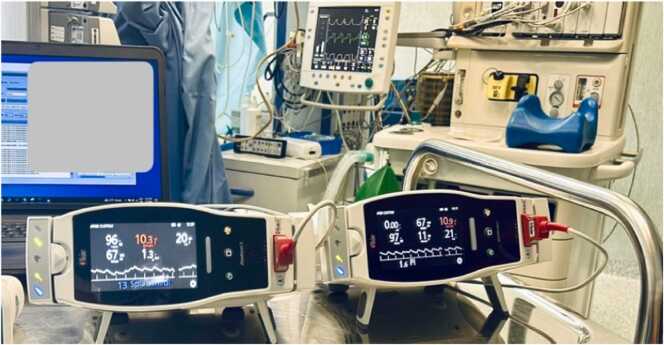 Figure 3
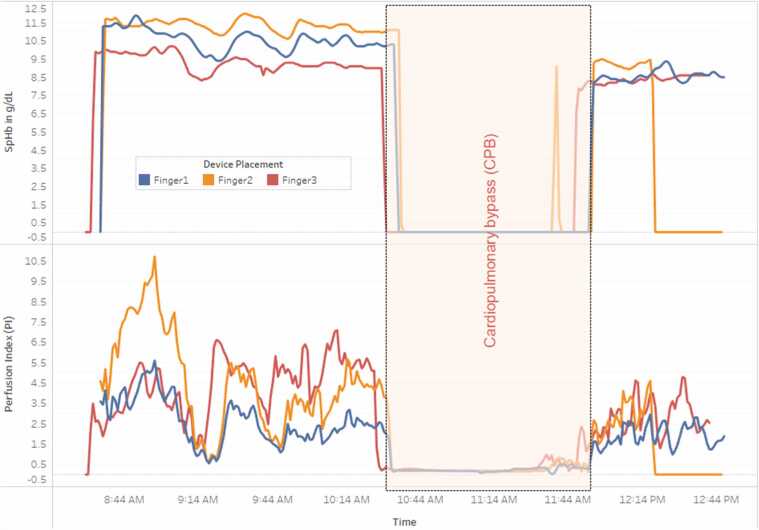 Figure 4
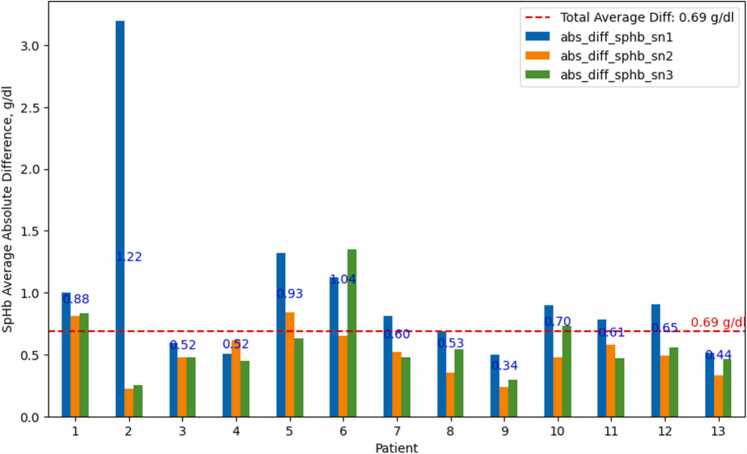 Figure 5
 Figure 6
 Figure 7
 Figure 8
Peer Reviews
No public reviews on file for this paper yet. If you reviewed it on a platform where reviews are public (OpenReview, ICLR, NeurIPS, ICML), you can paste yours below so the community can read it here.
Videos
No videos yet. Explain this paper in a talk, walkthrough, or lecture? Add one.
Taxonomy
TopicsCardiac Arrest and Resuscitation · Hemodynamic Monitoring and Therapy · Non-Invasive Vital Sign Monitoring