Polygenic Scores of Executive Function Provide Limited Support for Genetic Confounding With Socio‐Economic Measures
Lucas C. Perry, Nicolas Chevalier, Michelle Luciano

TL;DR
Polygenic scores for executive function show limited support for genetic confounding with socio-economic factors, suggesting caution in their use for this purpose.
Contribution
This study evaluates the effectiveness of polygenic scores as a scalable alternative to specialized samples for detecting genetic confounding in executive function research.
Findings
Polygenic scores showed modest evidence for genetic confounding with maternal education, but weaker than in other studies.
Environmental factors other than maternal education were best explained by their association with maternal education.
Polygenic scores did not replicate findings from other genetically informed studies of executive function.
Abstract
Previous work has suggested that genetic confounding is a persistent issue in studies of environmental predictors of executive function (EF). This is largely because controlling for genetic confounding typically requires specialized samples such as twins or adoptees, which are more difficult to recruit. Polygenic scores provide a potential alternative control, scalable to smaller samples and not requiring specialized sample features. The purpose of this study was to determine if polygenic scores of EF could be used to replicate the findings of other genetic confounding studies in a less specialized sample. Confounding models showed evidence for genetic confounding in maternal education, although it was far weaker in magnitude than in other genetically informed studies. However, consistent with previous research, there were no detectable influences of indirect genetic effects on the EF…
Genes, proteins, chemicals, diseases, species, mutations and cell lines named across the full text — each resolved to its canonical identifier and authoritative record.
Click any figure to enlarge with its caption.
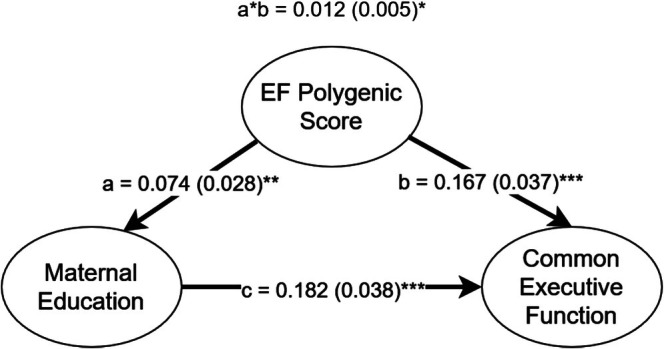 Figure 1
 Figure 2
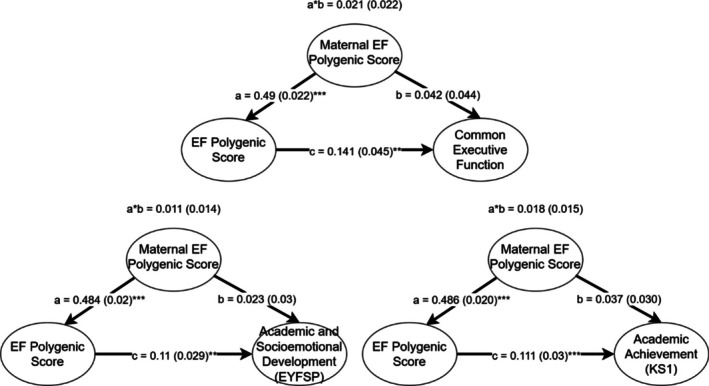 Figure 3
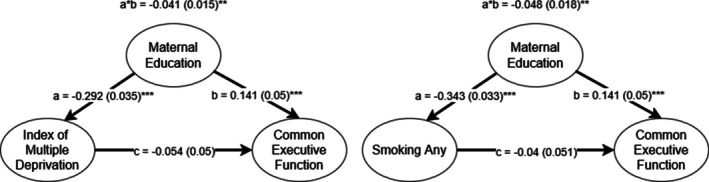 Figure 4
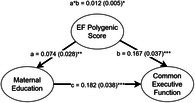 Figure 5
Peer Reviews
No public reviews on file for this paper yet. If you reviewed it on a platform where reviews are public (OpenReview, ICLR, NeurIPS, ICML), you can paste yours below so the community can read it here.
Videos
No videos yet. Explain this paper in a talk, walkthrough, or lecture? Add one.
Taxonomy
TopicsCognitive Abilities and Testing · Intergenerational and Educational Inequality Studies · Birth, Development, and Health