The perils of the first try: experimental evidence for visuomotor calibration in darts and hammering
David J. C. Smith, Philip Furley, Fabian Wunderlich, Herbert Heuer, Daniel Memmert

TL;DR
This study shows that people need to recalibrate their movements after changing positions, even for simple tasks like darts and hammering.
Contribution
The study provides experimental evidence for the calibration effect in both skilled and unskilled individuals across different tasks.
Findings
The first attempt in a round was less accurate than subsequent attempts, showing a need for recalibration.
Calibration effects were observed in both dart throwing and hammering tasks.
Performance decrements occurred when body position was changed between rounds.
Abstract
Task such as hammering or throwing darts involve intentional actions performed with the anticipation of a desired effect that requires precision to achieve success. Visual perception of the goal, defined in an external frame of reference, plays a crucial role in specifying movement parameters in a body-centered frame of reference. Physical interruption of the task decouples the internal and external frames of reference leading to rapid performance decrements. Motor calibration, as noted by the ‘Calibration Effect’, is the fine-tuning of motor commands following performance-related feedback in the external frame of reference. Here we test the calibration effect with non-skilled populations in both a sport specific and an everyday type of task, darts and hammering. Participants performed 20 rounds of five attempts of hitting a goal with a stable bodily position. Between rounds they moved…
Genes, proteins, chemicals, diseases, species, mutations and cell lines named across the full text — each resolved to its canonical identifier and authoritative record.
Click any figure to enlarge with its caption.
 Figure 1
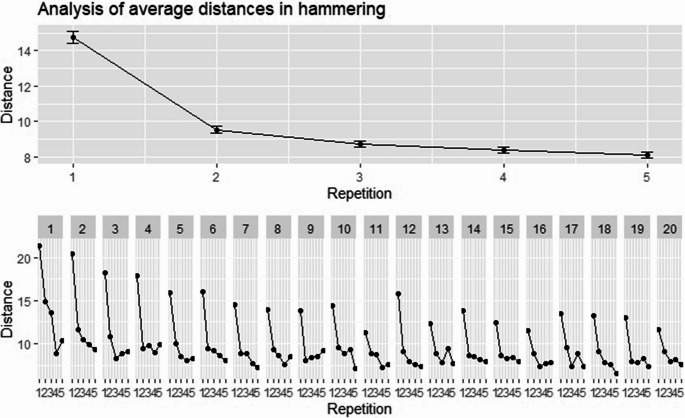 Figure 2
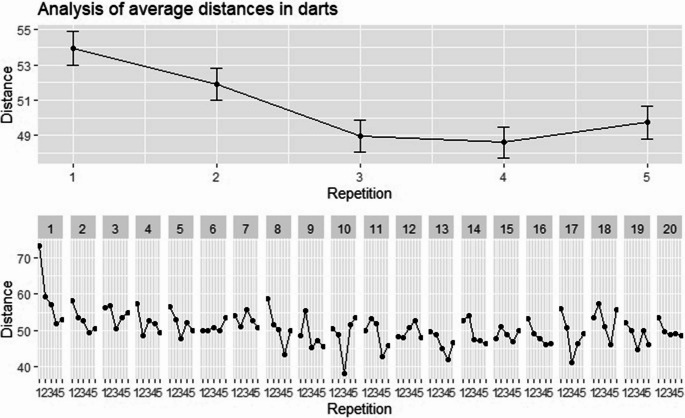 Figure 3
Peer Reviews
No public reviews on file for this paper yet. If you reviewed it on a platform where reviews are public (OpenReview, ICLR, NeurIPS, ICML), you can paste yours below so the community can read it here.
Videos
No videos yet. Explain this paper in a talk, walkthrough, or lecture? Add one.
Taxonomy
TopicsMotor Control and Adaptation · Sport Psychology and Performance · Action Observation and Synchronization