“When he is around, I’ll take the PrEP, but when he is not, I will not take PrEP”: key influences on PrEP use decisions among women attending family planning clinics in Kenya
Vallery Ogello, Kristin Beima-Sofie, Sandra Urusaro, Mercy Awuor, Annabell Dollah, Winnie Atieno, Cynthia Wandera, Daniel Matemo, Jennifer F. Morton, Kenneth Ngure, John Kinuthia, Kenneth K. Mugwanya

TL;DR
This study explores why women in Kenya make certain decisions about using PrEP, highlighting factors like partner influence, autonomy, and preferences for alternative HIV prevention methods.
Contribution
The study identifies context-specific factors influencing PrEP use decisions among women in Kenya, emphasizing the role of agency, partner dynamics, and formulation preferences.
Findings
PrEP use decisions were influenced by changes in HIV risk dynamics and perceived autonomy.
Women who declined PrEP cited lack of autonomy, partner influence, and insufficient information.
Participants preferred injectable PrEP due to ease of use and privacy.
Abstract
Women of childbearing age in sub-Saharan Africa (SSA) face a disproportionately high risk of HIV acquisition. Although oral PrEP has been universally scaled up for individuals at significant risk of HIV, its uptake and sustained use remain suboptimal. Understanding PrEP use decisions offers insights into context-specific barriers and facilitators to its utilization. From September to November 2023, we conducted a qualitative study nested in a larger prospective, open-label clinical trial (FP-Plus). We conducted in-depth interviews (IDIs) with younger women (ages 15–24) and older women (ages ≥25) who declined, delayed, discontinued, or restarted PrEP during the study. IDIs were conducted at two FP clinics by trained Kenyan social scientists and were audio recorded, translated, and transcribed. We analyzed data using inductive and deductive thematic analysis through the lens of the…
Genes, proteins, chemicals, diseases, species, mutations and cell lines named across the full text — each resolved to its canonical identifier and authoritative record.
Click any figure to enlarge with its caption.
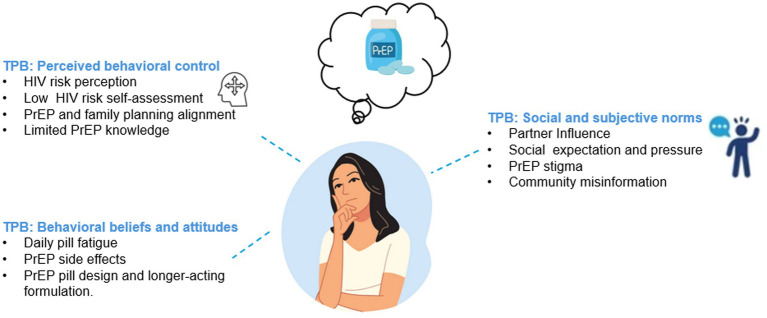 Figure 1
Peer Reviews
No public reviews on file for this paper yet. If you reviewed it on a platform where reviews are public (OpenReview, ICLR, NeurIPS, ICML), you can paste yours below so the community can read it here.
Videos
No videos yet. Explain this paper in a talk, walkthrough, or lecture? Add one.
Taxonomy
TopicsHIV/AIDS Research and Interventions · Global Maternal and Child Health · Adolescent Sexual and Reproductive Health