Sustained high Life’s Essential 8 is associated with lower risk of cerebral small vessel disease: a community-based study
Huijing Shi, Liufu Cui, Ying Hui, Rong Shu, Haicheng Song, Jierui Wang, Ping Yu, Shuohua Chen, Jing Li, Xiaoliang Liang, Chunyu Ruan, Jing Chen, Zhenchang Wang, Shouling Wu, Xiaoshuai Li

TL;DR
Maintaining high Life’s Essential 8 scores is linked to a lower risk of cerebral small vessel disease in a community-based study.
Contribution
This study shows that long-term adherence to Life’s Essential 8 reduces the risk of cerebral small vessel disease.
Findings
Sustained high LE8 scores are associated with a significantly lower risk of cerebral small vessel disease.
LE8 has the strongest protective effect on lacunar infarcts, enlarged perivascular spaces, and white matter hyperintensities.
No significant association was found between LE8 and cerebral microbleeds.
Abstract
We aimed to investigate the influence of Life’s Essential 8 (LE8) score trajectories on cerebral small vessel disease (CSVD). A total of 1,162 subjects from the Kailuan prospective cohort study were enrolled. The LE8 score trajectories were developed from 2006 to 2021 using trajectory modeling of the SAS procedure Proc Traj. Participants were classified into three trajectory models: low stable group, medium stable group, and high stable group. Magnetic resonance imaging (MRI) was performed at the last follow-up. Ordered logistic regression and binary logistic regression models were employed to analyze the association between LE8 trajectory groups and the total CSVD score. Furthermore, we examined the relationship between LE8 trajectory groups and Various CSVD Lesions: lacunar infarcts, cerebral microbleeds (CMB), white matter hyperintensities (WMH), and enlarged perivascular spaces…
Genes, proteins, chemicals, diseases, species, mutations and cell lines named across the full text — each resolved to its canonical identifier and authoritative record.
Click any figure to enlarge with its caption.
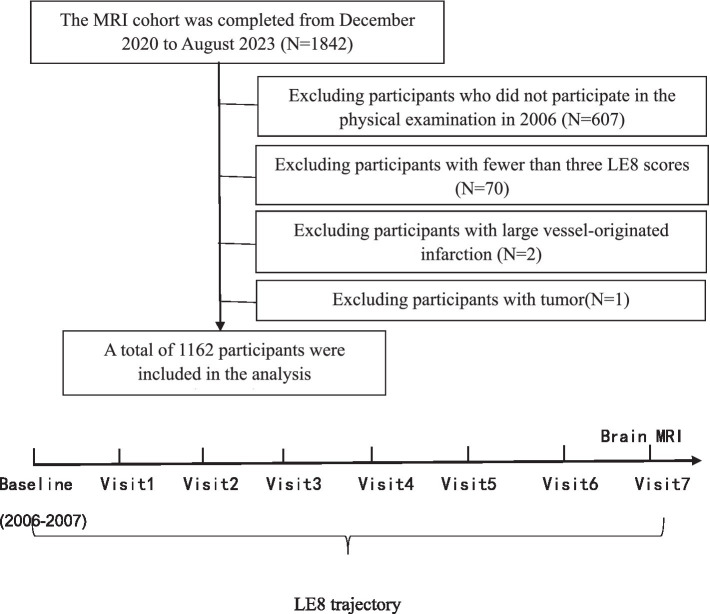 Figure 1
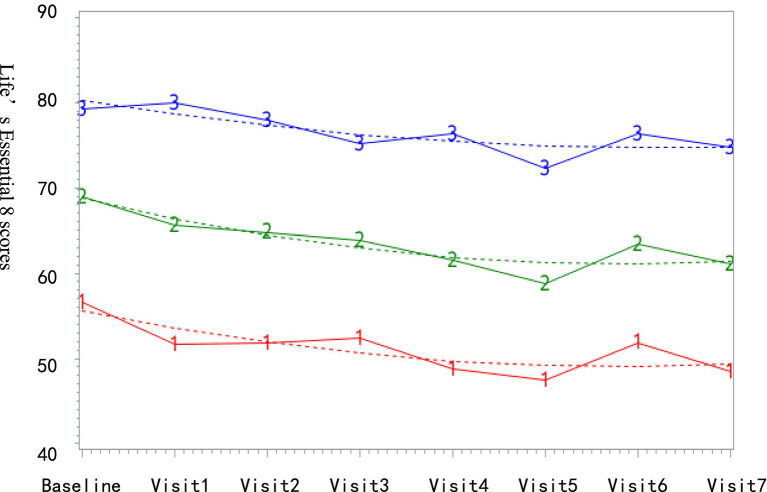 Figure 2
Peer Reviews
No public reviews on file for this paper yet. If you reviewed it on a platform where reviews are public (OpenReview, ICLR, NeurIPS, ICML), you can paste yours below so the community can read it here.
Videos
No videos yet. Explain this paper in a talk, walkthrough, or lecture? Add one.
Taxonomy
TopicsCardiovascular Health and Risk Factors · Health, Environment, Cognitive Aging · Dementia and Cognitive Impairment Research