Photobiomodulation therapy in keloid management: a comprehensive review
Arya Tjipta Prananda, Rony Abdi Syahputra

TL;DR
This review explores how light therapy (PBMT) can safely and effectively manage keloids by reducing inflammation and fibrosis, offering a non-invasive alternative to traditional treatments.
Contribution
The paper provides a comprehensive evaluation of PBMT as a novel, non-invasive treatment for keloids, highlighting its mechanisms and clinical potential.
Findings
PBMT reduces scar size, collagen deposition, and fibroblast activity in preclinical models.
Clinical studies show PBMT improves keloid height, elasticity, and texture with fewer side effects.
PBMT is safe for all skin types and lowers recurrence rates compared to conventional therapies.
Abstract
Keloid formation is a pathological scarring process marked by excessive fibroblast activity, overproduction of extracellular matrix (ECM), and chronic inflammation, presenting significant challenges in management despite existing treatments like corticosteroid injections, surgical excision, and cryotherapy. This review evaluates Photobiomodulation Therapy (PBMT) as a promising non-invasive approach for keloid treatment. PBMT utilizes non-thermal light in the red to near-infrared spectrum, which enhances mitochondrial activity, reduces reactive oxygen species (ROS), and regulates fibroblast proliferation and apoptosis. It also exhibits anti-fibrotic properties by inhibiting TGF-β1 expression, collagen synthesis, and Smad signaling, while modulating inflammation through reduced pro-inflammatory cytokines (IL-6, TNF-α) and enhanced macrophage activity. Preclinical evidence in animal models…
Genes, proteins, chemicals, diseases, species, mutations and cell lines named across the full text — each resolved to its canonical identifier and authoritative record.
Click any figure to enlarge with its caption.
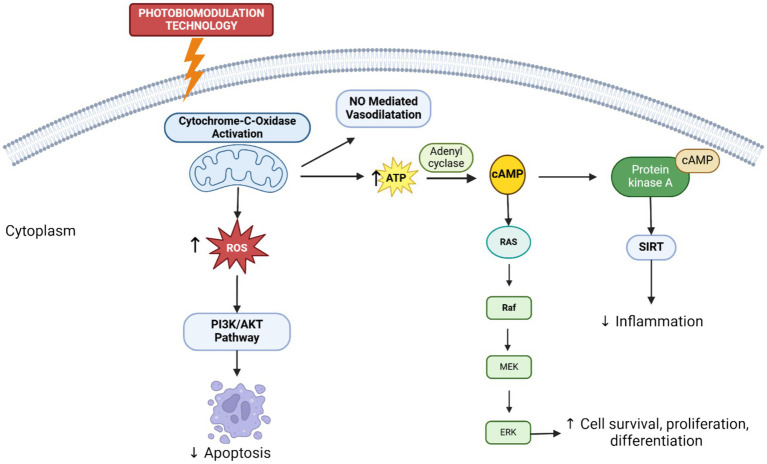 Figure 1
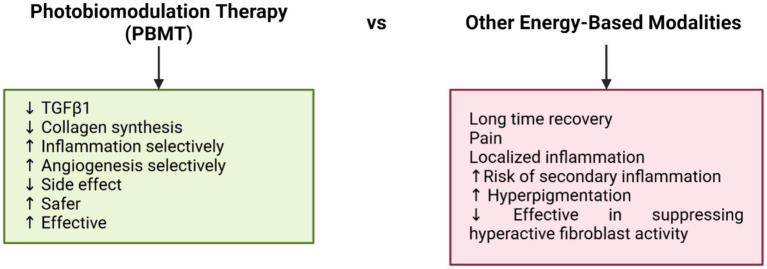 Figure 2
Peer Reviews
No public reviews on file for this paper yet. If you reviewed it on a platform where reviews are public (OpenReview, ICLR, NeurIPS, ICML), you can paste yours below so the community can read it here.
Videos
No videos yet. Explain this paper in a talk, walkthrough, or lecture? Add one.
Taxonomy
TopicsLaser Applications in Dentistry and Medicine · Dermatologic Treatments and Research · Medical and Biological Ozone Research