Emergency Field Hospital Surgical Response to Cyclone Chido in Mayotte
Anne Daoudal, Jean Philippe Page, Olivier Yavari‐Sartakhti, Guillaume Bouhours, Gauthier Buzancais, Bérangère Sauzeat, Francois Ansart, Jean‐louis Quesada, Paul Ribelles, Yael Lecras, Patrice Dusserre, Valinkini Da Costa, Michel Cherbetian, Isabelle Arnaud, Anthony Couret

TL;DR
This paper describes the surgical response of a French emergency medical team in Mayotte after a cyclone, focusing on patient care and coordination in a resource-limited setting.
Contribution
The study provides insights into surgical practices and coordination during a large-scale disaster in a resource-limited environment.
Findings
169 surgical procedures were performed on 130 patients, with a mean age of 31 and 68% being female.
The main surgical indications were post-traumatic septic wounds, with 80% classified as grade IV.
General anesthesia was used in 57% of procedures, highlighting the adaptability of anesthetic techniques in emergency settings.
Abstract
The Island of Mayotte was struck by the tropical cyclone CHIDO on 12/14/2024. The French government decided to deploy the Element de Securite Civile Rapide d'Intervention Medicale (ESCRIM) involving a joint detachment of rescue engineers from UIISC7 (Unité d'Instruction et d'Intervention de la Sécurité Civile) and firefighters, comprising a medical support and hospitalization detachment and a surgical support detachment. The aim of this work is to focus on the role of ESCRIM surgical team in Mayotte. ESCRIM received 5533 patients between 12/24/2024 and 02/03/2025. A prospective cohort study was conducted from 12/31/2024 to 01/20/2025 on a subset of 130 consecutive patients which underwent surgery in the operating room (OR). Variables included patient demographics, surgical indications, and anaesthetic techniques used. Anonymised data were collected from medical records, surgical…
Genes, proteins, chemicals, diseases, species, mutations and cell lines named across the full text — each resolved to its canonical identifier and authoritative record.
Click any figure to enlarge with its caption.
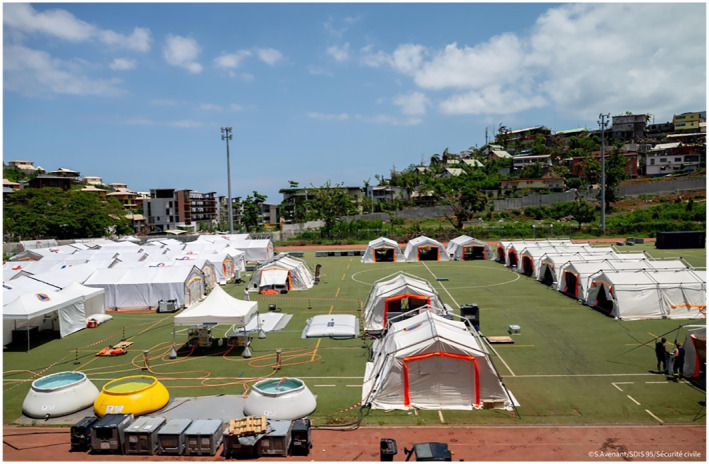 FIGURE 1
|
| |
|---|---|
| Mean ± standard deviation (min; max) | |
| Number (percentage) | |
| Age | 31.2 ± 18.3 (2; 74) |
| Children < 15 years old | 46 (27%) |
| Sex | |
| Male | 115 (68%) |
| Female | 54 (32%) |
| Localization | |
| Burns | 5 (3%) |
| Noninfected traumatic wounds | 8 (4.7%) |
| Orthopedic fracture or tendon treatment | 2 (1.2%) |
| Nontraumatic general surgery | 8 (4.7%) |
| Vascular surgery | 1 (0.6%) |
| Lower extremity sepsis | 46 (27.2%) |
| Upper extremity sepsis | 65 (38.5%) |
| Limb root sepsis | 20 (11.8%) |
| Trunk sepsis | 14 (8.3%) |
| Surgical wound classification [ | |
| Class I/Clean | 6 (3.6%) |
| Class II/Clean‐contaminated | 4 (2.4%) |
| Class III/Contaminated | 23 (13.6%) |
| Class IV/Dirty‐infected | 136 (80.5%) |
| Anesthesia | |
| General + intubation | 65 (%) |
| General without intubation with (65 cases) or without intubation (31 cases) | 31 (%) |
| Local | 23 (13.6%) |
| Locoregional | 36 (21.3%) |
| Spinal | 3 (1.8%) |
| Sedation | 11 (6.5%) |
| Types of surgery | |
| Closure by secondary intention | 128 (75.6%) |
| Direct closure of a wound | 25 (14.7%) |
| Negative pressure therapy on a wound | 12 (7.1%) |
| Other | 4 (2.5%) |
| Number of reinterventions | |
| 0 | 130 (76.9%) |
| 1 | 20 (11.8%) |
| 2 | 9 (5.3%) |
| 3 | 4 (2.4%) |
| 4 | 3 (1.8%) |
| 5 | 1 (0.6%) |
| 6 | 1 (0.6%) |
| 7 | 1 (0.6%) |
| Total of procedures | 169 |
Peer Reviews
No public reviews on file for this paper yet. If you reviewed it on a platform where reviews are public (OpenReview, ICLR, NeurIPS, ICML), you can paste yours below so the community can read it here.
Videos
No videos yet. Explain this paper in a talk, walkthrough, or lecture? Add one.
Taxonomy
TopicsGlobal Health and Surgery · Disaster Response and Management · Trauma and Emergency Care Studies
Introduction
1
The Island of Mayotte, located in the Comoros archipelago, is densely populated approximately 3000,000‐734 people per km^2^ was struck by the tropical cyclone Chido on 12/14/2024, affecting an already vulnerable population living in informal and precarious settlements known as Bangas [1]. On 12/16/2024, the French government decided to deploy the Element de Securite Civile Rapide d'Intervention Medicale (ESCRIM) to support the emergency services in caring for the victims [2] (Figure 1).
World Health Organization (WHO; Geneva, Switzerland) classified Emergency Medical Team level 2 (EMT 2) Element de Securité Civile Rapide d'Intervention Medicale (ESCRIM) structure deployed in the stadium of Mamoudzou, the economic capital of Mayotte. This module involved a joint detachment of rescue engineers from UIISC7 (Unité d'Instruction et d'Intervention de la Sécurité Civile) and firefighters, comprising a medical support and hospitalization detachment (DAMHO) and a surgical support detachment (DAC). This structure had the theoretical capacity to care for around a hundred people and to perform 7 major or 15 minor operations per day during one month. The DAC consisted of two operating theaters, a sterilization room, four postinterventional monitoring beds (SSPI), six intensive care beds, and two outpatient beds. Due to the partial annihilation of the Mayotte–Dzaoudzi airport, travel from France to Mayotte took respectively 7 days, 3 days et 2 days for the three successive surgical teams to reach the site.
Wild et al. conducted a literature review in 2023 to identify adequacy of records that described perioperative risk assessment in low‐resource or humanitarian settings. The review showed that only 50 reports remained eligible for analysis in quantitative and qualitative synthesis and fewer than half of reports presented the indication for surgery [3]. Similarly, several authors have highlighted the poor quality of reporting and the lack of comprehensive descriptive data on medical activities during natural disasters or conflict‐related humanitarian crises [4, 5, 6].
The aim of this work is to focus on the role of the EMT surgical team in Mayotte in response to the storm and describes their practices in a situation of massive influx.
Materials and Methods
2
ESCRIM received 5533 patients between 12/24/2024 and 02/03/2025. We conducted a prospective cohort study from 12/31/2024 to 01/20/2025 on a subset of 130 consecutive patients out of 205, which underwent surgery in the operating room (OR).
Triage of patients followed the Interagency Integrated Triage Tool (IITT) by WHO (https://www.who.int/publications/m/item/IITT) involving the surgeon if necessary. In‐depth discussions with the authorities and the staff of the local hospital of MAMOUDZOU (CHM) showed that their structure, although severely affected by the cyclone, still had a functional maternity ward, CT scan, and two out of five operating theaters, with one dedicated full time for caesarean sections. For patients requiring surgery, the decision was made that only patients with polytrauma and nontraumatic emergencies would be referred to the CHM for CT scan evaluation and treatment. Apart from these few patients, all surgical treatments were carried out at the ESCRIM facility, enabling synergistic re‐evaluation by the surgeon and the anesthetic for the need of reintervention and ongoing antibiotic coverage.
The ESCRIM facility had to be closed from 01/10/2025 to 01/15/2025 due to the occurrence of a second storm. During this period, the population was under curfew with virtually no access to healthcare.
Consent was obtained from all study participants included in the study. Variables included patient demographics, surgical indications, and anesthetic techniques used. Anonymized data were collected from medical records, surgical reports, and clinical notes. Quantitative variables were summarized as means and standard deviations or median {IQR} whereas categorical variables were expressed as number and percentages.
Results (Table 1)
3
There were 169 surgical procedures, with 39 patients undergoing two or more procedures over 20 days time period, resulting in a mean of 8.5 surgeries per day (6; 12). The mean age of the patients was 31 years, 68% were female and 27% of procedures were performed in children. General anesthesia was used in 57% of procedures. The main surgical indications were post‐traumatic extremity septic wounds of the upper limb (38%) and lower limb (27%). The majority of the wounds were grade IV according to the Centers for Disease Control and Prevention (CDC) surgical wound classification [7]. Closure by secondary intention was used in 76% of cases, primary closure in 15% of cases, and negative pressure therapy was used in 7% of cases. One transmetatarsal amputation was performed.
Perioperative antibiotic treatment, almost exclusively with amoxicillin and clavulanic acid, was carried out for 48 h. Tetanus immunoglobulin injection was administered when the Tetanus Quick Stick test indicated a nonimmunized state.
Discussion
4
In terms of daily workload and available equipment, the facility was at the limits of its capacity. Very few surgical patients had to be transferred from ESCRIM to CHM due to the good synergy between the rescue services and the two systems.
Soft tissue and orthopedics procedures were the most frequent, similar to that found in the literature review of Nickerson et al. [8]. We utilized the 2019 Management of Limb Injuries in Disasters and Conflicts consensus to guide clinical care [9]. Decisions about major amputations were delayed to consider patient preference due to the consequences a potentially fatal loss of autonomy and mobility in the living conditions of the Bangas. Interventions were limited to iterative debridement and trimming of necrotic or infected areas.
The main limitations of this study include the lack of long‐term follow‐up and the exclusion of patients who underwent surgery at the structure before December 31, 2024.
Conclusion
5
This study highlights the importance of adapting surgical and anesthetic practices in resource‐limited settings and the necessity of in‐depth cooperation and coordination among the entire response team, including emergency physicians, nurses, the operative team, and local practitioners. Despite constraints, it was possible to provide quality care in a complex disaster context. It is essential for teams to recognize that severely infected wounds require specialized care and distinct approaches in the disaster context. The results of this study support following WHO and other expert triage and treatment protocols for disaster contexts and contribute to the ongoing challenges of data collection in austere or limited environments.
Author Contributions
Anne Daoudal: conceptualization, investigation, writing – original draft, methodology, validation, writing – review and editing, supervision. Jean Philippe Page: conceptualization, investigation, methodology, validation. Olivier Yavari‐Sartakhti: conceptualization, investigation, methodology, validation, writing – original draft, supervision. Guillaume Bouhours: investigation, writing – original draft, validation. Gauthier Buzancais: investigation, validation. Bérangére Sauzeat: investigation, validation. Francois Ansart: investigation. Jean‐louis Quesada: methodology, data curation, software. Paul Ribelles: investigation. Yael Lecras: investigation. Patrice Dusserre: investigation. Valinkini Da Costa: validation, investigation. Michel Cherbetian: supervision. Isabelle Arnaud: supervision. Anthony Couret: supervision. Romain Kedzierewicz: supervision. Philippe Agopian: supervision, validation, visualization. Catherine Arvieux: conceptualization, investigation, writing – original draft, methodology, validation, writing – review and editing, supervision.
Conflicts of Interest
The authors declare no conflicts of interest.
The reference list from the paper itself. Each links out to its DOI / PubMed record.
- 1M. Soler , A. Lapostolle , Q. Mano , et al., “Immediate Public Health Surveillance Response to Cyclone Chido, Mayotte, 14 December 2024,” Euro Surveillance 30, no. 6 (2025), 10.2807/1560-7917.es.2025.30.6.2500060.PMC 1191496839949322 · doi ↗ · pubmed ↗
- 2R. Kedzierewicz , A. Couret , N. Cazes , et al., “Deployment of the French Civil Protection Field Hospital (ESCRIM) in Golbasi, Turkey After the February 2023 Earthquake: Lessons Learned,” Prehospital and Disaster Medicine 38, no. 4 (2023): 522–528, 10.1017/s 1049023 x 23005873.37317865 · doi ↗ · pubmed ↗
- 3H. Wild , B. T. Stewart , C. Le Boa , T. Jewell , K. Mehta , and S. M. Wren , “Perioperative Risk Assessment in Humanitarian Settings: A Scoping Review,” World Journal of Surgery 47, no. 5 (2023): 1092–1113, 10.1007/s 00268-023-06893-x.36631590 · doi ↗ · pubmed ↗
- 4T. C. Hardcastle , A. Gyedu , G. M. Doherty , and S. M. Wren , “Editorial Commentary and Call for Papers‐Humanitarian Surgery in Conflict Zones,” World Journal of Surgery 48, no. 3 (2024): 507–508, 10.1002/wjs.12119.38407321 · doi ↗ · pubmed ↗
- 5F. M. Burkle Jr , J. W. Nickerson , J. von Schreeb , et al., “Emergency Surgery Data and Documentation Reporting Forms for Sudden‐Onset Humanitarian Crises, Natural Disasters and the Existing Burden of Surgical Disease,” Prehospital and Disaster Medicine 27, no. 6 (2012): 577–582, 10.1017/s 1049023 x 12001306.22999226 · doi ↗ · pubmed ↗
- 6K. Chu , M. Trelles , and N. Ford , “Rethinking Surgical Care in Conflict,” Lancet 375, no. 9711 (2010): 262–263, 10.1016/s 0140-6736(10)60107-9.20109934 · doi ↗ · pubmed ↗
- 7V. Yin , J. P. Cobb , S. C. Wightman , S. M. Atay , T. Harano , and A. W. Kim , and Centers for Disease Control (CDC) , “Wound Classification Is Prognostic of 30‐Day Readmission Following Surgery,” World Journal of Surgery 47, no. 10 (October 2023): 2392–2400, 10.1007/s 00268-023-07093-3.37405445 PMC 10474202 · doi ↗ · pubmed ↗
- 8J. W. Nickerson , S. Chackungal , L. Knowlton , K. Mc Queen , and F. M. Burkle Jr. , “Surgical Care During Humanitarian Crises: A Systematic Review of Published Surgical Caseload Data From Foreign Medical Teams,” Prehospital and Disaster Medicine 27, no. 2 (2012): 184–189, 10.1017/s 1049023 x 12000556.22591739 · doi ↗ · pubmed ↗