A Single‐Blind, Randomized, Clinical Trial Comparing Scalpel Versus Electrocautery for Skin Incision in Young Patients Undergoing Thyroidectomy
Jacqueline Hawthorne, Lokesh Sharma, Rosemary Carroll, Elizabeth Freihaut, Kirstin Miteff, Christine O'Neill, Cino Bendinelli

Abstract
Patient characteristics.
Genes, proteins, chemicals, diseases, species, mutations and cell lines named across the full text — each resolved to its canonical identifier and authoritative record.
Click any figure to enlarge with its caption.
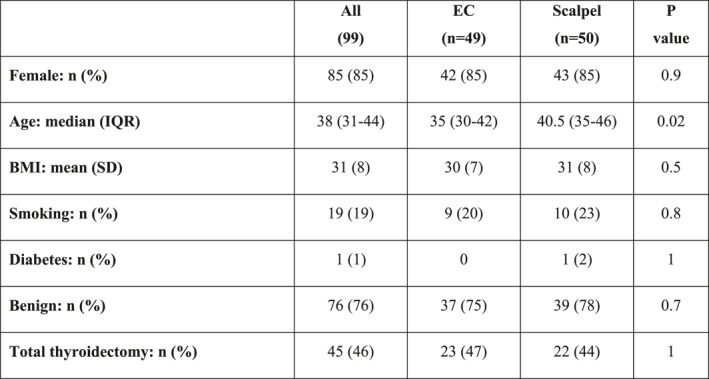 Figure 1
| All (99) | EC ( | Scalpel ( |
| |
|---|---|---|---|---|
| Female: | 85 (85) | 42 (85) | 43 (85) | 0.9 |
| Age: Median (IQR) | 38 (31–44) | 35 (30–42) | 40.5 (35–46) | 0.02 |
| BMI: Mean (SD) | 31 (8) | 30 (7) | 31 (8) | 0.5 |
| Smoking: | 19 (19) | 9 (20) | 10 (23) | 0.8 |
| Diabetes: | 1 (1) | 0 | 1 (2) | 1 |
| Benign: | 76 (76) | 37 (75) | 39 (78) | 0.7 |
| Total thyroidectomy: | 45 (46) | 23 (47) | 22 (44) | 1 |
| EC ( | Scalpel ( |
| |
|---|---|---|---|
| Patient POSAS (1–60) | 18 (13–25) | 17 (8.5–21.5) | 0.17 |
| Observer POSAS (1–40) | 10.5 (9–14) | 9.5 (8–13) | 0.13 |
| VAS at 1 h | 4 (3–7) | 5.5 (3–7) | 0.41 |
| VAS at 24 h | 3 (1–4) | 3 (1.5–5) | 0.20 |
| Morphine milliequivalent use | 24 (16–40) | 35 (19.5–55) | 0.16 |
Peer Reviews
No public reviews on file for this paper yet. If you reviewed it on a platform where reviews are public (OpenReview, ICLR, NeurIPS, ICML), you can paste yours below so the community can read it here.
Videos
No videos yet. Explain this paper in a talk, walkthrough, or lecture? Add one.
Taxonomy
TopicsThyroid and Parathyroid Surgery · Sympathectomy and Hyperhidrosis Treatments · Dermatologic Treatments and Research
Introduction
1
Scalpel handling at the time of skin incision represents a well‐documented occupational hazard [1]. Monopolar electrocautery (EC) is routinely employed for the creation of subplatysmal flaps and further dissection and may well represent a more efficient and inherently safer alternative to scalpel. In randomized control trials (RCT) on laparotomy incisions, cosmetic outcomes were equivalent and postoperative pain reduced by EC when compared to scalpel [2, 3]. This study tested cosmesis and postoperative pain in young patients undergoing a cosmetically crucial neck incision for thyroidectomy.
Methods
2
A single‐blind RCT recruited patients aged 18–50 undergoing elective thyroid surgery. Those requiring neck dissection or with previous neck surgery or radiotherapy were excluded. Randomization dictated skin incision with either EC or scalpel. All procedures were carried out in standard fashion by two high volume endocrine surgeons (CB, CO). Perioperative analgesia was standardized.
The primary outcome was cosmesis at 6 months assessed with a modified patient and observer scar assessment scale 2.0 (POSAS) [4]. Participants scored pain, itch, color, stiffness, thickness, and irregularity using online surveys, with a total value ranging from 1 (optimal) to 60 (worst possible). A plastic surgeon scored scar photographs for vascularity, pigmentation, thickness, and surface area, with a total value ranging from 1 (optimal) to 40 (worst possible). Secondary outcomes were postoperative pain measured at 1 and 24 h with visual analog scale (VAS) and inhospital postoperative analgesic consumption measured in morphine milliequivalents. Wound related events were recorded. Both participants and plastic surgeon were blinded to treatment allocation.
Sample size was determined considering an expected mean POSAS of 11, smallest detectable difference of 2 mean points, power of 80%, and confidence interval of 95%. This was calculated to detect a 33% difference and account for a 10% drop out rate, giving a sample size of two groups of 40 patients each. A chi‐squared was used for categorical variables, independent t‐test was used for normally distributed data, and Mann–Whitney U‐test was used for skewed data. Statistical significance was set at p < 0.05.
Results
3
Between October 2018 and December 2023, 335 patients were referred for thyroid surgery and 99 were included in the study, with 49 randomized to EC and 50 to scalpel. Photographs and questionnaires were returned by 30 (61%) and 22 (44%) patients in EC and scalpel groups, respectively. The groups were statistically similar apart from a small age difference (Table 1).
The cosmetic outcome did not differ between groups in either patient‐reported (18 vs. 17; p = 0.17) nor observer (10.5 vs. 9.5; p = 0.13) POSAS. Both postoperative VAS score and morphine milliequivalents used were similar (Table 2). One superficial wound dehiscence was observed in the EC group.
Discussion
4
Thyroidectomy scars remain extremely noticeable and can effect patient quality of life [5]. A RCT on 19 bilateral neck dissections (38 incisions) performed with EC on one side and scalpel on the other showed no difference in cosmesis or patient satisfaction, but this study recruited patients with crucial confounders such as aggressive cancer, advanced age, and/or radiotherapy [6]. Geometric electron modulation (GEM) EC offers similar hemostasis to EC with reduced heat exchanged to surrounding tissues [7]. GEM EC was compared to scalpel in a small RCT on 11 thyroidectomy and 11 lateral neck dissections. No statistically significant differences were observed in cosmetic outcomes at 3 months, but this study evaluated a slightly different technology and premature scars [8].
In this trial, we focused on a younger population and excluded patients with locally advanced disease or prior neck surgery. The cosmetic outcome was assessed blindly at 6 months by both the patients and a plastic surgeon. Cosmetic outcomes were generally good, and patients of both groups were equally satisfied with cosmesis. Observer scores were also comparable. The fascinating assumption, that nerve necrosis by EC tissue vaporization may reduce postoperative pain, could not be validated, potentially due to the small series.
The main study limitations were related to the COVID‐19 pandemic and included a longer than expected study period and a lower than expected patient response rate. This might be responsible for a type II error. Furthermore, the length of the incision, which may influence both cosmesis and pain, was not collected. Thyroidectomy incisions do vary depending on the gland size, but the randomization process would have eliminated this potential bias.
In conclusion, we demonstrated that using EC rather than scalpel to perform the skin incision leads to comparable cosmetically outcomes even in the neck of young patients. We encourage this practice to optimize occupational safety.
Author Contributions
Jacqueline Hawthorne: data curation, formal analysis, writing – original draft. Lokesh Sharma: investigation, writing – original draft. Rosemary Carroll: writing – original draft, data curation. Elizabeth Freihaut: methodology, writing – original draft. Kirstin Miteff: investigation. Christine O’Neill: writing – review and editing. Cino Bendinelli: conceptualization, supervision, writing – review and editing.
Ethics Statement
Hunter New England Local Health District Human Research Ethics Committee: 2018/ETH00013.
Conflicts of Interest
The authors declare no conflicts of interest.
The reference list from the paper itself. Each links out to its DOI / PubMed record.
- 1J. F. Waljee , S. Malay , and K. C. Chung , “Sharps Injuries: The Risks and Relevance to Plastic Surgeons,” Plastic and Reconstructive Surgery 131, no. 4 (2013): 784–791, 10.1097/prs.0b 013e 3182818 bae.23542251 PMC 4784232 · doi ↗ · pubmed ↗
- 2O. O. Afuwape , O. O. Ayandipo , D. Irabor , O. M. Oluwatosin , and V. Odigie , “Diathermy Versus Scalpel Incision in a Heterogeneous Cohort of General Surgery Patients in a Nigerian Teaching Hospital,” Nigerian Journal of Surgery 21, no. 1 (2015): 43–47, 10.4103/1117-6806.153193.25838766 PMC 4382642 · doi ↗ · pubmed ↗
- 3M. Shamim , “Diathermy vs. Scalpel Skin Incisions in General Surgery: Double‐Blind, Randomized, Clinical Trial,” World Journal of Surgery 33, no. 8 (2009): 1594–1599, 10.1007/s 00268-009-0064-9.19418093 · doi ↗ · pubmed ↗
- 4K. Shao , J. C. Parker , L. Taylor , N. Mitra , and J. F. Sobanko , “Reliability of the Patient and Observer Scar Assessment Scale When Used With Postsurgical Scar Photographs,” Dermatologic Surgery 44, no. 12 (2018): 1650–1652, 10.1097/dss.0000000000001479.29381545 PMC 7433706 · doi ↗ · pubmed ↗
- 5Y. Choi , Ji H. Lee , Y. H. Kim , et al., “Impact of Post Thyroidectomy Scar on the Quality of Life of Thyroid Cancer Patients,” Annals of Dermatology 26, no. 6 (2014): 693–699, 10.5021/ad.2014.26.6.693.25473220 PMC 4252665 · doi ↗ · pubmed ↗
- 6J. K. Chau , P. Dzigielewski , A. Mlynarek , et al., “Steel Scalpel Versus Electrocautery Blade: Comparison of Cosmetic and Patient Satisfaction Outcomes of Different Incision Methods,” Journal of Otolaryngology ‐ Head & Neck Surgery 38 (2009): 427–433.19755082 · pubmed ↗
- 7J. F. Amaral , R. D. Lewis , and P. R. Borgmeier , “Geometric Electron Modulation (GEM) Technology: Technical Monograph,” (2021).
- 8W. Tirayaudomsuk , K. Kowitwibool , and W. Samuckkeethum , “The Short‐Term Outcomes of Surgical Scars in Head and Neck Surgery Comparing Between Surgical Blade and Geometric Electron Modulation Electrocautery,” European Archives of Oto‐Rhino‐Laryngology 281, no. 10 (2024): 5429–5436, 10.1007/s 00405-024-08771-1.38847842 · doi ↗ · pubmed ↗