Fonsecazyma yulaniae sp. nov., a yeast species isolated from flowers
You-Jun Liao, Xuan Zhang, Zi-Xuan Liu, Rui Wang, Ya-Jing Yu, Lu Xue, Ai-Hua Li

TL;DR
Scientists discovered a new yeast species, Fonsecazyma yulaniae, from flowers in Beijing and identified it through genetic and phenotypic analysis.
Contribution
The discovery and characterization of a new yeast species, Fonsecazyma yulaniae, based on molecular and phenotypic data.
Findings
Fonsecazyma yulaniae is a novel species within the genus Fonsecazyma, distinct from F. mujuensis.
The new species can assimilate inulin and creatinine but not lactose or erythritol.
F. yulaniae can grow in vitamin-free and 50% glucose media, unlike F. mujuensis.
Abstract
Two basidiomycete yeast strains, designated as 21S12 and 12S11, were isolated from the flowers of Yulania denudata collected from the Beijing Olympic Forest Park, PR China. Molecular phylogenetic analyses based on the D1/D2 domains of the large subunit rRNA gene and the internal transcribed spacer (ITS) region revealed that these strains represent a novel species within the genus Fonsecazyma. The new species, Fonsecazyma yulaniae sp. nov., is most closely related to Fonsecazyma mujuensis CBS 10308T, with sequence divergences of 4.3% (28 substitutions and 2 indels) in the D1/D2 domain and 8.4% (28 substitutions and 10 indels) in the ITS region. Phenotypically, F. yulaniae sp. nov. differs from F. mujuensis CBS 10308T in its ability to assimilate inulin and creatinine, as well as its inability to assimilate lactose and erythritol. Additionally, F. yulaniae sp. nov. can grow in a…
Genes, proteins, chemicals, diseases, species, mutations and cell lines named across the full text — each resolved to its canonical identifier and authoritative record.
Click any figure to enlarge with its caption.
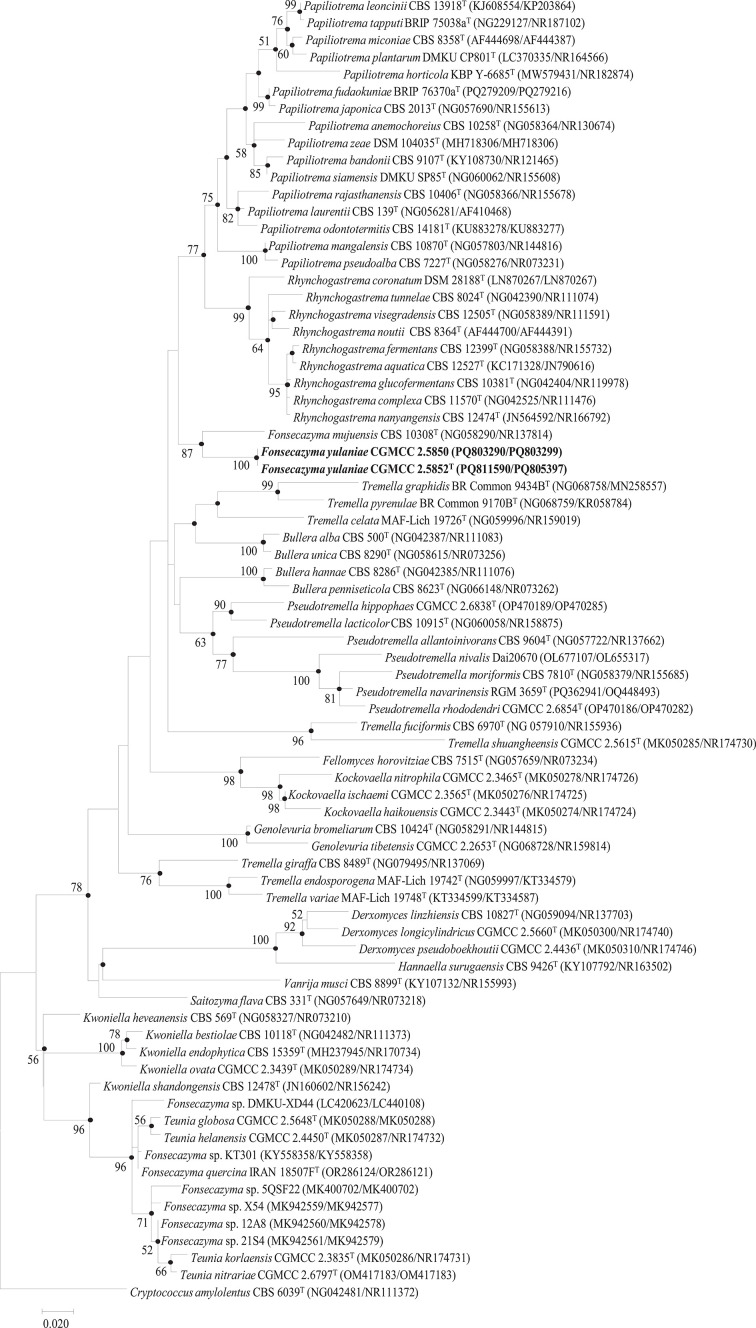 Fig. 1
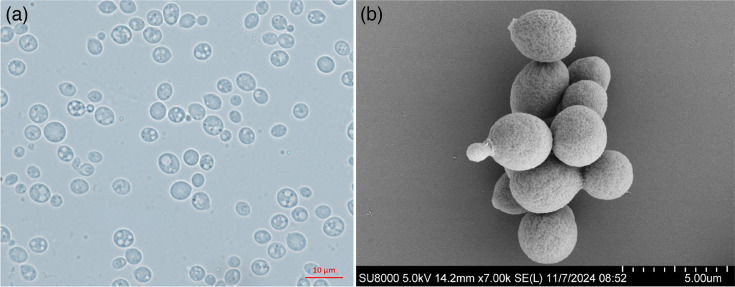 Fig. 2
| Characteristic | 1 | 2 | 3 |
|---|---|---|---|
| Assimilation of: | |||
| Galactose | + | + | − |
| Cellobiose | + | + |
|
| Lactose | − | + | − |
| Melibiose | − | d | − |
| Inulin | + | − | n |
| | + | + | − |
| | + | + | − |
| | + | + |
|
| Ethanol | + | n | n |
| Glycerol |
| d | n |
| Erythritol | − | + | n |
| | − | dw | n |
| | + | + |
|
| Salicin |
| + | n |
| | + | d | n |
| Creatine |
| − | n |
| Creatinine | + | − | n |
| Other tests: | |||
| Vitamin-free | + | − | n |
| 50% glucose | + | − | n |
| 10% NaCl | − | + | + |
- —the Strategic Biological Resources Capacity Building Project of Chinese Academy of Sciences
- —the Science and Technology Projects of Xizang Autonomous Region, China
- —the Key Research and Development Project of Xizang Autonomous Region
- —the National Natural Science Funds of China
Peer Reviews
No public reviews on file for this paper yet. If you reviewed it on a platform where reviews are public (OpenReview, ICLR, NeurIPS, ICML), you can paste yours below so the community can read it here.
Videos
No videos yet. Explain this paper in a talk, walkthrough, or lecture? Add one.
Taxonomy
TopicsYeasts and Rust Fungi Studies · Plant Disease Resistance and Genetics · Plant Pathogens and Resistance
Introduction
The genus Fonsecazyma was established in 2015 by Liu et al. [1] to accommodate a distinct clade within the family Bulleraceae (order Tremellales, class Tremellomycetes). This clade, which exhibited strong phylogenetic support, initially included Cryptococcus mujuensis, Cryptococcus tronadorensis and Kwoniella betulae. Due to significant genetic divergence from other members of the genus Cryptococcus and the lack of close relatives for K. betulae within Kwoniella, these species were reclassified under the newly proposed genus Fonsecazyma [1]. However, in 2020, Fonsecazyma betulae and Fonsecazyma tronadorensis were transferred to the newly established genus Teunia, where they were renamed Teunia betulae and Teunia tronadorensis, respectively [2]. In 2024, Ghobadi et al. isolated a novel strain IRAN 18507F from Persian oak (Quercus brantii) branch in Iran and proposed it as a novel species of Fonsecazyma, Fonsecazyma quercina [3]. As a result, Fonsecazyma currently comprises two recognized species, Fonsecazyma mujuensis and F. quercina, while the newly published species F. quercina was not clustered together with the type species of Fonsecazyma, F. mujuensis, but clustered with some strains that seemed to be members of the genus Teunia.
Flowers are well-known habitats for yeasts [4], and numerous yeast strains have been isolated from floral sources, including Vishniacozyma floricola [5], Wickerhamiella lachancei [6], Hannaella floricola [7] and Starmerella kisarazuensis [8]. During a survey of yeast diversity associated with flowers, two basidiomycetous yeast strains, designated as 21S12 and 12S11, were isolated from the flowers of Yulania denudata in the Olympic Forest Park, Beijing, PR China. Phylogenetic analysis based on the D1/D2 domains of the large subunit (LSU) rRNA gene and the internal transcribed spacer (ITS) region revealed that these strains represent a novel species within the Fonsecazyma clade. Based on their distinct morphological, physiological and genetic characteristics, we propose it as a new species, with the name Fonsecazyma yulaniae sp. nov.
Methods
Sampling and yeast isolation
Flowers of Y. denudata were collected from the Olympic Forest Park in Beijing, PR China (40.02° N 116.40° E). The floral samples were collected with sterile tools and placed in sterile plastic bags, stored at 4 °C and transported to the laboratory for immediate processing. Approximately 5 g of floral stamen and petal material was suspended in 20 ml of sterile water and vigorously shaken to release microbial cells. Serial dilutions of the suspension were prepared, and 100 µl of each dilution was spread onto yeast extract-malt extract (YM) agar plates (containing 1.0% yeast extract, 2.0% malt extract, 0.4% glucose and 2.0% agar) supplemented with 100 mg l^−1^ chloramphenicol to inhibit bacterial growth. Three replicate plates were prepared for each dilution and incubated at 25 °C for 7 days. Yeast colonies that emerged were purified through repeated streaking on YM agar plates. Pure isolates were preserved by freeze-drying and stored in liquid nitrogen at the China General Microbiological Culture Collection Center (CGMCC).
Phenotypic characterization
The morphological, physiological and biochemical characteristics of the strains were evaluated using standard methods as described by Kurtzman et al. [9]. Carbon assimilation tests were performed in a liquid medium of yeast nitrogen base (Difco, 291940), while nitrogen assimilation tests were conducted in a liquid medium of yeast carbon base (Difco, 239110), using starved inocula for the latter [10]. Fermentation tests were carried out using Durham inverted tubes [11]. Cell morphology was examined using both light microscopy and scanning electron microscopy (SEM; SU8180, Hitachi) after 3 days of growth in YM broth at 25 °C [12]. Pseudohyphae formation was assessed microscopically following incubation at 25 °C for 1 month on YM agar and corn meal agar (CMA; 2.5% corn starch and 2% agar, w/v). A cover glass was placed over the colony to create an oxygen-limited environment, facilitating the observation of pseudohyphae [13]. Growth at different temperatures was evaluated on YM agar. To investigate potential sexual stages, both strains were incubated individually and in mixed cultures on YM agar, CMA, Fowell’s acetate agar and malt extract agar (MEA; 5% malt extract and 2% agar, w/v) at 25 °C for up to 2 months, with periodic microscopic examinations [1213].
Molecular phylogenetic analysis
DNA extraction was conducted according to the procedure described by Kurtzman [14]. The D1/D2 domains of the LSU rRNA and the ITS region were amplified and sequenced using the primers NL1 and NL4 (for the D1/D2 domain) [15] and ITS1 and ITS4 (for the ITS region) [16], respectively. Yeast strains were primarily identified through the blast in GenBank using their D1/D2 and ITS sequences as queries [17]. Subsequently, the sequences of related type strains were retrieved and downloaded from GenBank and aligned using mega 7.0 with manual adjustment.
Phylogenetic trees were constructed using the maximum-likelihood (ML), the neighbour-joining (NJ) and the maximum-parsimony (MP) methods [1820] in mega 7.0 based on sequences of the D1/D2 domains of LSU rRNA gene and the concatenated D1/D2-ITS region. For the ML analysis, the general time reversible model was applied, while the Kimura-2 parameter model was used for distance correction in the NJ analysis. Cryptococcus amylolentus CBS 6039^T^ was used as the outgroup. The robustness of the phylogenetic trees was assessed using bootstrap analysis with 1,000 replicates [21], and only bootstrap values exceeding 50% were indicated on the resulting trees [22].
Result and discussion
Molecular phylogenetic analyses
Sequence analysis of the D1/D2 domains of the LSU rRNA gene and the ITS region revealed that strains 21S12 and 12S11 exhibit significant divergence from all recognized yeast species. Phylogenetically, the strains were most closely related to F. mujuensis CBS 10308^T^, with sequence similarities of 95.73% for the D1/D2 domains and 91.59% for the ITS region. The divergence between the D1/D2 regions of the new isolates and F. mujuensis CBS 10308^T^ comprised 28 nt substitutions and 2 indels, while the ITS region showed 28 substitutions and 10 indels. Notably, strains 21S12 and 12S11 shared identical D1/D2 and ITS sequences, confirming that they belong to the same species. As they were isolated from distinct samples (21S12: twelfth colony from Sample 21; 12S11: eleventh colony from Sample 12), they represent non-clonal isolates. These results support the conclusion that the two strains represent a novel species within the genus Fonsecazyma.
The phylogenetic position of strains 21S12 and 12S11 was determined using NJ, ML and MP analyses based on D1/D2 domains of the LSU rRNA gene (Fig. S1, available in the online Supplementary Material) and the concatenated sequences of the D1/D2 domains of the LSU rRNA gene and the ITS region, respectively. As shown in Fig. 1, the ML analysis placed the two novel strains adjacent to F. mujuensis CBS 10308^T^, forming a well-supported clade with a bootstrap value of 87%. This phylogenetic placement was further corroborated by the NJ and MP methods, which yielded consistent topologies (Fig. S2).
ML phylogenetic tree based on concatenated sequences of the D1/D2 domains of the LSU rRNA gene and the ITS region, showing the phylogenetic placement of F. yulaniae sp. nov. among related genera. Bootstrap values ≥50% (from 1,000 replicates) are indicated at the nodes. Filled circles represent nodes supported by all three methods: ML, NJ and MP. C. amylolentus CBS 6039T was used as the outgroup. Bar, 0.02 substitutions per nt position.
Based on the significant genetic divergence from F. mujuensis and their distinct phylogenetic position, strains 21S12 and 12S11 are proposed to represent a novel species within the genus Fonsecazyma, for which the name F. yulaniae sp. nov. is designated.
A point worthy of note is that, despite the strain IRAN 18507F was initially described as a novel species within the genus Fonsecazyma, designated as F. quercina sp. nov., phylogenetic analysis revealed that this strain clustered within the Teunia clade, demonstrating closer phylogenetic affinity to members of the genus Teunia than to Fonsecazyma. This incongruence between taxonomic designation and molecular phylogeny suggests that the current classification of F. quercina may require re-evaluation as additional genomic data from related taxa become available.
Phenotypic characteristics
After 3 days of growth in YM broth at 25 °C, multilateral budding was observed in the new species. When observed under SEM, the cells of strain 21S12^T^ were ellipsoidal or spherical and exhibited a rough cell surface, which may be due to the minute structures of the cell wall (Fig. 2). Physiologically, the novel species shares several traits with its closest relative, F. mujuensis CBS 10308^T^. Both species can assimilate d-glucose, d-ribose, d-xylose, l-arabinose, sucrose, maltose, methyl-α-d-glucoside, trehalose, cellobiose, raffinose, melezitose, soluble starch, inositol, succinic acid, ethylamine hydrochloride and cadaverine. Conversely, they are unable to assimilate l-sorbose, methanol, potassium nitrate or sodium nitrite, and neither species grows at 35 °C. The novel species can be distinguished from its closest relative, F. mujuensis CBS 10308^T^, by several key physiological and biochemical traits. Specifically, the new species demonstrates the ability to assimilate inulin, creatine (weakly) and creatinine, capabilities absent in F. mujuensis (Table 1). Conversely, the novel species cannot assimilate melibiose, lactose, erythritol or dl-lactate, all of which are assimilated by F. mujuensis (Table 1). Additionally, the novel species exhibits unique growth capabilities: it can grow in a vitamin-free medium and in a medium supplemented with 50% glucose, conditions under which F. mujuensis fails to grow. In contrast, F. mujuensis can grow in the presence of 10% NaCl, a trait not observed in the novel species.
Cell morphology of F. yulaniae sp. nov. 21S12T observed by optical microscope (a) and SEM (b) after 3 days of growth at 25 °C in YM broth.
Ecology
The genus Fonsecazyma currently comprises only two known species, F. mujuensis and F. quercina. F. mujuensis was originally isolated from wild rabbit faeces and is hypothesized to play a role in the decomposition of organic matter in faecal environments [23]. F. quercina was first isolated from a Persian oak branch, and it is speculated that this species may decompose organic matter within the branches, convert it into simple compounds and supply these compounds back to the tree, thereby promoting material cycling. In contrast, the novel species, F. yulaniae sp. nov., was isolated from the flowers of Y. denudata, suggesting a distinct ecological niche and a potential association with floral ecosystems.
As for the investigation of the yeast community structure in floral environments, we collected various flower samples (including petals and floral cores) from the Beijing Olympic Forest Park, PR China, to isolate the yeast strains. The yeast strains we isolated from flower samples belonged totally to 70 species of 42 genera. The predominant yeast species inhabiting the floral niches were Starmerella bombicola, Teunomyces globosus, Kwoniella ovata, Aureobasidium pullulans, Vishniacozyma tephrensis and Cystobasidium pinicola. The detailed information of the yeast strains is listed in Table S1. The study of floricolous yeasts is an emerging field that seeks to understand the biodiversity, ecological roles and interactions of yeasts within floral environments [24]. Investigating these unique ecosystems not only expands our knowledge of yeast diversity but also provides insights into the complex relationships between micro-organisms and their habitats.
Description of Fonsecazyma yulaniae Y.J. Liao, X. Zhang and A.H. Li sp. nov.
Fonsecazyma yulaniae (yu.la'ni.ae. N.L. gen. n. yulaniae, of the plant species Y. denudata, from which flowers it has been isolated).
The cells are ovoid to ellipsoid (2.1–5.4×2.8–5.9 µm) and occur singly or in pairs after 3 days of growth in YM broth at 25 °C. Multilateral budding is observed (Fig. 2a). After growth in YM broth for 1 month at 25 °C, a ring and a sediment are formed. The streak culture is pale yellow-cream, glistening, butyrous and smooth with an entire margin after 1 month of incubation on YM agar at 25 °C. No hyphae or pseudohyphae are observed on CMA, potato dextrose agar (PDA) and YM agar. Additionally, sexual reproduction is not observed on CMA, MEA, Fowell’s acetate agar or PDA agar under the same conditions. The strain could grow (weak) at 30 °C but could not grow at 35 °C. Growth in YM broth with 50% (w/v) glucose and in the vitamin-free medium is positive. Growth in YM broth with 10% (w/v) sodium chloride is negative. Additionally, the strain shows positive urease activity and a positive diazonium blue B reaction. Fermentation of glucose, galactose, sucrose, maltose, lactose and raffinose was absent. Glucose, galactose, sucrose, maltose, cellobiose, trehalose, raffinose, melezitose, inulin, soluble starch, d-xylose, d-ribose, l-arabinose, l-rhamnose, ethanol, glycerol (weak), ribitol, galactitol, d-mannitol, d-glucitol, methyl-α-d-glucoside, salicin (weak), succinic acid and inositol are assimilated as sole carbon sources. l-Sorbose, lactose, melibiose, methanol, erythritol, dl-lactate and citrate are not assimilated. Ethylamine hydrochloride, cadaverine, l-lysine, creatine (weak) and creatinine are assimilated as sole nitrogen sources, whereas nitrate and nitrite are not assimilated.
The holotype, CGMCC 2.5852^T^, was isolated from the flowers of Y. denudata collected from the Beijing Olympic Forest Park, PR China. It has been deposited in a metabolically inactive state in the CGMCC, Beijing, PR China. The ex-type culture has been deposited in the Biological Resource Center, NITE (NBRC), Japan, as NBRC 114206. The GenBank/EMBL/DDBJ accession number for the 26S rRNA gene D1/D2 domain and the ITS sequence of strain CGMCC 2.5852^T^ are PQ811590 and PQ805397. Its taxonomic description has been registered in Fungal Names (FN572294).
Supplementary material
10.1099/ijsem.0.006830Uncited Supplementary Material 1.
The reference list from the paper itself. Each links out to its DOI / PubMed record.
- 1Liu X-Z Wang Q-M Göker M Groenewald M Kachalkin AV et al Towards an integrated phylogenetic classification of the Tremellomycetes Stud Mycol 2015818514710.1016/j.simyco.2015.12.00126955199 PMC 4777781 · doi ↗ · pubmed ↗
- 2Li A-H Yuan F-X Groenewald M Bensch K Yurkov AM et al Diversity and phylogeny of basidiomycetous yeasts from plant leaves and soil: proposal of two new orders, three new families, eight new genera and one hundred and seven new species Stud Mycol 2020961714010.1016/j.simyco.2020.01.00232206137 PMC 7082220 · doi ↗ · pubmed ↗
- 3Ghobadi A Jamali S Hosseini S Fonsecazyma quercina sp. nov., a novel yeast species isolated from Persian oak (Quercus brantii Lind.) branch in Iran Rostaniha 20242510712210.21203/rs.3.rs-4186375/v 1 · doi ↗
- 4Alimadadi N Soudi MR Wang S-A Wang Q-M Talebpour Z et al Starmerella orientalis f.a., sp. nov., an ascomycetous yeast species isolated from flowers Int J Syst Evol Microbiol 2016661476148110.1099/ijsem.0.00090526780917 · doi ↗ · pubmed ↗
- 5Dlauchy D Álvarez-Pérez S Tóbiás A Péter G Vishniacozyma floricola sp. nov., a flower-related tremellomycetous yeast species from Europe Int J Syst Evol Microbiol 20247410.1099/ijsem.0.00655539466839 · doi ↗ · pubmed ↗
- 6Avchar R Giri G Thakkar L Sharma A Paulo Sampaio J Wickerhamiella lachancei f.a. sp. nov., a novel ascomycetous yeast species isolated from flowers of Lantana camara in India Int J Syst Evol Microbiol 20247410.1099/ijsem.0.00636538713197 · doi ↗ · pubmed ↗
- 7Aires A Gonçalves C Sampaio JP Hannaella floricola sp. nov., a novel basidiomycetous yeast species isolated from a flower of Lantana camara in Portugal Int J Syst Evol Microbiol 20237310.1099/ijsem.0.00574036815562 · doi ↗ · pubmed ↗
- 8Shibayama K Miyazaki Y Ikeda M Yamaguchi K Inaba S et al Starmerella kisarazuensis f.a., sp. nov., a novel yeast isolated from Trifolium pratense flowers Int J Syst Evol Microbiol 20247410.1099/ijsem.0.00625338284408 · doi ↗ · pubmed ↗