Myeloid and Mast Cell Progenitors Are Elevated in Atopic Dermatitis
Katie Ridge, Barry Moran, Mark A. Little, Cliona O’Farrelly, Jean Dunne, Julianne Clowry, Clodagh Loftus, Conor M. Finlay, Alan D. Irvine, Niall Conlon

TL;DR
This study found higher levels of myeloid and mast cell progenitors in people with atopic dermatitis, suggesting a new role for these cells in the disease.
Contribution
The first reported examination of Lin−CD117+CD34+FceRI+ cells in atopic dermatitis and their potential role in disease pathogenesis.
Findings
Myeloid progenitors were significantly elevated in atopic dermatitis patients compared to healthy controls.
Total serum IgE levels did not correlate with myeloid progenitor levels in these patients.
Abstract
Chronic spontaneous urticaria and atopic dermatitis (AD) are chronic skin disorders characterized by itch. Although mast cells play an integral role in the pathogenesis of chronic spontaneous urticaria, their role in AD is unclear, having a contributory role in a disease largely driven by T helper 2 polarization. Despite this, the role of mast cells in AD is important, given their release of proinflammatory mediators. Recently, myeloid and mast cell progenitors were identified as potential biomarkers for treatment response in chronic spontaneous urticaria. These Lin−CD117+CD34+FceRI+ cells appear to have increased egress from the bone marrow in atopy. We measured Lin−CD117+CD34+FceRI+ cells in the peripheral blood of 10 individuals with AD and 10 healthy controls. Flow cytometry revealed a significant increase in myeloid progenitors in participants with AD (P = .0067). Total serum IgE…
Genes, proteins, chemicals, diseases, species, mutations and cell lines named across the full text — each resolved to its canonical identifier and authoritative record.
Click any figure to enlarge with its caption.
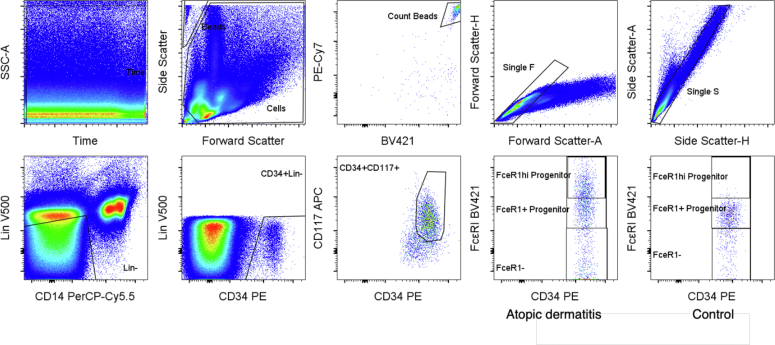 Figure 1
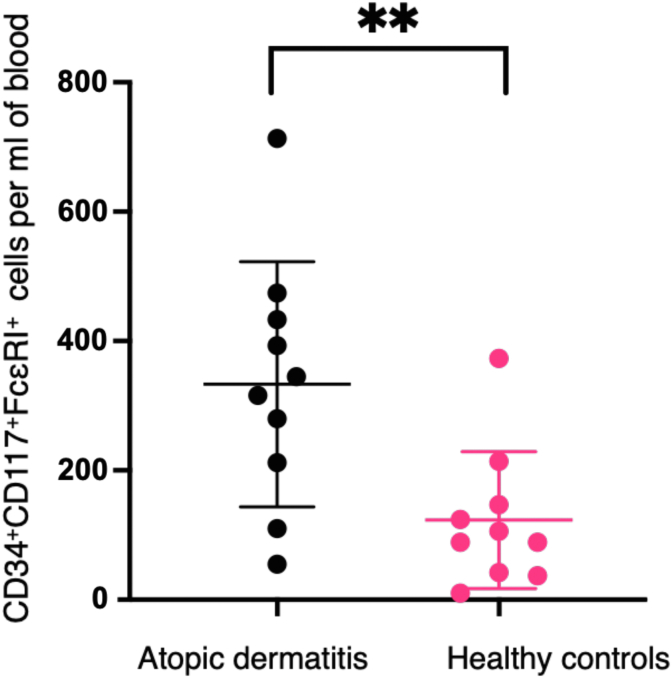 Figure 2
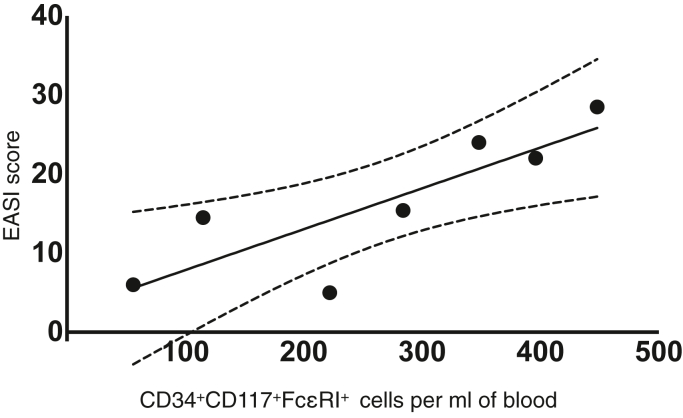 Figure 3
Peer Reviews
No public reviews on file for this paper yet. If you reviewed it on a platform where reviews are public (OpenReview, ICLR, NeurIPS, ICML), you can paste yours below so the community can read it here.
Videos
No videos yet. Explain this paper in a talk, walkthrough, or lecture? Add one.
Taxonomy
TopicsDermatology and Skin Diseases · Asthma and respiratory diseases · Food Allergy and Anaphylaxis Research
Introduction
Atopic dermatitis (AD) is a common inflammatory skin disorder characterized by recurrent eczematous lesions with the dominant symptom of intense itch (Langan et al, 2020). Whereas the role of T-cell–mediated type 2 inflammation is integral to the pathogenesis of AD, mast cells and the inflammatory mediators they release may have an important role. Mast cells secrete effector cytokines with critical functions in AD pathogenesis such as IL-4 and IL-13 (Voss et al, 2021). Furthermore, the close association of mast cells with sensory neurons in the skin may provoke inflammation and sensation of itch (Voss et al, 2021).
Mast cells are challenging to study given their absence from peripheral blood. Lineage^−^CD34^hi^CD117^int/hi^FceR1^+^ cells in the blood display mast cell–like morphology and gene expression (Dahlin et al, 2016). Mast cell progenitors have been found to be increased in allergic asthma, allergic rhinitis, and chronic spontaneous urticaria (Alvarado-Vazquez et al, 2023; Ridge et al, 2024; Salomonsson et al, 2019). Recently, their numbers have also been found to decrease after treatment with anti–IL-5 and anti–IL-5Ra therapies in allergic asthma (Alvarado-Vazquez et al, 2024). Intriguingly, these cells have also been found to be increased in nonatopic, inflammatory disease states (Lei et al, 2024). Recently, Lin^−^CD117^+^CD34^+^FceRI^+^ progenitor cells predicted treatment response to omalizumab in chronic spontaneous urticaria (Ridge et al, 2024). This study seeks to identify and quantify Lin^−^CD117^+^CD34^+^FceRI^+^ progenitor cells in the peripheral blood of 10 individuals with a clinical diagnosis of AD and 10 healthy controls.
Results and Discussion
Baseline characteristics are illustrated in Table 1. Figure 1 outlines the gating strategy used to identify cells, with examples of a patient with AD and a healthy control provided. CD34^+^CD117^+^FcεRI^+^ cells were elevated in individuals with AD compared with those in healthy controls (n = 10; P = .0067) (Figure 2). There was no difference in FcεRI^−^ or FceRI^hi^ progenitors between individuals with AD and healthy controls (P = .356 and P = .276, respectively). Mean total serum IgE was not correlated with the number of myeloid progenitors in peripheral blood in individuals with AD (r = 0.486, P = .223) or in healthy controls (r = −0.267, P = .522). A significant positive correlation was found between FcεRI^+^ progenitors and Eczema Area and Severity Index scores (r = 0.8386, P = .0184) (Figure 3). The mean number of circulating FceRI^+^ progenitors in males with AD (n = 6) was 413.3 per ml of peripheral blood compared with 212.8 per ml in females, but this was not statistically significant (P = .102). There was no difference in the number of circulating progenitors between male and female controls (P = .162).Table 1. Baseline CharacteristicsCharacteristicAD (n = 10)Controls (n = 10)P-ValueSex4F:6M7F:3MAge, y, median (range)22 (18–44)32 (24–43)White cell count (per 10^9^/l), mean (SD)7.83 (1.94)6.5 (1.52)Eosinophils (per 10^9^/l), mean (SD)0.76 (0.47)0.16 (0.1)Basophils (per 10^9^/l), mean (SD)0.05 (0.05)0.03 (0.05)Total serum IgE (kU/l), mean (SD)3400 (1813)54.75 (74.86)Lin^−^CD34^+^CD117^+^ cells per ml of blood, median (range)446 (69–1705)140 (49–501).03531Lin^−^CD117^+^CD34^+^FceRI^+^ cells per ml of blood, median (range)330.5 (55–713)97.5 (10–373).00672Disease duration, y, mean (SD)23.3 (8.64)Topical corticosteroids10/10 (100%)Oral corticosteroids within the last 4 wk0/0Previous systemic treatment for AD0/0EASI score3, median (range)15.4 (5–38.5)DLQI4, median (range)11 (5–19)Abbreviations: AD, atopic dermatitis; DLQI, Dermatology Life Quality Index; EASI, Eczema Area and Severity Index; F, female; M, male.1Unpaired t-test.2Unpaired t-test.3EASI score interpretation: clear = 0, almost clear = 0.1–1.0, mild = 1.1–7.0, moderate = 7.1–21.0, severe = 21.1–50.0, and very severe = 50.1–72.0.4DLQI scores: 0–1 = no effect at all on patient’s life, 2–5 = small effect on patient’s life, 6–10 = moderate effect on patient’s life, 11–20 = very large effect on patient’s life, and 21–30 = extremely large effect on patient’s life.Figure 1Gating of Lin^−^CD117^+^CD34^+^ progenitor cells showing FceRI^−^ cells, FceRI^+^ cells, and FceRI^hi^ cells in an atopic dermatitis sample and a healthy control. APC, allophycocyanin; PE, phycoerythrin; SSC-A, side scatter area.Figure 2Lin^−^CD117^+^CD34^+^FceRI^+^ progenitor cells are elevated in atopic dermatitis (n = 10) compared with those in healthy controls (n = 10).P = .0067, unpaired t-test.Figure 3Lin^−^CD117^+^CD34^+^FceRI^+^ progenitor cells shown with associated EASI score (n = 7). r = 0.8386. EASI, Eczema Area and Severity Index.
These data are preliminary and require replication in larger cohorts. However, they are, to our knowledge, a previously unexamined cell type in AD and add to a growing body of evidence on amplification of these cells in atopy. Although mast cells are acknowledged as a primary effector cell in allergic disease, recognition of their function in fields such as autoimmunity and cancer is growing (Maurer et al, 2019; Komi and Redegeld, 2020). Indeed, increased numbers of mast cell progenitors have been reported in the peripheral blood of individuals with rheumatoid arthritis (Lei et al, 2024). Therefore, it is plausible that recruitment of myeloid and mast cell progenitors may not be attributable to an amplification of a type 2 response and that diverse drivers of inflammation may have a role in triggering the egress of these cells. Inflammation may influence leucocyte chemotaxis by altering CXCR4/CXCL12 interactions in the bone marrow (Cambier et al, 2023). Elevated stem cell factor as a result of inflammatory processes may also influence chemotactic gradients and progenitor egress (Nilsson et al, 1994). Contemporaneous tissue quantification of cells may help to clarify whether progenitor cells in peripheral blood reflect increased bone marrow production or reduced emigration into tissues. Identifying the cytokines and transcription factors that incite the release of these cells from the bone marrow are important next steps. Transcriptomic data may help to inform our understanding of these cells, their maturity, and heterogeneity in AD (Ridge et al, 2024).
Findings offer valuable insights into potential differences in circulating myeloid and mast cell progenitors in patients with AD. Notably, an association was observed between FceRI^+^ progenitor cells and clinical severity of AD as assessed by the Eczema Area and Severity Index score. Although the role of mast cells in AD remains to be fully elucidated, it is important to note that the primary pruritogen released by mast cells (histamine) does not represent a major pruritogen in AD, aligning with the limited efficacy of antihistamines in this condition (Rukwied et al, 2000). Nonetheless, the observed difference in FceRI^+^ myeloid progenitors in AD raises the possibility that the bone marrow is responding to chemotactic gradients in AD. Paired analyses of individuals off and on systemic treatment modalities in AD may provide additional insights into the triggers of progenitor egress. Although we did not record a quantitative measure of itch in this cohort, future studies may benefit from interrogating whether clinical measures such as itch correlate with circulating mast cell progenitor burden.
Materials and Methods
Ethical approval was granted by the Joint Research Ethics Committee in Tallaght University Hospital and St. James’s Hospital in Ireland. Written, informed consent was obtained. Healthy control participants had no diagnosis of atopic disease, which we defined as the absence of self-reported AD, allergic rhinitis, asthma, food allergy, eosinophilic esophagitis, or chronic spontaneous urticaria. We excluded patients with AD who were in receipt of any systemic treatment. Where possible, each patient had an Eczema Area and Severity Index score calculated (Hanifin et al, 2022).
Samples were prepared in line with established protocols (Salomonsson et al, 2019). Whole blood (12–15 ml) was collected in EDTA-treated tubes (BD Vacutainer, BD Bioscience). PBMCs were enriched using Ficoll-Paque Premium (ρ = 1.076 g/ml) (GE Healthcare) in SepMate-50 tubes (Stemcell Technologies). PBMCs were incubated in PBS at pH 7.4 with 2% heat-inactivated fetal calf serum with the following fluorescent-labeled antibodies: V500 CD4 (RPA-T4), V500 CD8 (RPA-T8), PerCP-Cy5.5 CD14 (M5E2), V500 CD19 (HIB19), phycoerythrin CD34 (581), allophycocyanin CD117 (104D2), and BV421 FcεRI (AER-37). Total number of single cells and absolute numbers of cells per ml were calculated using BD Biosciences Liquid Counting Beads. Sample acquisition was performed on a FACSCanto II flow cytometer (BD Biosciences). Data analysis was performed using FlowJo (version 10, BD Biosciences). Fluorescence minus one controls were used to confirm CD34, CD117, and FcεRI positivity. We categorized progenitor cells according to whether they were Lin^−^CD34^+^CD117^+^FcεRI^−^ (referred to as FceRI^−^ progenitors), Lin^−^CD34^+^CD117^+^FcεRI^+^ (referred to as FceRI^+^ progenitors), or Lin^−^CD34^+^CD117^+^FcεRI^hi^ (referred to as FceRI^hi^ progenitors) (Figure 1). FceRI^hi^ progenitors represent an extremely rare cell type with the phenotype of true mast cell precursors (Dahlin et al, 2016).
Statistical analysis
Data were assessed for normality using a Shapiro–Wilk test. Results indicated that variables were normally distributed (W = 0.9638, P = .8282). An unpaired t-test was used to compare the quantities of progenitors in patients with AD and controls. A Pearson’s r correlation was used to assess for an association between progenitors and Eczema Area and Severity Index scores in patients with AD.
Ethics Statement
Ethical approval was granted by the Joint Research Ethics Committee in Tallaght University Hospital and St. James’s Hospital in Ireland. Written, informed consent was obtained from all participants.
Data Availability Statement
Data will be made available upon reasonable request to corresponding author.
ORCIDs
Katie Ridge: http://orcid.org/0000-0003-4276-7050
Conor M. Finlay: http://orcid.org/0000-0001-8285-0903
Barry Moran: http://orcid.org/0000-0002-8243-1079
Cliona O’Farrelly: http://orcid.org/0000-0002-0616-2874
Julianne Clowry: http://orcid.org/0000-0002-8526-4966
Alan D. Irvine: http://orcid.org/0000-0002-9048-2044
Niall Conlon: http://orcid.org/0000-0002-8023-280X
Conflict of Interest
NC has received support for attending meetings from Novartis. ADI is a consultant and on the advisory board for AbbVie, Novartis, Regeneron, Sanofi, Leo Pharma, Pfizer, Eli Lilly, Benevolent AI, and Arena. The remaining authors state no conflict of interest.
The reference list from the paper itself. Each links out to its DOI / PubMed record.
- 1Alvarado-Vazquez P.A.Mendez-Enriquez E.Salomonsson M.Kopac P.Koren A.Bidovec-Stojkovic U.Targeting of the IL-5 pathway in severe asthma reduces mast cell progenitors J Allergy Clin Immunol 153202414411453.e 1010.1016/j.jaci.2024.10.02539521285 · doi ↗ · pubmed ↗
- 2Alvarado-Vazquez P.A.Mendez-Enriquez E.Salomonsson M.Waern I.Janson C.Wernersson S.Circulating mast cell progenitors increase during natural birch pollen exposure in allergic asthma patients Allergy 782023295929683761543210.1111/all.15860 · doi ↗ · pubmed ↗
- 3Cambier S.Gouwy M.Proost P.The chemokines CXCL 8 and CXCL 12: molecular and functional properties, role in disease and efforts towards pharmacological intervention Cell Mol Immunol 2020232172513672596410.1038/s 41423-023-00974-6PMC 9890491 · doi ↗ · pubmed ↗
- 4Dahlin J.S.Malinovschi A.Öhrvik H.Sandelin M.Janson C.Alving K.Lin- CD 34hi CD 117int/hi FcεRI+ cells in human blood constitute a rare population of mast cell progenitors Blood 12720163833912662699210.1182/blood-2015-06-650648 PMC 4731844 · doi ↗ · pubmed ↗
- 5Hanifin J.M.Baghoomian W.Grinich E.Leshem Y.A.Jacobson M.Simpson E.L.The eczema area and severity index-a practical guide Dermatitis 3320221871923559445710.1097/DER.0000000000000895 PMC 9154300 · doi ↗ · pubmed ↗
- 6Komi D.E.A.Redegeld F.A.Role of mast cells in shaping the tumor microenvironment Clin Rev Allergy Immunol 5820203133253125632710.1007/s 12016-019-08753-w PMC 7244463 · doi ↗ · pubmed ↗
- 7Langan S.M.Irvine A.D.Weidinger S.Atopic dermatitis[published correction appears in Lancet. 2020;396:758]Lancet 39620203453603273895610.1016/S 0140-6736(20)31286-1 · doi ↗ · pubmed ↗
- 8Lei Y.Guo X.Luo Y.Niu X.Xi Y.Xiao L.Synovial microenvironment-influenced mast cells promote the progression of rheumatoid arthritis Nat Commun 1520241133816810310.1038/s 41467-023-44304-w PMC 10761862 · doi ↗ · pubmed ↗