Closed-loop versus open-loop “remind-to-move” treatment using wearables for hemiparetic upper extremity in patients after stroke: A proof-of-concept study
Kenneth N. K. Fong, Jasmine P. Y. Pak, Alissa H. L. Koo, Maggie M. K. Szeto, Natalie M. T. Wong, Keily K. Y. Yau, Sharon F. M. Toh, Vivian W. Lou, Hector W. H. Tsang, Gary K. K. Lau

TL;DR
A study compared wearable devices that remind stroke patients to move their affected arm, finding that closed-loop devices were more effective than open-loop ones.
Contribution
This study introduces a closed-loop wearable device for stroke rehabilitation and demonstrates its superior effectiveness over open-loop systems.
Findings
Both closed-loop and open-loop devices improved upper extremity function in stroke patients.
Closed-loop devices showed greater improvements in movement frequency and actual arm use.
Benefits from closed-loop training were maintained at a 4-week follow-up.
Abstract
This is a proof-of-concept study to compare the effects of a 2-week program of “Remind-to-move” (RTM) treatment using closed-loop and open-loop wearables for hemiparetic upper extremity in patients with chronic stroke in the community. The RTM open-loop wearable device has been proven in our previous studies to be useful to address the learned nonuse phenomenon of the hemiparetic upper extremity. A closed-loop RTM wearable device, which emits reminding cues according to actual arm use, was developed in this study. A convenience sample of 16 participants with chronic unilateral stroke recruited in the community was engaged in repetitive upper extremity task-specific practice for 2 weeks while wearing either a closed-loop or an open-loop ambulatory RTM wearable device on their affected hand for 3 hrs a day. Evaluations were conducted at pre-/post-intervention and follow-up after 4 weeks…
Genes, proteins, chemicals, diseases, species, mutations and cell lines named across the full text — each resolved to its canonical identifier and authoritative record.
Click any figure to enlarge with its caption.
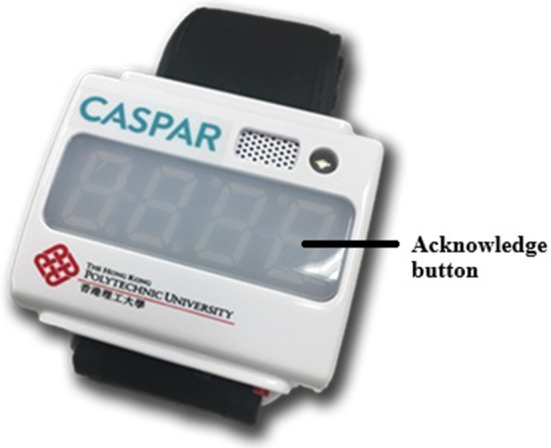 Figure 1
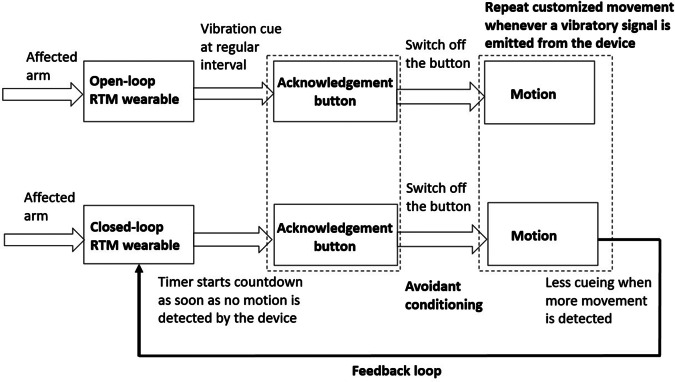 Figure 2
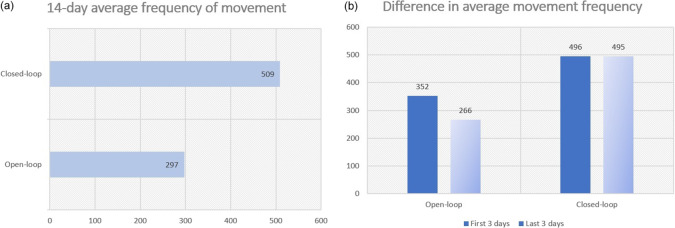 Figure 3
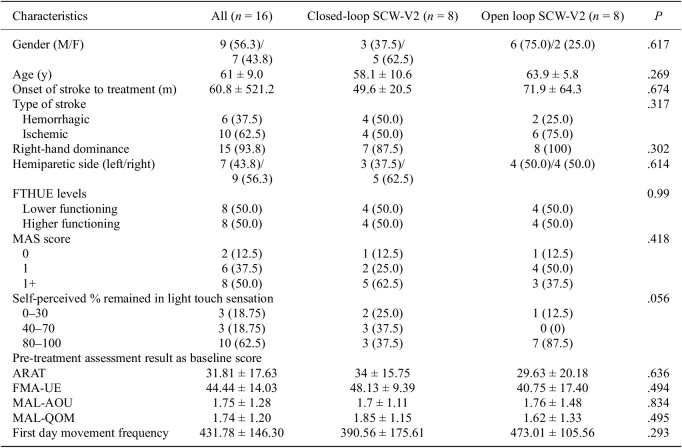 Figure 4
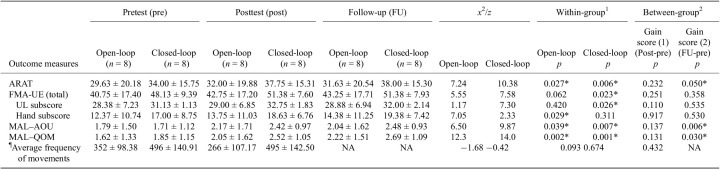 Figure 5
Peer Reviews
No public reviews on file for this paper yet. If you reviewed it on a platform where reviews are public (OpenReview, ICLR, NeurIPS, ICML), you can paste yours below so the community can read it here.
Videos
No videos yet. Explain this paper in a talk, walkthrough, or lecture? Add one.
Taxonomy
TopicsStroke Rehabilitation and Recovery · Botulinum Toxin and Related Neurological Disorders · Musculoskeletal pain and rehabilitation