The Idiom Processing Advantage is Explained By Surprisal
Michaela Socolof, Timothy J. O'Donnell, Michael Wagner

TL;DR
Idioms are processed faster than literal phrases because they are more predictable, according to surprisal theory.
Contribution
The idiom processing advantage is explained by surprisal, not just compositionality.
Findings
Idioms have lower surprisal than matched literal phrases.
The idiom advantage is most evident on the noun in verb-object idioms.
Abstract
It has been repeatedly found that idioms are processed faster than syntactically matched literal phrases, in both comprehension and production. This has led to debate about whether idioms are accessed as chunks or built compositionally, with different studies attempting to measure the effect of compositionality on processing, with differing conclusions. This paper looks at idiom processing through the lens of information update, in particular surprisal theory, which is a standard theory of sentence processing. Compositionality is just one aspect of a word's predictability; we argue that surprisal, as an expectation‐based theory, provides a more general unifying framework for understanding the idiom processing advantage. In this paper, comprehension and production experiments on verb‐object idioms reveal that the idiom processing advantage can be largely explained by the fact that idioms…
Genes, proteins, chemicals, diseases, species, mutations and cell lines named across the full text — each resolved to its canonical identifier and authoritative record.
Click any figure to enlarge with its caption.
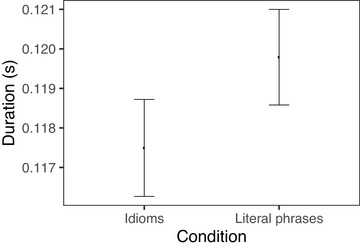 Figure 1
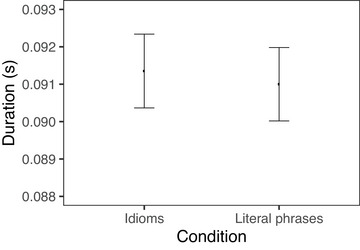 Figure 2
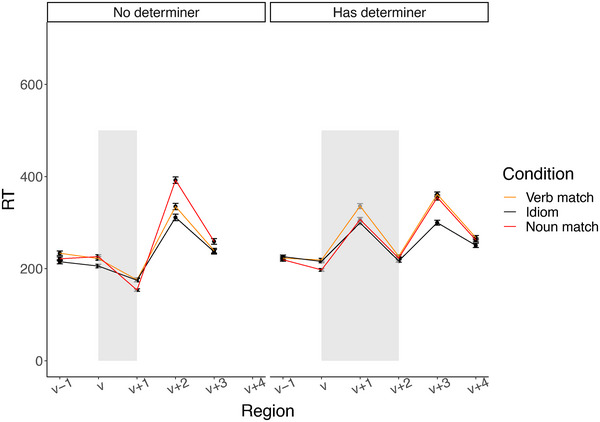 Figure 3
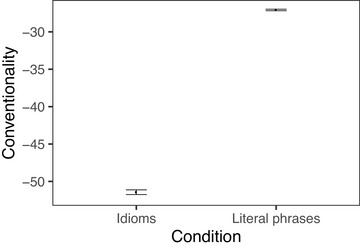 Figure 4
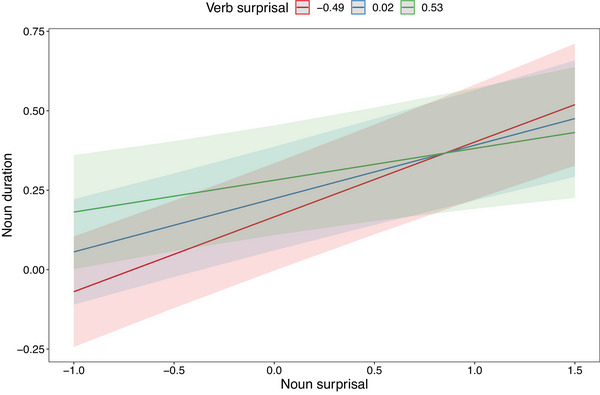 Figure 5
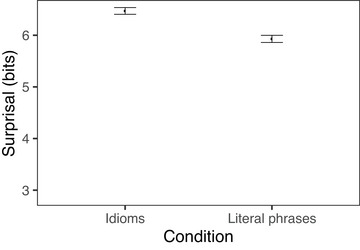 Figure 6
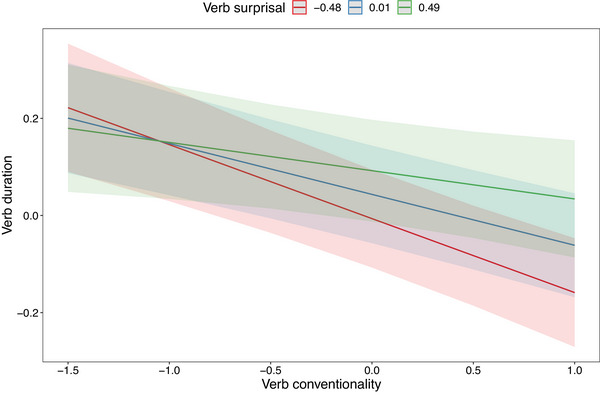 Figure 7
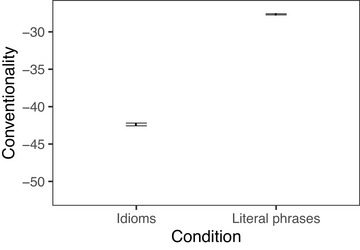 Figure 8
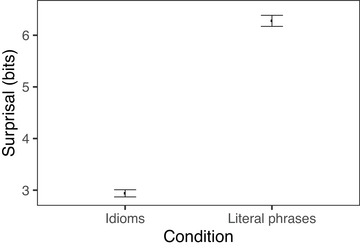 Figure 9
Peer Reviews
No public reviews on file for this paper yet. If you reviewed it on a platform where reviews are public (OpenReview, ICLR, NeurIPS, ICML), you can paste yours below so the community can read it here.
Videos
No videos yet. Explain this paper in a talk, walkthrough, or lecture? Add one.
Taxonomy
TopicsLanguage, Metaphor, and Cognition · Linguistics and Discourse Analysis · Natural Language Processing Techniques