Nanomechanical binding mechanism of ligands drives agonistic activity
Hannah Seferovic, Patricia Sticht, Lisa Hain, Rong Zhu, Sebastian Diethör, Christian Wechselberger, Florian Weber, David Bernhard, Birgit Plochberger, Yoo Jin Oh, Javier Chaparro-Riggers, Peter Hinterdorfer

TL;DR
The study reveals how the natural CD40 ligand interacts with receptors more efficiently than antibodies, offering insights for better drug design.
Contribution
The paper introduces a novel nanomechanical binding mechanism of CD40 ligands that explains their superior agonistic activity.
Findings
ChiLob 7/4 dynamically rotates its Fab arms to screen for hCD40 binding.
hCD40L forms and releases hCD40 clusters ten times faster than ChiLob 7/4.
The natural ligand's binding mechanism could inspire new drug formats with enhanced activity.
Abstract
Monoclonal antibodies and ligands targeting CD40 exhibit a wide range of agonistic activities and antitumor responses. Studies have shown that the flexibility and affinity of antibodies play a crucial role in their immunostimulatory activity. However, a systematic comparison with the natural ligand is yet missing and a detailed investigation with respect to molecular rigidity, binding kinetics, and bond lifetime has not been undertaken to date. Here, we study the dynamic binding features of clinically relevant anti-hCD40 antibody subclasses, ChiLob 7/4, and the trimeric human CD40L to hCD40 at the single-molecule level. We visualize resembling of hCD40 receptors into dimers and higher-order oligomers that are dynamically captured and released by both ChiLob 7/4 and hCD40L with their multiple binding sites. Thereby, ChiLob 7/4 acts as a nanomechanical calliper and rotates its Fab arms in…
Genes, proteins, chemicals, diseases, species, mutations and cell lines named across the full text — each resolved to its canonical identifier and authoritative record.
Click any figure to enlarge with its caption.
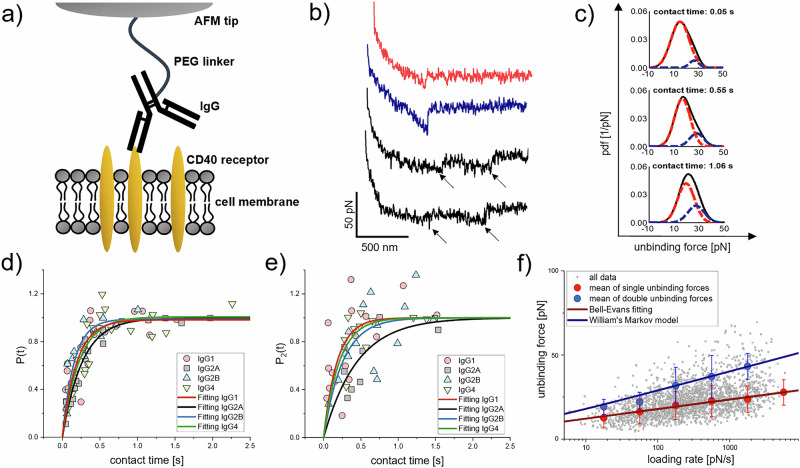 Figure 1
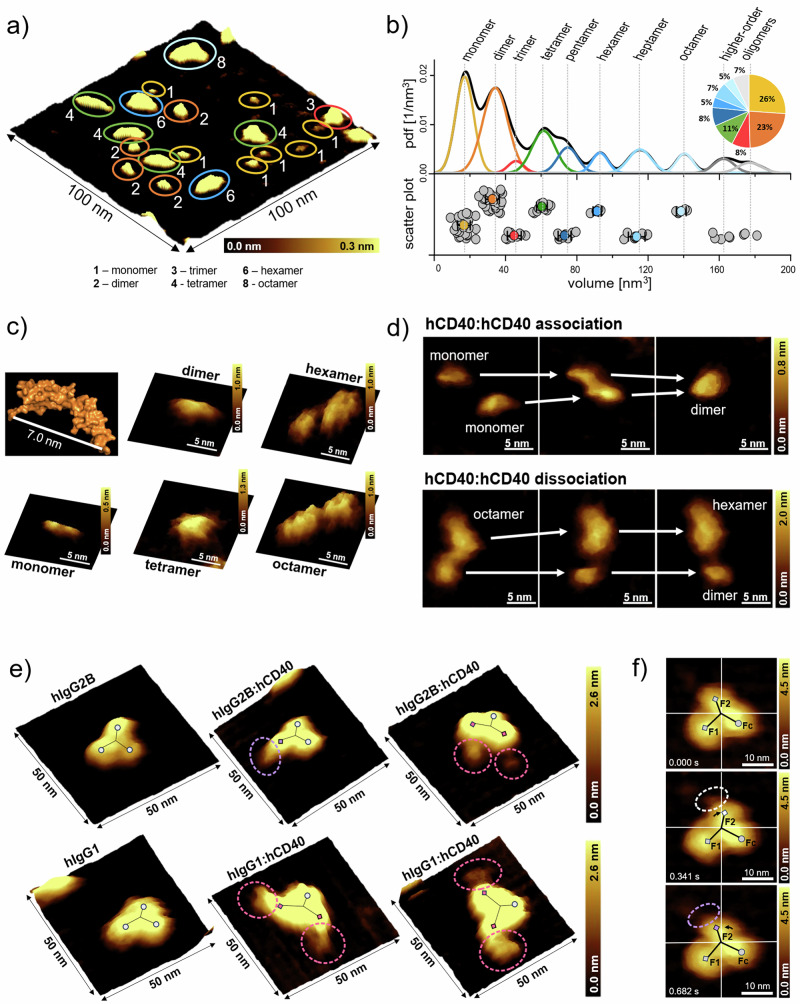 Figure 2
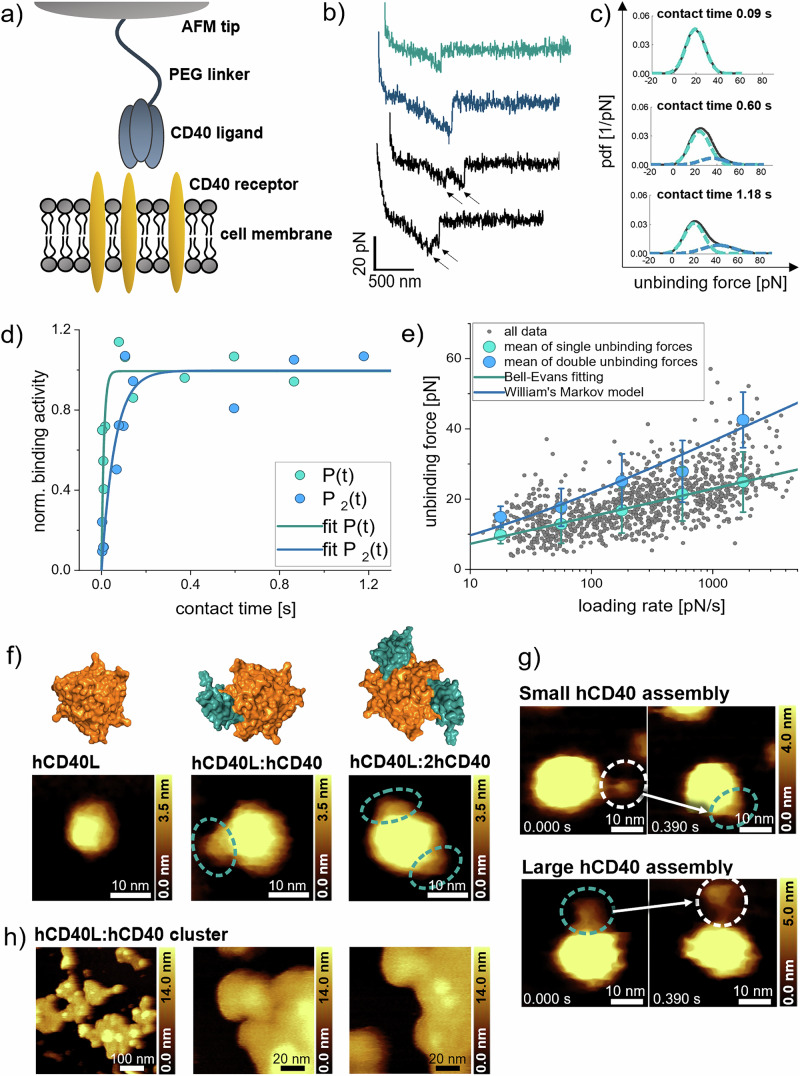 Figure 3
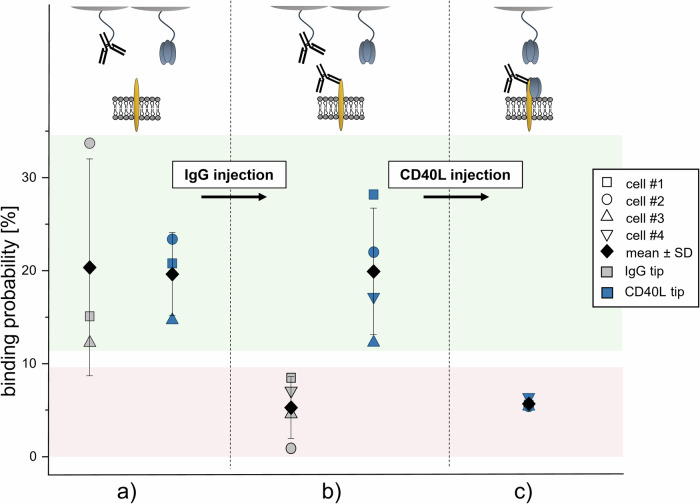 Figure 4
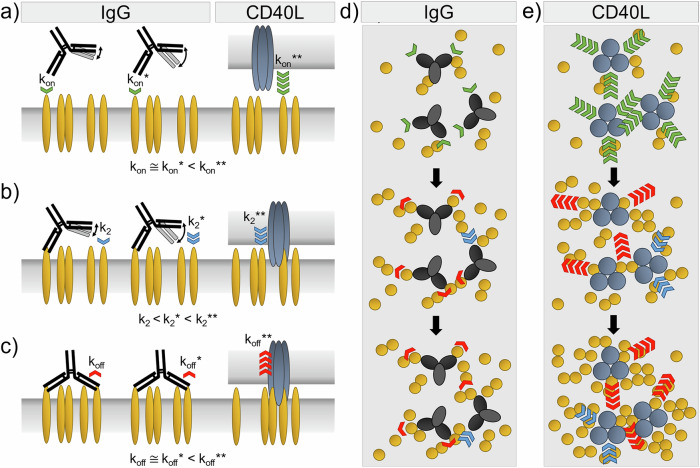 Figure 5
Peer Reviews
No public reviews on file for this paper yet. If you reviewed it on a platform where reviews are public (OpenReview, ICLR, NeurIPS, ICML), you can paste yours below so the community can read it here.
Videos
No videos yet. Explain this paper in a talk, walkthrough, or lecture? Add one.
Taxonomy
TopicsForce Microscopy Techniques and Applications · Computational Drug Discovery Methods · thermodynamics and calorimetric analyses