Genetically proxied blood pressure, vascular brain injury, and Alzheimer's disease pathology
Iyas Daghlas, Michelle R. Caunca, Lincoln M. P. Shade, Malik Nassan, Kristine Yaffe, David W. Fardo, Dipender Gill

TL;DR
This study finds that lower blood pressure reduces dementia risk by protecting blood vessels in the brain, but does not directly affect Alzheimer's disease pathology.
Contribution
The study uses genetic data to clarify that lower blood pressure reduces vascular brain injury but does not influence Alzheimer's pathology.
Findings
Genetically lower systolic blood pressure is linked to reduced vascular brain injury measures like atherosclerosis and infarcts.
No evidence was found linking systolic blood pressure to Alzheimer's disease pathology markers like amyloid or tau.
Diastolic blood pressure showed similar results to systolic blood pressure in relation to vascular brain injury.
Abstract
Lower blood pressure (BP) is linked to reduced dementia risk, though it is uncertain whether this benefit stems solely from mitigating vascular brain injury (VBI) or also extends to directly influencing Alzheimer's disease (AD) pathology. We leveraged Mendelian randomization (MR) to assess whether lifelong lower BP is causally associated with neuropathological correlates of VBI and AD. We identified genetic proxies for systolic and diastolic BP (n = 1,028,980) and applied them in MR analyses of post mortem neuropathological measures of VBI and AD (n = 6363–7786). Genetically proxied lower systolic BP associated with reduced risk of all VBI measures, including atherosclerosis, arteriolosclerosis, gross infarcts, and microinfarcts. There was no evidence for associations between systolic BP and AD pathology, including measures of amyloid and tau pathology. Diastolic BP analyses yielded…
Genes, proteins, chemicals, diseases, species, mutations and cell lines named across the full text — each resolved to its canonical identifier and authoritative record.
Click any figure to enlarge with its caption.
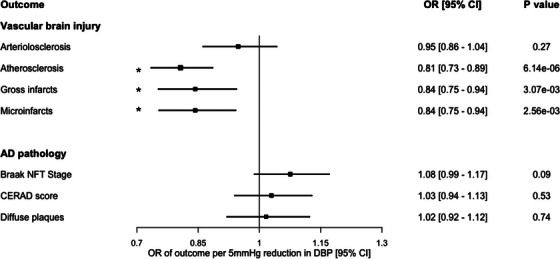 Figure 1
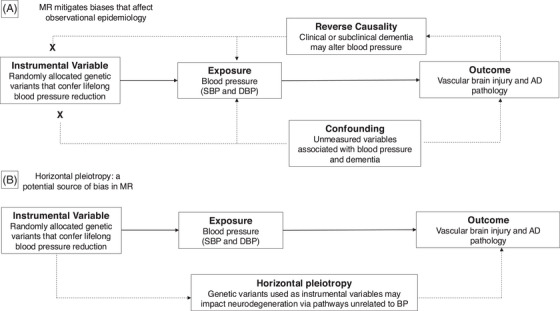 Figure 2
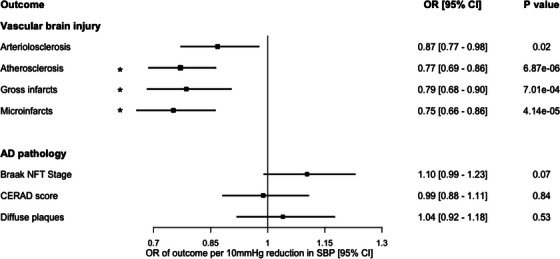 Figure 3
Peer Reviews
No public reviews on file for this paper yet. If you reviewed it on a platform where reviews are public (OpenReview, ICLR, NeurIPS, ICML), you can paste yours below so the community can read it here.
Videos
No videos yet. Explain this paper in a talk, walkthrough, or lecture? Add one.
Taxonomy
TopicsBirth, Development, and Health · Genetic Associations and Epidemiology · Diet and metabolism studies