Matrix remodeling-associated protein 5 as a novel biomarker for predicting disease activity and endoscopic response to infliximab in Crohn's disease
Daopo Lin, Jiayue Xu, Mengqian Ye, Luyan Fang, Tianhao Xia, Wenyu Tong, Gokuljayanth Jayaseelan Ranichandra, Yifan Bao, Bo Zheng, Yi Jiang, Lianpin Wu, Dingyuan Hu

TL;DR
This study identifies MXRA5 as a potential blood biomarker for tracking Crohn's disease activity and predicting response to infliximab treatment.
Contribution
MXRA5 is newly proposed as a serum biomarker for Crohn's disease endoscopic activity and response to infliximab.
Findings
MXRA5 levels were significantly higher in CD patients in remission compared to active cases.
MXRA5 showed an inverse correlation with SES-CD scores and effectively distinguished endoscopic activity (AUC = 0.80).
Higher baseline MXRA5 levels predicted better endoscopic response to infliximab.
Abstract
The primary objective of treating Crohn's disease (CD) is to achieve and sustain endoscopic remission. However, repeated endoscopic examination leads to decreased patient compliance and procedural risks. Non-invasive biomarkers for endoscopic activity of CD are thus promising in clinical use. This study compared proteomic profiles between inflammatory and non-inflammatory intestinal tissues on 10 active CD patients through liquid chromatography–tandem mass spectrometry, and identified 384 differentially expressed proteins. Four candidate secretory proteins (MXRA5, AZU/HBP, CRYAB, DEFA3) were validated via ELISA in serum from 74 CD patients (43 active CD and 31 in remission). Serum MXRA5 levels were notably increased in CD patients in remission compared to active cases (P < 0.001) and showed an inverse correlation with SES-CD scores (r = −0.33, P < 0.05). ROC analysis demonstrated…
Genes, proteins, chemicals, diseases, species, mutations and cell lines named across the full text — each resolved to its canonical identifier and authoritative record.
Click any figure to enlarge with its caption.
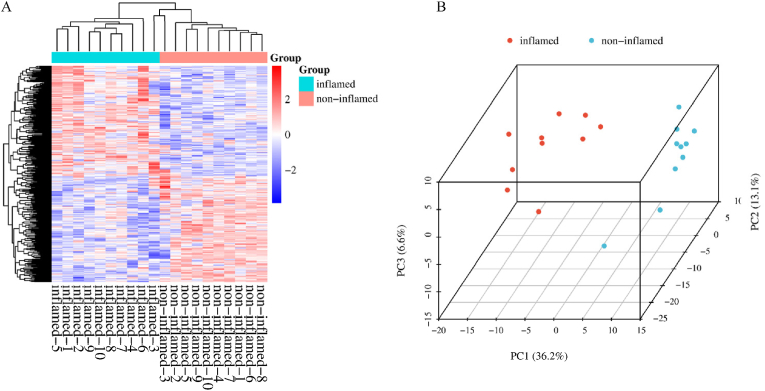 Figure 1
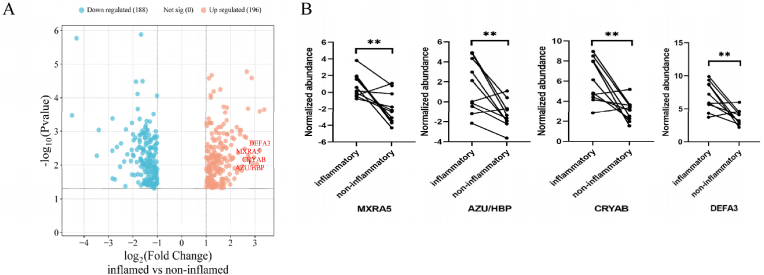 Figure 2
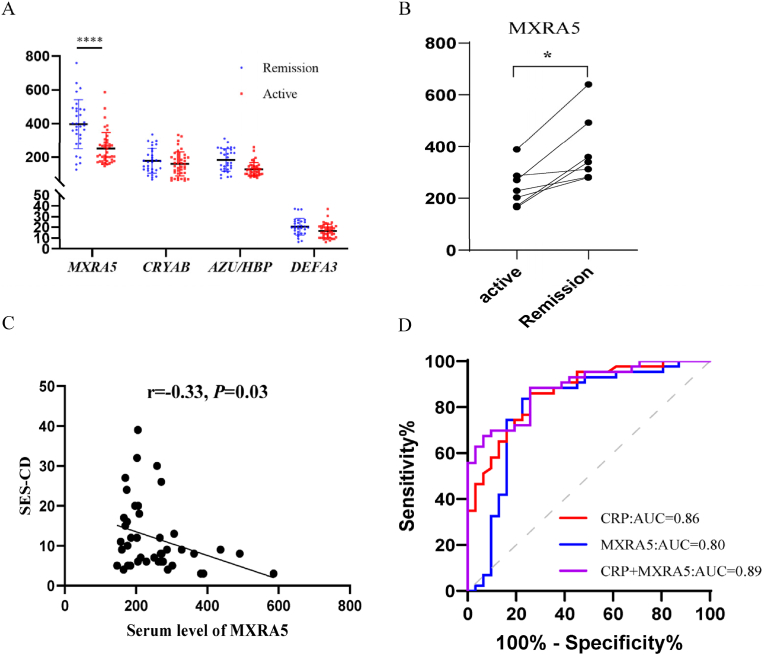 Figure 3
Peer Reviews
No public reviews on file for this paper yet. If you reviewed it on a platform where reviews are public (OpenReview, ICLR, NeurIPS, ICML), you can paste yours below so the community can read it here.
Videos
No videos yet. Explain this paper in a talk, walkthrough, or lecture? Add one.
Taxonomy
TopicsInflammatory Bowel Disease · Galectins and Cancer Biology · Autoimmune and Inflammatory Disorders Research