Immunogenicity and Safety of ChAdOx1 nCoV-19 (AZD1222) as a Homologous Fourth-Dose Booster: A Substudy of the Phase 3 COV003 Trial in Brazil
Sue Ann Costa Clemens, Sagida Bibi, Natalie G. Marchevsky, Parvinder K. Aley, Federica Cappuccini, Sophie A. Davies, Isabela Gonzalez, Sarah C. Kelly, Yama F. Mujadidi, Eveline Pipolo Milan, Alexandre V. Schwarzbold, Eduardo Sprinz, Merryn Voysey, Lily Y. Weckx, Daniel Wright

TL;DR
This study shows that a fourth dose of the ChAdOx1 nCoV-19 vaccine boosts immunity and is safe, with no new safety issues.
Contribution
The study provides new clinical data on the fourth-dose immunogenicity and safety of ChAdOx1 nCoV-19 as a booster.
Findings
Fourth-dose neutralizing antibody responses were noninferior to third-dose responses across SARS-CoV-2 variants.
The fourth dose was well tolerated with no emergent safety concerns.
Immunogenicity results were consistent across all analyzed variants.
Abstract
To address that, despite widespread use of ChAdOx1 nCoV-19 (AZD1222) as a COVID-2019 booster, fourth-dose clinical outcomes data are limited. We report immunogenicity and safety for ChAdOx1 nCoV-19 as a homologous fourth-dose booster. Participants (aged ≥18 years) who had received 2 doses of ChAdOx1 nCoV-19 in phase 3 COV003 trial in Brazil were offered a third dose after a planned dose interval from 11 to 13 months and a fourth dose after a planned interval from 6 to 15 months (both 5 × 10¹⁰ viral particles). All fourth doses were administered to substudy participants between August 18 and October 28, 2022. The data cutoff was December 9, 2022. The primary immunogenicity outcome was noninferiority of ancestral severe acute respiratory syndrome coronavirus (SARS-CoV)-2–neutralizing antibody responses 28 days after dose 4 versus dose 3. Solicited and unsolicited adverse events were…
Genes, proteins, chemicals, diseases, species, mutations and cell lines named across the full text — each resolved to its canonical identifier and authoritative record.
Click any figure to enlarge with its caption.
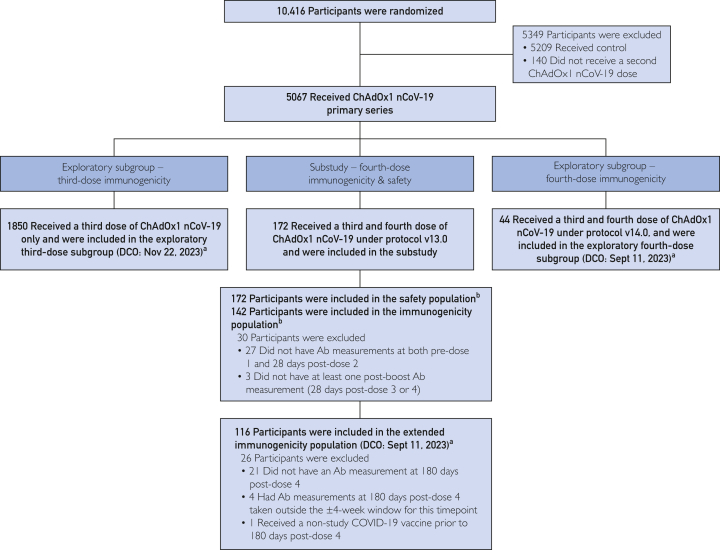 Figure 1
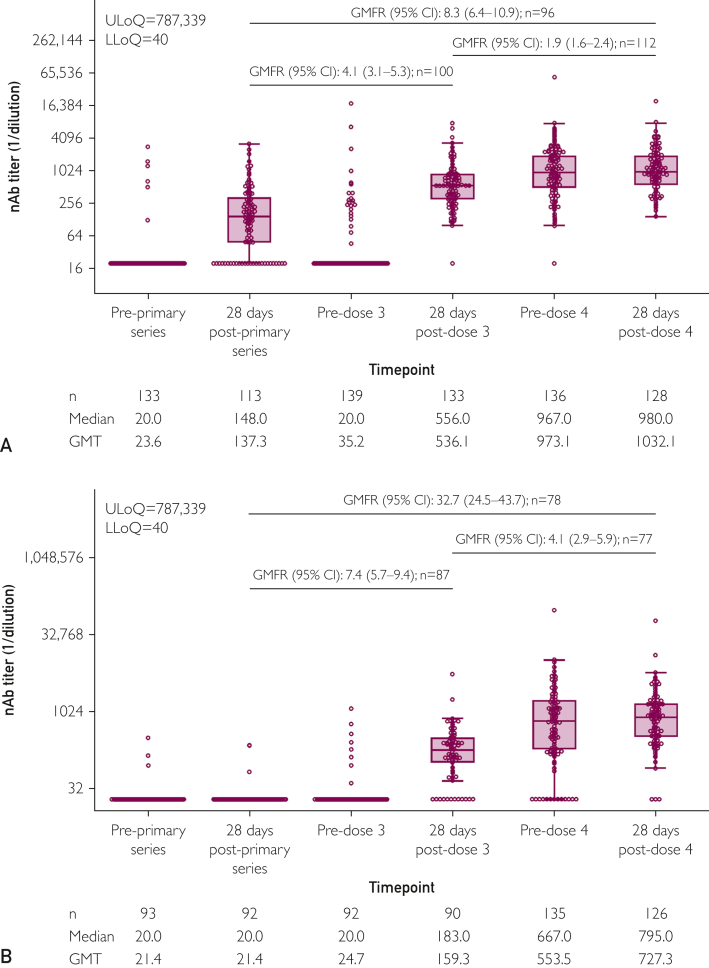 Figure 2
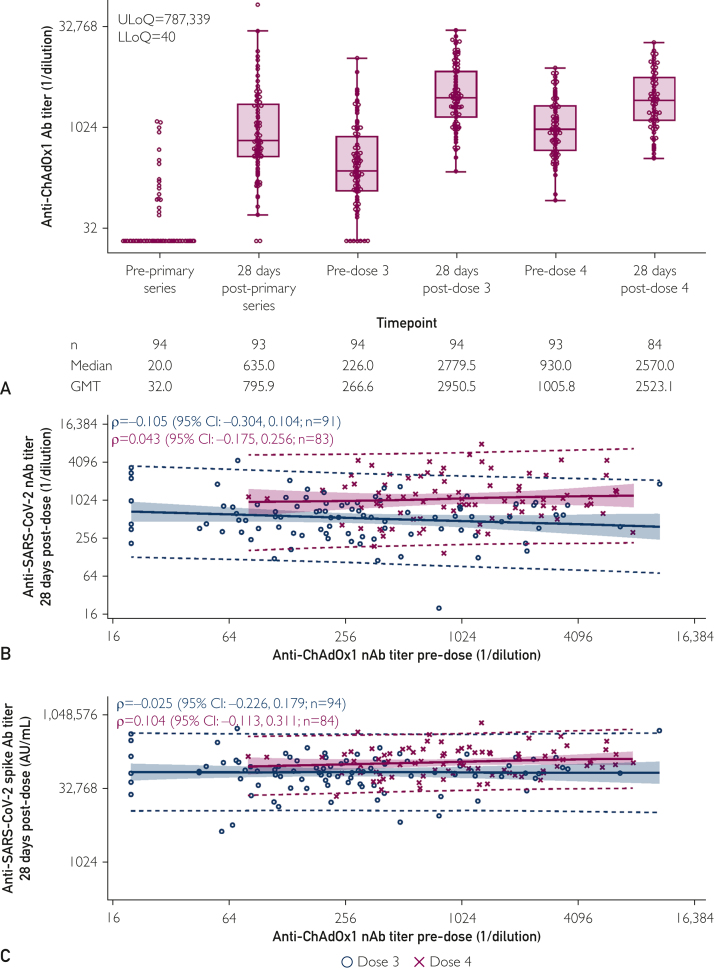 Figure 3
Peer Reviews
No public reviews on file for this paper yet. If you reviewed it on a platform where reviews are public (OpenReview, ICLR, NeurIPS, ICML), you can paste yours below so the community can read it here.
Videos
No videos yet. Explain this paper in a talk, walkthrough, or lecture? Add one.
Taxonomy
TopicsSARS-CoV-2 and COVID-19 Research · COVID-19 Clinical Research Studies · Retinal and Optic Conditions