Prediction of local convergent shifts in evolutionary rates with phyloConverge
Elysia Saputra, Weiguang Mao, Guillermo Hoffmann Meyer, Nathan Clark, Maria Chikina

TL;DR
A new method called phyloConverge improves the detection of convergent genetic changes in noncoding regions, helping to understand how species adapt to similar environments.
Contribution
phyloConverge introduces a scalable and flexible phylogenetic approach for local convergence analysis of genomic elements.
Findings
phyloConverge identifies rate-accelerated conserved noncoding elements (CNEs) with high specificity and statistical robustness.
Regulatory element regression in subterranean mammals is enriched for neuronal phenotypes and developmental processes.
phyloConverge enables high-resolution genome-wide convergence analysis with modular adaptation detection.
Abstract
Convergence analysis can characterize genetic elements underlying morphological adaptations. However, its performance on regulatory elements is limited due to their modular composition of transcription factor motifs, which have rapid turnover and experience different evolutionary pressures. We introduce phyloConverge, a phylogenetic method that performs scalable, fine-grained local convergence analysis of genomic elements at flexible length scales. Using a benchmarking case of convergent subterranean mammal adaptation, phyloConverge identifies rate-accelerated conserved noncoding elements (CNEs) with high specificity and statistical robustness relative to competing methods. From CNE-level scoring, we detect the convergent regression of entire CNE units and highlight the contrast that subterranean-associated coding region regression is highly specific to ocular functions, whereas…
Genes, proteins, chemicals, diseases, species, mutations and cell lines named across the full text — each resolved to its canonical identifier and authoritative record.
Click any figure to enlarge with its caption.
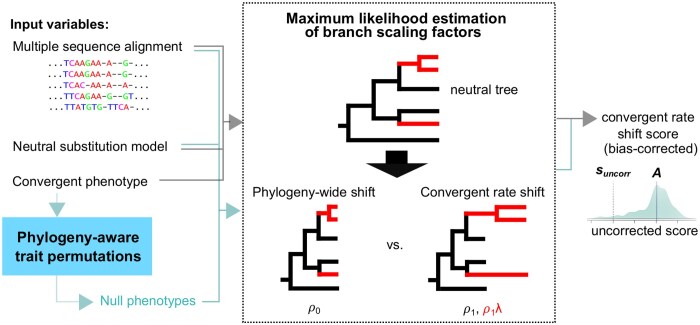 Figure 1
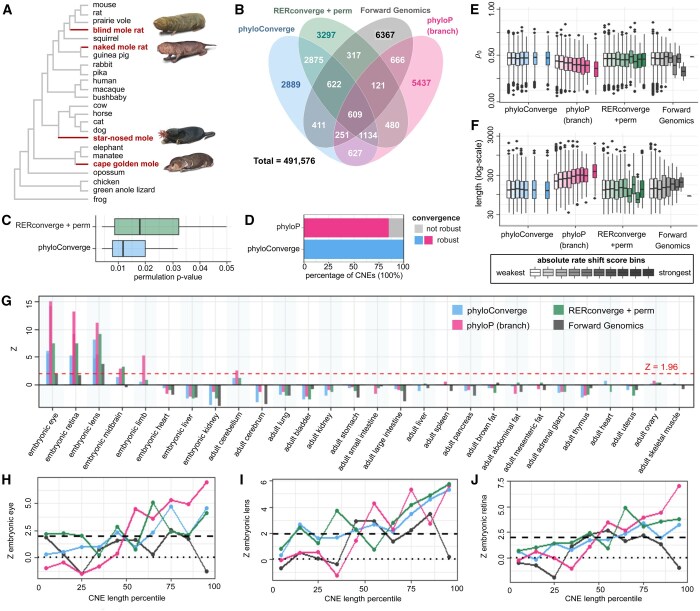 Figure 2
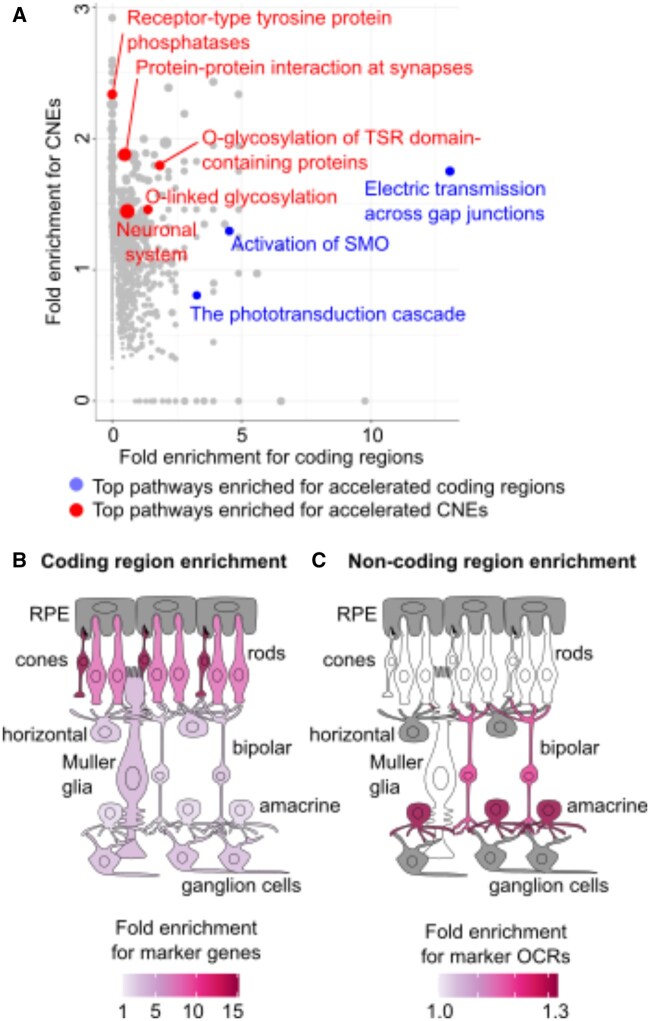 Figure 3
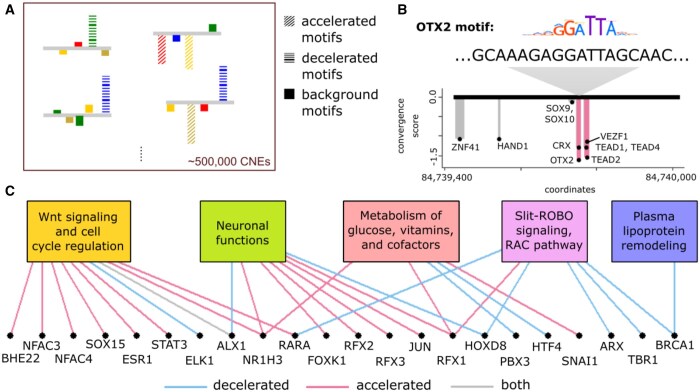 Figure 4
Peer Reviews
No public reviews on file for this paper yet. If you reviewed it on a platform where reviews are public (OpenReview, ICLR, NeurIPS, ICML), you can paste yours below so the community can read it here.
Videos
No videos yet. Explain this paper in a talk, walkthrough, or lecture? Add one.
Taxonomy
TopicsSingle-cell and spatial transcriptomics · Genomics and Phylogenetic Studies · Chromosomal and Genetic Variations