Efficient and simple protocol for mechanical isolation of foreskin-derived primary human dermal fibroblasts for replicative senescence studies
Astrid Feinisa Khairani, Nayla Majeda Alfarafisa, Yoan Chou, Widad Aghnia Shalannandia, Maiko Ikezawa, Achadiyani Achadiyani, Nur Atik

TL;DR
This paper presents a simple and cost-effective method to isolate human skin cells for studying aging, suitable for settings with limited resources.
Contribution
A novel mechanical isolation protocol for dermal fibroblasts that reduces reliance on expensive reagents and complex procedures.
Findings
The method successfully produced viable fibroblasts with spindle-shaped morphology and key protein/gene markers.
Cells survived up to passage 8, supporting replicative senescence studies.
The protocol is practical for intrinsic skin aging research in resource-limited environments.
Abstract
An efficient and reproducible protocol was developed for the mechanical isolation of human dermal fibroblasts (HDFs) from the foreskin, providing a practical alternative to enzymatic methods. This protocol could be easily performed with limited resources by reducing the need for expensive reagents and complex procedures. Viable cells were successfully subcultured repeatedly for cellular senescence studies, with reproducibility ensured through a detailed description. This mechanical isolation method successfully generated HDFs with elongated spindle-shaped morphological characteristics that expressed the ACTIN protein, VIMENTIN protein, and SERPINH1 gene. HDFs survived through passage 8 (P8) during repeated subculturing. The mechanical isolation protocol efficiently yields primary HDFs from the foreskin and supports replicative senescence up to passage 8 (P8). It can be applied to…
Genes, proteins, chemicals, diseases, species, mutations and cell lines named across the full text — each resolved to its canonical identifier and authoritative record.
Click any figure to enlarge with its caption.
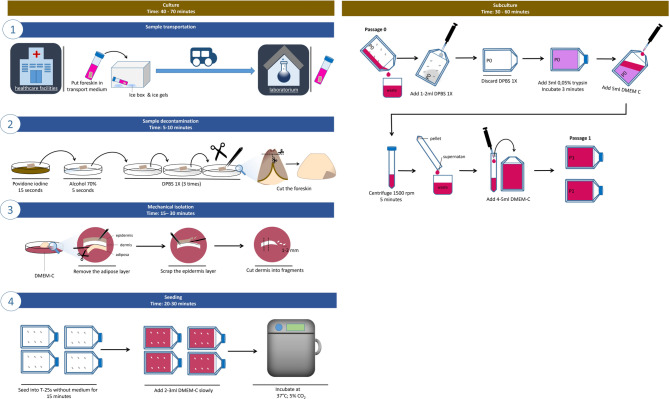 Figure 1
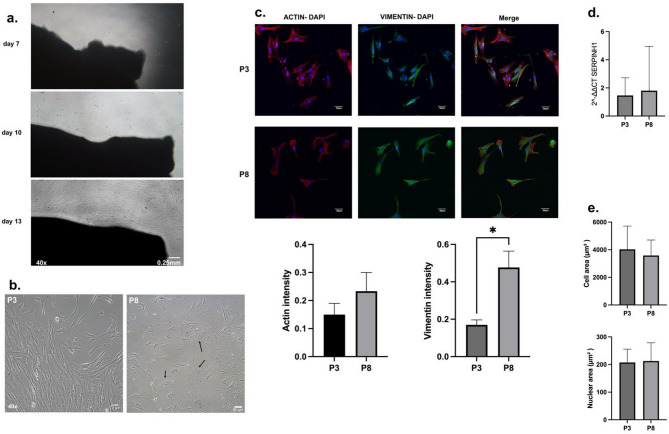 Figure 2
Peer Reviews
No public reviews on file for this paper yet. If you reviewed it on a platform where reviews are public (OpenReview, ICLR, NeurIPS, ICML), you can paste yours below so the community can read it here.
Videos
No videos yet. Explain this paper in a talk, walkthrough, or lecture? Add one.
Taxonomy
TopicsTelomeres, Telomerase, and Senescence · Skin Protection and Aging · Genetics, Aging, and Longevity in Model Organisms