Changes in splenic volumes following stereotactic ablative radiotherapy (SABR) to adrenal tumors
Nicolas Giraud, Miguel A. Palacios, John R. van Sornsen de Koste, Antonio M. Marzo, Peter S.N. van Rossum, Famke L. Schneiders, Suresh Senan

TL;DR
This study found that a significant portion of patients receiving SABR for adrenal tumors experience reduced spleen volume, especially when the spleen is exposed to higher radiation doses.
Contribution
The study identifies associations between splenic dose metrics and volume reduction following adrenal SABR, and demonstrates feasibility of dose optimization.
Findings
40–50% of patients with mean spleen dose >10 Gy experienced a >20% spleen volume reduction at 6–24 months.
Baseline splenic volume, mean dose, and V5-10Gy were associated with significant spleen volume reduction.
Re-planning with spleen dose optimization was feasible while meeting other organ constraints.
Abstract
•Reductions in splenic volume at 6/12/24 months after adrenal SABR were observed in 40–50 % with mean spleen dose >10 Gy.•Baseline splenic volume, mean spleen dose, spleen V5-10Gy were associated with a >20 % spleen volume reduction at 6 months.•Re-planning with spleen dose optimization was feasible and still meeting other organs at risks’ institutional constraints. Reductions in splenic volume at 6/12/24 months after adrenal SABR were observed in 40–50 % with mean spleen dose >10 Gy. Baseline splenic volume, mean spleen dose, spleen V5-10Gy were associated with a >20 % spleen volume reduction at 6 months. Re-planning with spleen dose optimization was feasible and still meeting other organs at risks’ institutional constraints. Splenic irradiation can result in life-threatening infections. Updated dose constraints have been recommended for patients undergoing chemoradiotherapy and…
Genes, proteins, chemicals, diseases, species, mutations and cell lines named across the full text — each resolved to its canonical identifier and authoritative record.
Click any figure to enlarge with its caption.
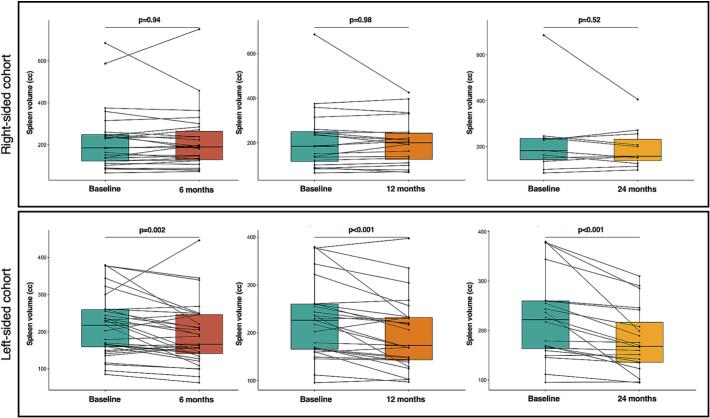 Figure 1
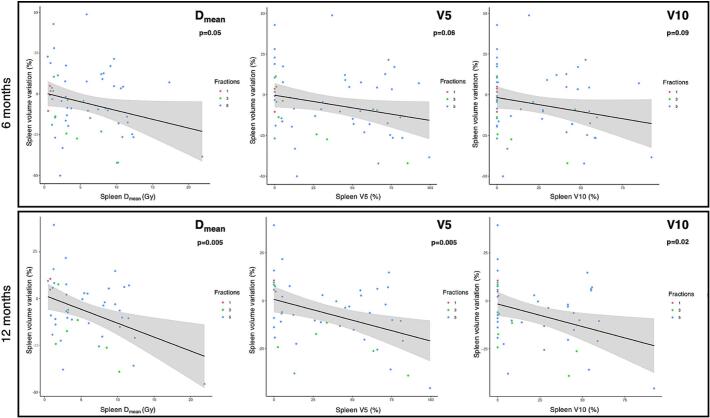 Figure 2
Peer Reviews
No public reviews on file for this paper yet. If you reviewed it on a platform where reviews are public (OpenReview, ICLR, NeurIPS, ICML), you can paste yours below so the community can read it here.
Videos
No videos yet. Explain this paper in a talk, walkthrough, or lecture? Add one.
Taxonomy
TopicsMRI in cancer diagnosis · Hepatocellular Carcinoma Treatment and Prognosis · Renal cell carcinoma treatment