Development of an artificial intelligence algorithm for automated surgical gestures annotation
Rikke Groth Olsen, Flemming Bjerrum, Annarita Ghosh Andersen, Lars Konge, Andreas Røder, Morten Bo Søndergaard Svendsen

TL;DR
This paper presents an AI algorithm that automatically labels surgical gestures in robot-assisted prostatectomy simulations, reducing the need for manual annotation.
Contribution
A novel recurrent neural network model for automated surgical gesture annotation using a VisionTransformer and LSTM architecture.
Findings
The model achieved an AUC of 0.95 and an F1-score of 0.71 for surgical gesture classification.
High classification accuracy (0.84–0.97) and specificity (0.90–0.99) were observed, though sensitivity was lower (0.62–0.81).
Total Agreement scores ranged from 0.72 to 0.91, indicating strong performance across gesture classes.
Abstract
Surgical gestures analysis is a promising method to assess surgical procedure quality, but manual annotation is time-consuming. We aimed to develop a recurrent neural network for automated surgical gesture annotation using simulated robot-assisted radical prostatectomies. We have previously manually annotated 161 videos with five different surgical gestures (Regular dissection, Hemostatic control, Clip application, Needle handling, and Suturing). We created a model consisting of two neural networks: a pre-trained feature extractor (VisionTransformer using Imagenet) and a classification head (recurrent neural network with a Long Short-Term Memory (LSTM(128) and fully connected layer)). The data set was split into a training + validation set and a test set. The trained model labeled input sequences with one of the five surgical gestures. The overall performance of the neural networks was…
Genes, proteins, chemicals, diseases, species, mutations and cell lines named across the full text — each resolved to its canonical identifier and authoritative record.
Click any figure to enlarge with its caption.
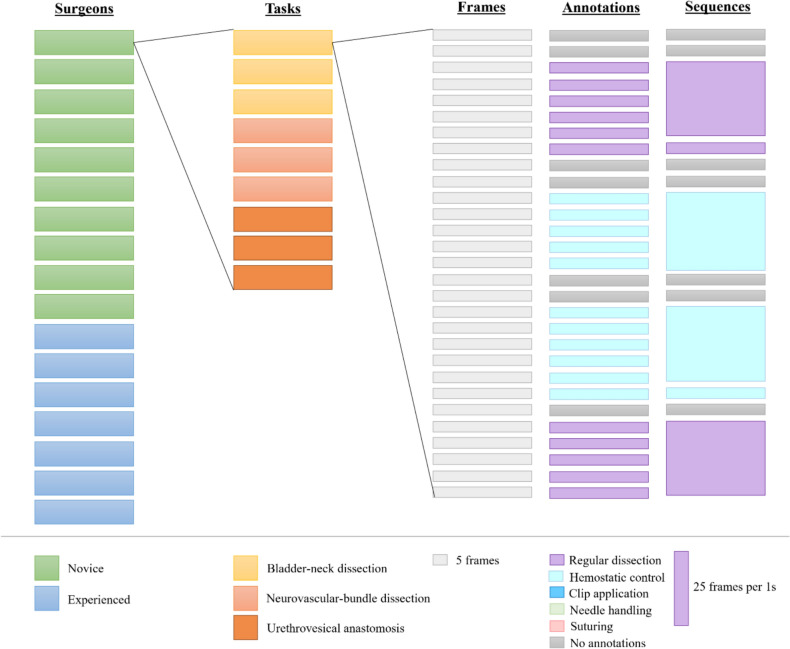 Figure 1
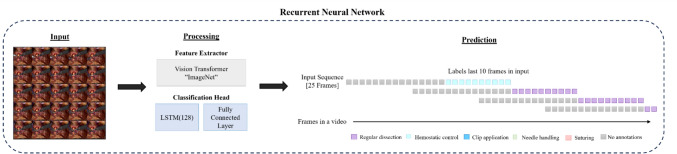 Figure 2
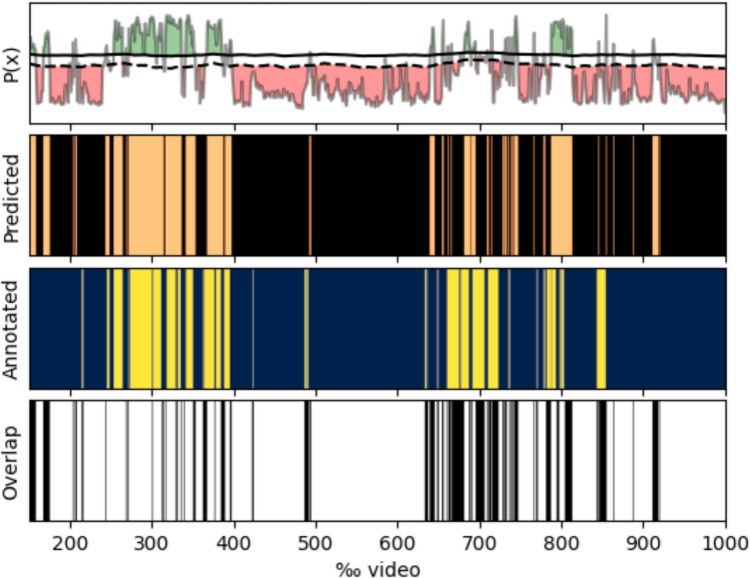 Figure 3
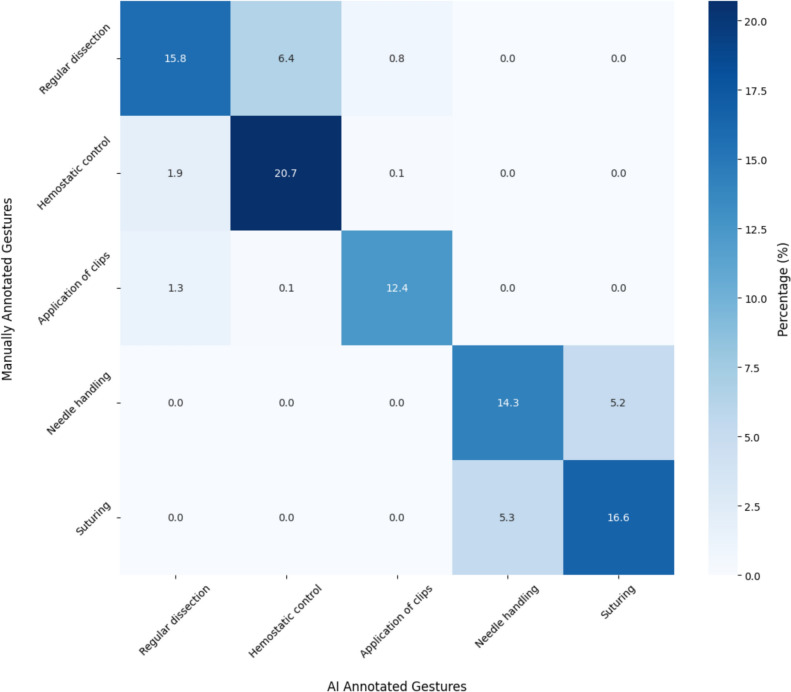 Figure 4
Peer Reviews
No public reviews on file for this paper yet. If you reviewed it on a platform where reviews are public (OpenReview, ICLR, NeurIPS, ICML), you can paste yours below so the community can read it here.
Videos
No videos yet. Explain this paper in a talk, walkthrough, or lecture? Add one.
Taxonomy
TopicsSurgical Simulation and Training · Anatomy and Medical Technology · Augmented Reality Applications