Neurocognitive impairment and patient-proxy agreement on health-related quality of life evaluations in recurrent high-grade glioma patients
Ivan Caramanna, Martin Klein, Martin van den Bent, Ahmed Idbaih, Martin J. B. Taphoorn, Linda Dirven, Thierry Gorlia, Jaap C. Reijneveld

TL;DR
This study examines how well proxies (like family members) can report on the quality of life of high-grade glioma patients compared to the patients themselves, especially when patients have neurocognitive impairments.
Contribution
The study provides new insights into patient-proxy agreement on HRQOL in HGG patients, highlighting the impact of neurocognitive status.
Findings
Patient-proxy agreement ranged from moderate to substantial, with CCC values between 0.231 and 0.811 for impaired patients.
Only 18.8% of patients were neurocognitively intact, emphasizing the importance of clinical and neurocognitive status in PRO assessments.
Results suggest that proxies can be relied upon, but differences between impaired and intact patients highlight the need for careful clinical consideration.
Abstract
The rate of missing data on patient-reported health-related quality of life (HRQOL) in brain tumor clinical trials is particularly high over time. One solution to this issue is the use of proxy (i.e. partner, relative, informal caregiver) ratings in lieu of patient-reported outcomes (PROs). In this study, we investigated patient-proxy agreement on HRQOL outcomes in high-grade glioma (HGG) patients. Generic and disease-specific HRQOL was assessed using the EORTC QLQ-C30 and QLQ-BN20 in a sample of 500 patient-proxy dyads participating in EORTC trials 26101 and 26091. Patients were classified as impaired or intact based on their neurocognitive performance. The level of patient-proxy agreement was measured using Lin’s concordance correlation coefficient (CCC), and the Bland–Altman limit of agreement. The Wilcoxon signed-rank test was used to evaluate differences between patients’ and…
Genes, proteins, chemicals, diseases, species, mutations and cell lines named across the full text — each resolved to its canonical identifier and authoritative record.
Click any figure to enlarge with its caption.
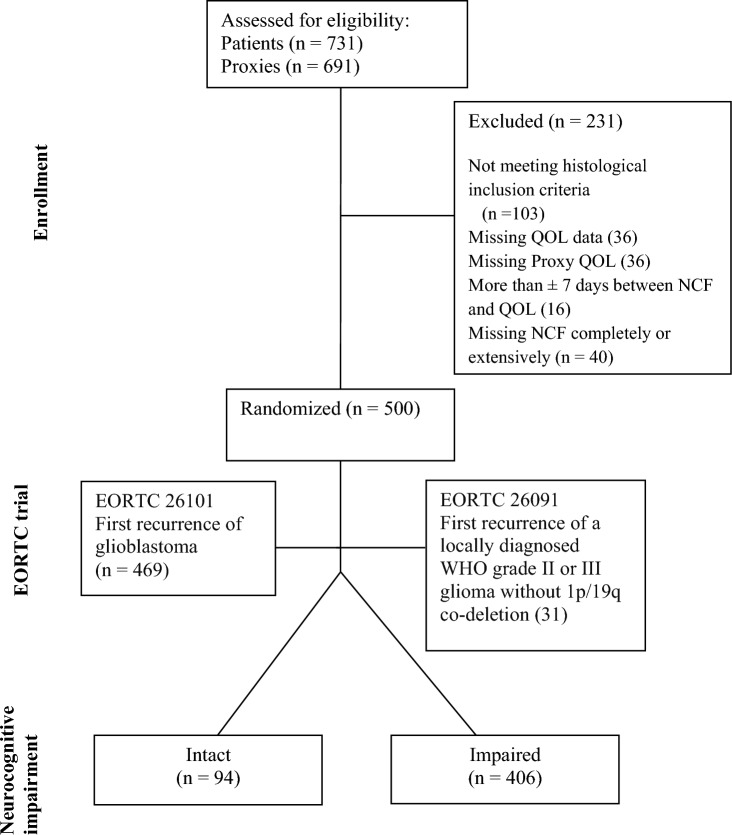 Figure 1
Peer Reviews
No public reviews on file for this paper yet. If you reviewed it on a platform where reviews are public (OpenReview, ICLR, NeurIPS, ICML), you can paste yours below so the community can read it here.
Videos
No videos yet. Explain this paper in a talk, walkthrough, or lecture? Add one.
Taxonomy
TopicsCancer-related cognitive impairment studies · Glioma Diagnosis and Treatment · Dementia and Cognitive Impairment Research