Digital pathways beyond Western-centric participants
Edmond Awad

TL;DR
This paper highlights the overrepresentation of Western participants in social science research and suggests digital tools to include more diverse global populations.
Contribution
The paper introduces and evaluates digital tools for broadening participant diversity in social science research.
Findings
Most studies in psychology still use WEIRD participants despite awareness of the issue.
Digital tools offer practical solutions to include non-Western participants in research.
Abstract
In 2010, Henrich and colleagues published a seminal article in which they noted that (1) studies in social and behavioural sciences oversample from Western, educated, industrialised, rich, and democratic (WEIRD) individuals, and (2) WEIRD subjects are particularly unusual compared to the rest of the world population with respect to several factors. Despite the positive reception of this article, not much has changed in the years to follow. For instance, reviews of recent papers in leading psychology journals reveal that only a small proportion of the studied samples originate from non-Western countries. This sampling bias cannot be excused for lack of means. The digital age has opened several opportunities to facilitate and support social science research with subjects from non-WEIRD backgrounds. In this article, I provide an overview of such tools and comment on the advantages and…
Genes, proteins, chemicals, diseases, species, mutations and cell lines named across the full text — each resolved to its canonical identifier and authoritative record.
Click any figure to enlarge with its caption.
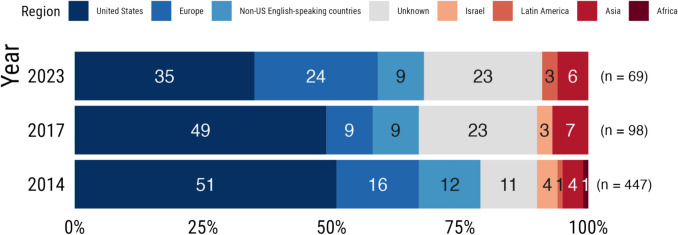 Figure 1
Peer Reviews
No public reviews on file for this paper yet. If you reviewed it on a platform where reviews are public (OpenReview, ICLR, NeurIPS, ICML), you can paste yours below so the community can read it here.
Videos
No videos yet. Explain this paper in a talk, walkthrough, or lecture? Add one.
Taxonomy
TopicsCultural Differences and Values · Social and Intergroup Psychology · Behavioral Health and Interventions