Longitudinal 12-Month Follow-Up of a Male Infant with CYP21A2 Compound Heterozygous Genotype in China: A Case Report
Yi Yin, Xinyue Huang, Yun Shi, Cheng Huang, Jian Yu, Qingsong Liu

TL;DR
A male infant with a rare genetic mutation causing congenital adrenal hyperplasia was effectively managed with early diagnosis and treatment, offering insights into genetic and clinical correlations.
Contribution
This case report highlights genotype-phenotype correlations in classic 21-hydroxylase deficiency and emphasizes the importance of early genetic diagnosis in neonatal care.
Findings
Early genetic diagnosis and immediate treatment improved clinical outcomes in a neonate with CYP21A2 compound heterozygous mutations.
Long-term management with hydrocortisone, fludrocortisone, and sodium chloride effectively controlled electrolyte and endocrine profiles.
The case underscores the need for comprehensive genetic diagnostics in managing rare endocrine disorders in infancy.
Abstract
Congenital adrenal hyperplasia (CAH), predominantly caused by 21-hydroxylase deficiency (21-OHD), arises from mutations in CYP21A2 . This frequently occurs via gene conversion events between CYP21A2 and its pseudogene, leading to impaired 21-hydroxylase activity and subsequent CAH manifestations. We encountered a case of classic CAH, characterized by electrolyte imbalances (hyponatremia: 125.10 mmol/L; hyperkalemia: 7.06 mmol/L), hyperpigmentation, and markedly elevated endocrine marker levels (17-hydroxyprogesterone: 319.91 nmol/L; adrenocorticotropic hormone: 611.00 pg/mL) in a male neonate. Through genetic diagnostics, we identified a maternal-derived deletion of CYP21A2 exons 1–7 combined with paternal-originated compound heterozygous mutations (c.293-13A/C>G in intron 2 and c.332_339 deletion in exon 3). Implementation of early genetic diagnosis revealed 21-OHD, and immediate…
Genes, proteins, chemicals, diseases, species, mutations and cell lines named across the full text — each resolved to its canonical identifier and authoritative record.
Click any figure to enlarge with its caption.
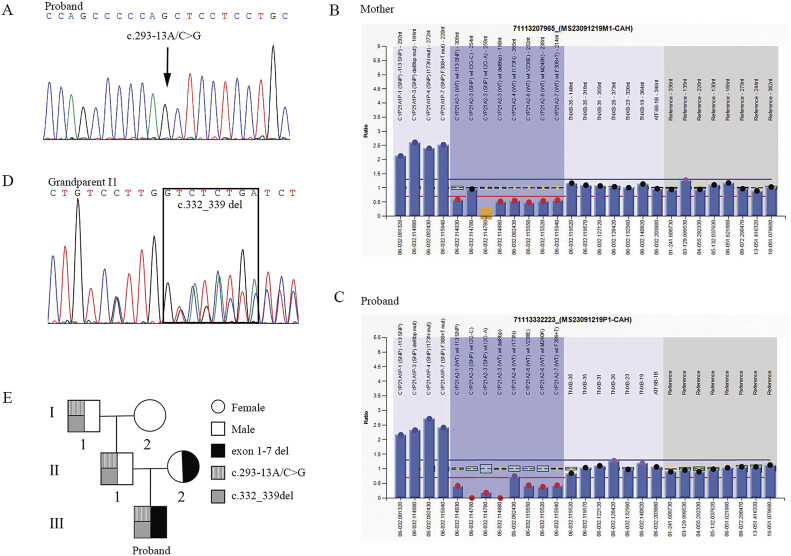 Figure 1
Peer Reviews
No public reviews on file for this paper yet. If you reviewed it on a platform where reviews are public (OpenReview, ICLR, NeurIPS, ICML), you can paste yours below so the community can read it here.
Videos
No videos yet. Explain this paper in a talk, walkthrough, or lecture? Add one.
Taxonomy
TopicsHormonal Regulation and Hypertension · Vitamin D Research Studies