A 20-month longitudinal study to evaluate humoral and cellular immunity after COVID-19 vaccines
Wlademir Braga Salgado Sobrinho, Bárbara Batista Salgado, Aguyda Rayany Cavalcante Barbosa, Vanessa Araújo Passos, Lisvane Paes Vieira, Lhorruama Dias do Nascimento, Jaila Dias Borges Lalwani, Pritesh Jaychand Lalwani, Paulo Afonso Nogueira

TL;DR
This study tracked immune responses over 20 months in people who received different COVID-19 vaccines and a Pfizer booster, finding that antibody levels lasted longer than cellular immunity, especially in those who initially got Sinovac.
Contribution
The study provides a detailed 20-month comparison of humoral and cellular immunity after different primary vaccination regimens and a Pfizer booster.
Findings
Anti-Spike IgG levels remained elevated for up to six months after the Pfizer booster in both groups.
The Sinovac-CoronaVac + Pfizer group showed a significant decline in IFNγ-producing cells compared to the AstraZeneca-Oxford + Pfizer group.
Over half of the Sinovac-CoronaVac + Pfizer group had no detectable cellular response by the final time point.
Abstract
The effectiveness of coronavirus disease 2019 (COVID-19) vaccines is well established; however, the long-term durability of vaccine-induced immunity remains to be fully elucidated. This study longitudinally compared humoral and cellular immune responses in two groups: G1, who received two doses of Sinovac-CoronaVac, and G2, who received two doses of AstraZeneca-Oxford, both subsequently boosted with Pfizer. Immune responses were assessed at five time points: P1 (prior to the second dose), P2 (90-180 days after the second dose), P3 (pre-booster, six-eight months post-second dose), P4 (90-180 days post-booster), and P5 (180-270 days post-booster). Anti-Spike severe acute respiratory syndrome coronavirus 2 (SARS-CoV-2) IgG levels were measured by enzyme-linked immunosorbent assay (ELISA), while IFNγ-producing cells in response to Spike peptides were quantified using enzyme-linked immune…
Genes, proteins, chemicals, diseases, species, mutations and cell lines named across the full text — each resolved to its canonical identifier and authoritative record.
Click any figure to enlarge with its caption.
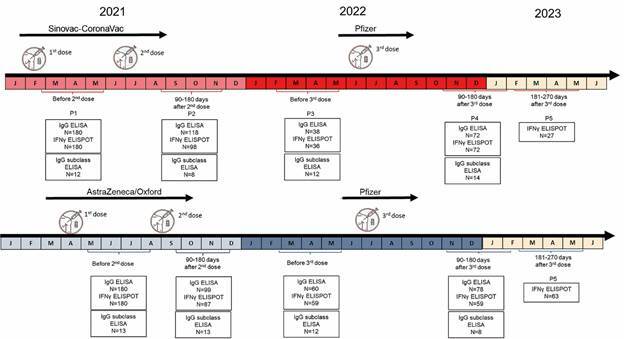 Figure 1
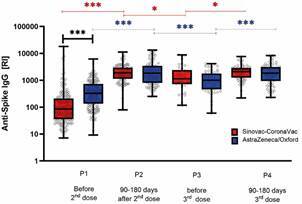 Figure 2
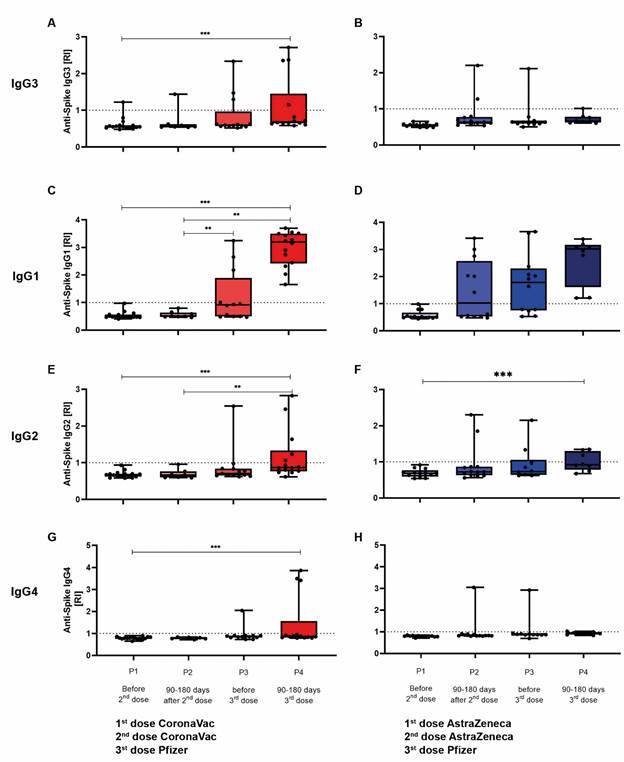 Figure 3
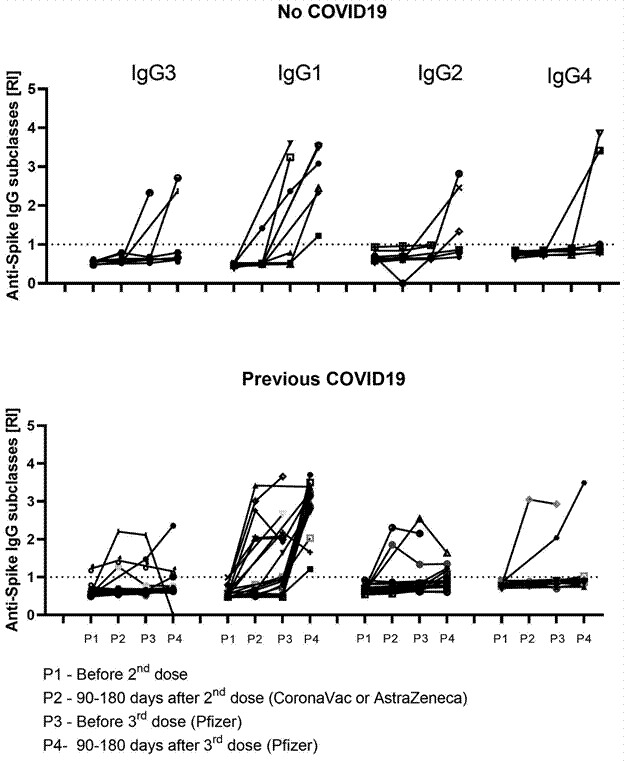 Figure 4
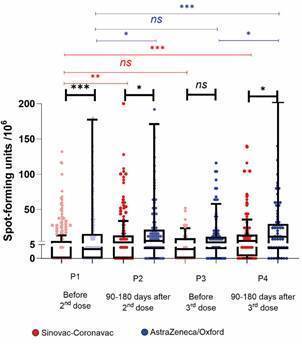 Figure 5
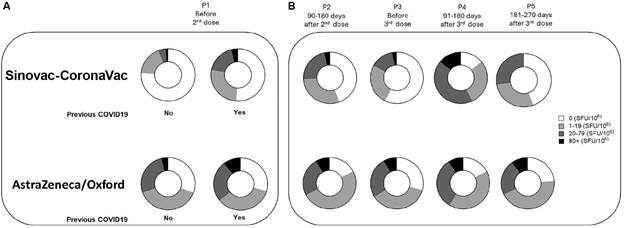 Figure 6
Peer Reviews
No public reviews on file for this paper yet. If you reviewed it on a platform where reviews are public (OpenReview, ICLR, NeurIPS, ICML), you can paste yours below so the community can read it here.
Videos
No videos yet. Explain this paper in a talk, walkthrough, or lecture? Add one.
Taxonomy
TopicsSARS-CoV-2 and COVID-19 Research · COVID-19 Clinical Research Studies · Bacterial Infections and Vaccines