Certain vs. uncertain actionable secondary findings in a cohort of 500 Lebanese participants: What to report to the patient?
Eileen Marie Hanna, Cybel Mehawej, Yazid Hoblos, Kelven Rahy, Andre Megarbane, Eliane Chouery

TL;DR
This study examines genetic data from 500 Lebanese individuals to determine which secondary findings should be reported to patients, highlighting inconsistencies between classification systems.
Contribution
The study reveals significant discrepancies between ACMG/AMP and ClinVar classifications in a Lebanese cohort, emphasizing the need for harmonization in variant databases.
Findings
Secondary findings were identified in 16.8% of cases using ACMG/AMP criteria, but only 6% using ClinVar.
Cardiovascular disease variants were most common, with 6.6% under ACMG/AMP and 2% under ClinVar.
The study highlights ethical challenges in reporting variants due to inconsistencies between classification systems.
Abstract
Advances in next-generation sequencing enabled its integration into genetic diagnosis and have led to the uncovering of secondary findings. In this paper, we analyzed 500 Lebanese participants for pathogenic and likely-pathogenic variants in 81 recommended genes listed by the American College of Medical Genetics (ACMG). In this retrospective study, 500 individuals seeking genetic diagnosis through Exome Sequencing were included. Variants were analyzed and their pathogenicity assessed based on ACMG/AMP criteria and ClinVar. Secondary findings were identified in 16.8% of cases based on ACMG/AMP criteria, which decreased to 6% when relying on ClinVar. Dominant cardiovascular disease variants were predominant, constituting 6.6% based on ACMG/AMP assessments and 2% according to ClinVar. Additionally, using ACMG/AMP criteria, dominant oncogenic variants were identified in 4.2% of individuals,…
Genes, proteins, chemicals, diseases, species, mutations and cell lines named across the full text — each resolved to its canonical identifier and authoritative record.
Click any figure to enlarge with its caption.
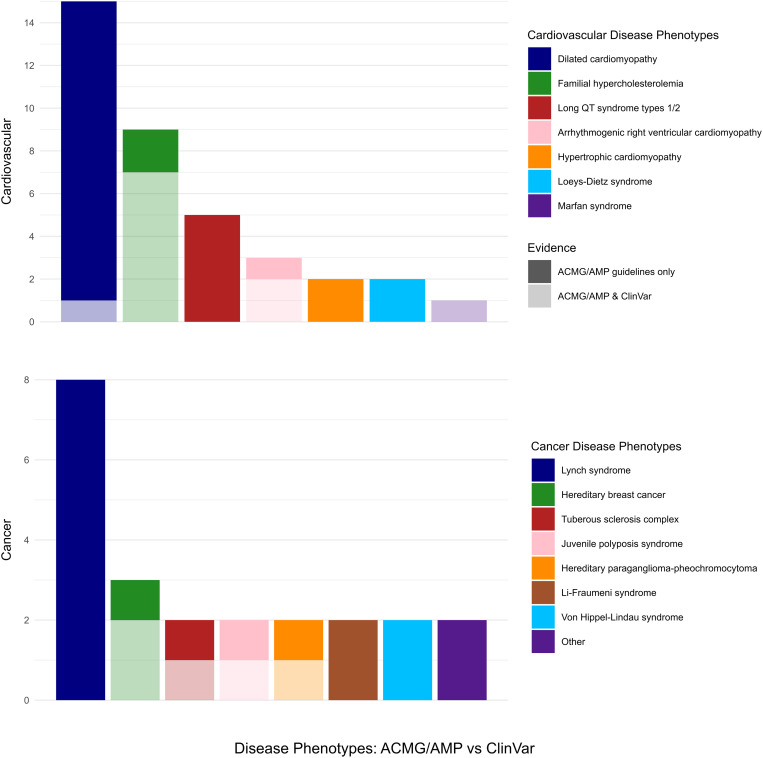 Figure 1
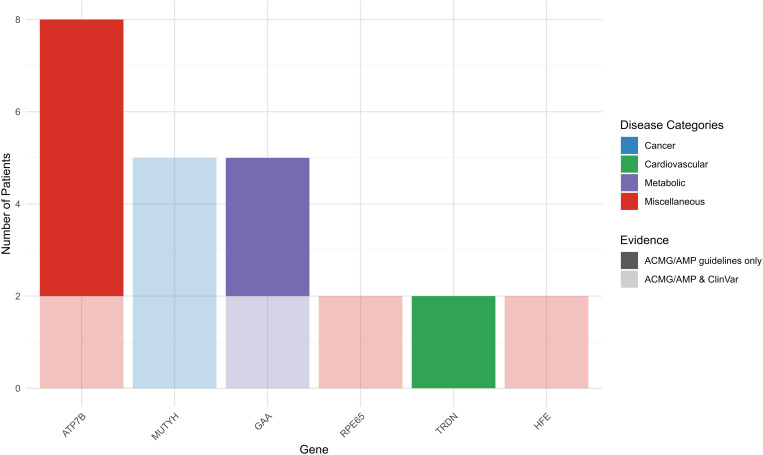 Figure 2
 Figure 3
Peer Reviews
No public reviews on file for this paper yet. If you reviewed it on a platform where reviews are public (OpenReview, ICLR, NeurIPS, ICML), you can paste yours below so the community can read it here.
Videos
No videos yet. Explain this paper in a talk, walkthrough, or lecture? Add one.
Taxonomy
TopicsGenomics and Rare Diseases · BRCA gene mutations in cancer · Genetic Associations and Epidemiology