Bending the curve: Modeling the impact of reducing risk factors for noncommunicable diseases to control future health expenditures in Latin America and the Caribbean
Andres I. Vecino-Ortiz, Timothy Roberton, Angelica López-Hernández, Caitlin M. Noonan, Angela P. Vega Landaeta, Daniel Maceira, Yvonne N. Flores, Claudio A. Mora-García, Paulina Giusti, T. Alafia Samuels, Natalia Palacio-Martínez, Andrea Prado, Carla Machado, Charmaine Metivier

TL;DR
This study models how reducing risk factors for noncommunicable diseases could save billions in health expenditures in Latin America and the Caribbean by 2050.
Contribution
The paper quantifies the financial impact of reducing NCD risk factors on health expenditures in 24 LAC countries for the first time.
Findings
Reducing high blood pressure prevalence by 10% could save $59 billion in cumulative health expenditures by 2050.
Addressing four NCD risk factors could save $185 billion cumulatively by 2050 across all LAC countries.
The impact of reducing risk factors on health expenditures is small relative to total spending but significant in absolute terms.
Abstract
Addressing the World Health Organization’s noncommunicable disease (NCD) “best buys” is key to reducing the disease burden in Latin America and the Caribbean (LAC). Yet, the potential impact of addressing NCD risk factors on current health expenditures (CHE) in LAC countries is unknown. This study uses both Global Burden of Disease (GBD) data and administrative information to model the impact of addressing four risk factors on CHE trends for 24 LAC countries. A comparative risk assessment model estimates changes in CHE associated with reducing five NCDs. Reducing the prevalence of the four risk factors by 10% could save $ 185 billion in cumulative expenditure by 2050 (1.32% of cumulative expenditure from 2020 to 2050) for all LAC countries assessed, with substantial heterogeneity across risk factors. Reducing the prevalence of high blood pressure had the largest impact. On average, a…
Genes, proteins, chemicals, diseases, species, mutations and cell lines named across the full text — each resolved to its canonical identifier and authoritative record.
Click any figure to enlarge with its caption.
 Figure 1
 Figure 2
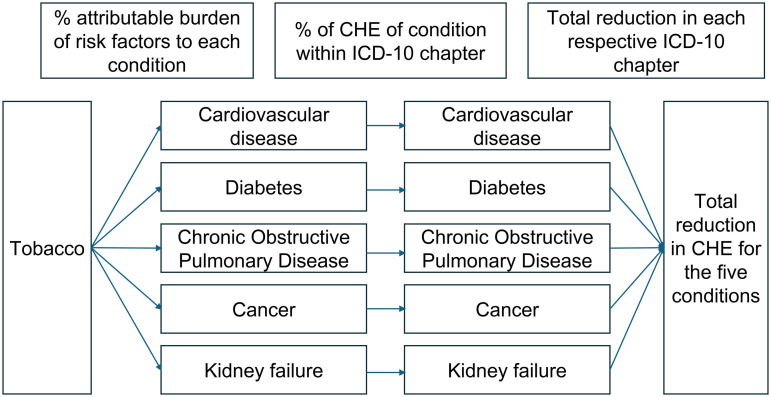 Figure 3
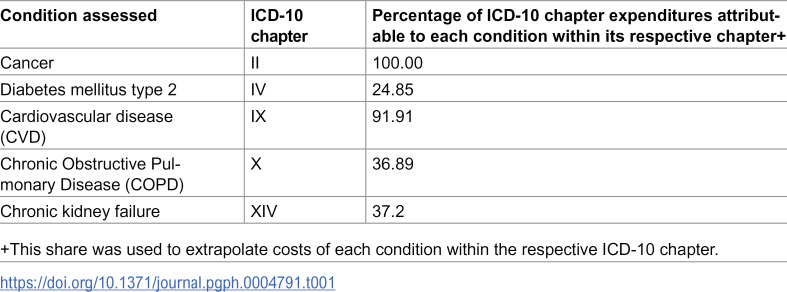 Figure 4
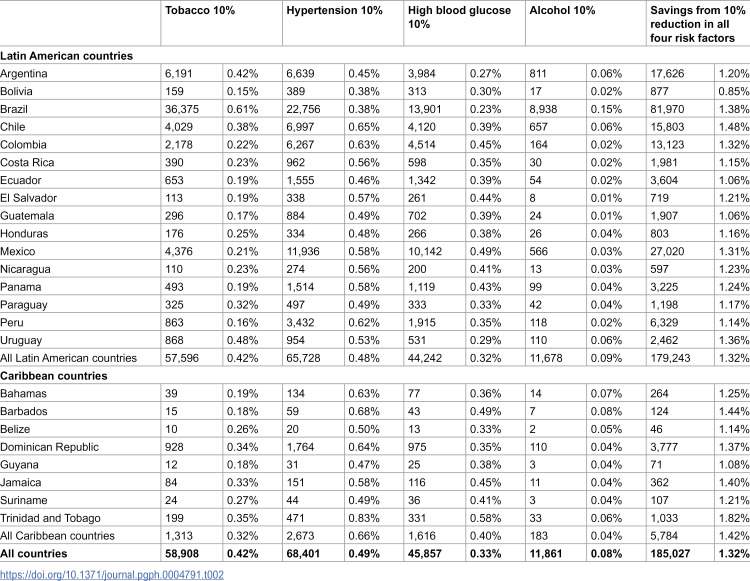 Figure 5
 Figure 6
Peer Reviews
No public reviews on file for this paper yet. If you reviewed it on a platform where reviews are public (OpenReview, ICLR, NeurIPS, ICML), you can paste yours below so the community can read it here.
Videos
No videos yet. Explain this paper in a talk, walkthrough, or lecture? Add one.
Taxonomy
TopicsGlobal Public Health Policies and Epidemiology · Global Health Care Issues · Health disparities and outcomes