Neglected Lunate Dislocation: A Case Report on Successful Management With Open Reduction and Internal Fixation
Mohammed Ali, Ahmed Alazzawi, Mohammed A Alwatari, Abdullah Zalzala, Mohammed Alghannami

TL;DR
A 65-year-old man with a missed wrist injury was successfully treated with surgery six months after the initial injury.
Contribution
This case highlights successful surgical treatment of a delayed lunate dislocation diagnosis.
Findings
Radiographs and CT confirmed a neglected volar lunate dislocation.
Surgical ORIF with Kirschner wires led to pain relief and improved wrist function.
Favorable outcomes are possible even with delayed surgical intervention.
Abstract
Lunate dislocations are often underdiagnosed wrist injuries that typically result from a fall onto an outstretched hand. If left untreated, they may lead to significant functional impairment. We report the case of a 65-year-old man who presented with persistent wrist pain six months after a fall. The initial diagnosis was missed. Radiographs and computed tomography (CT) revealed a neglected volar lunate dislocation. Surgical management with open reduction and internal fixation (ORIF) using Kirschner wires was performed under regional anesthesia. The patient experienced substantial pain relief and improved wrist function postoperatively. This case underscores the importance of early diagnosis and surgical intervention while demonstrating that favorable outcomes can still be achieved in delayed presentations.
Genes, proteins, chemicals, diseases, species, mutations and cell lines named across the full text — each resolved to its canonical identifier and authoritative record.
Click any figure to enlarge with its caption.
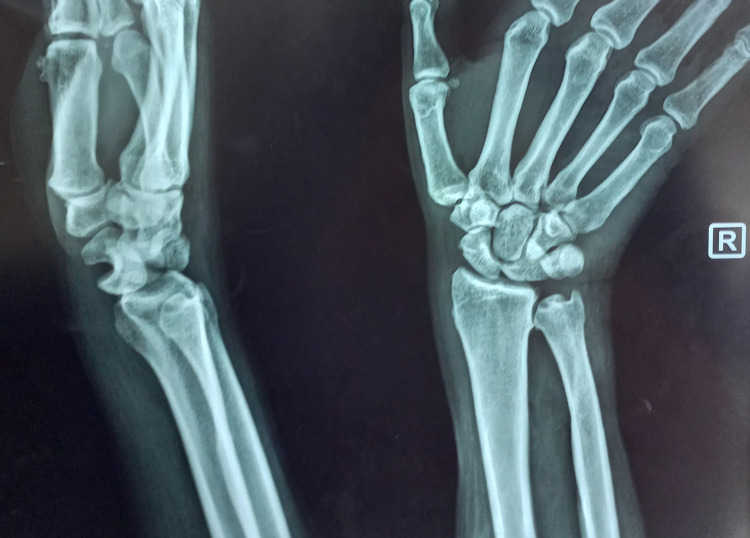 Figure 1
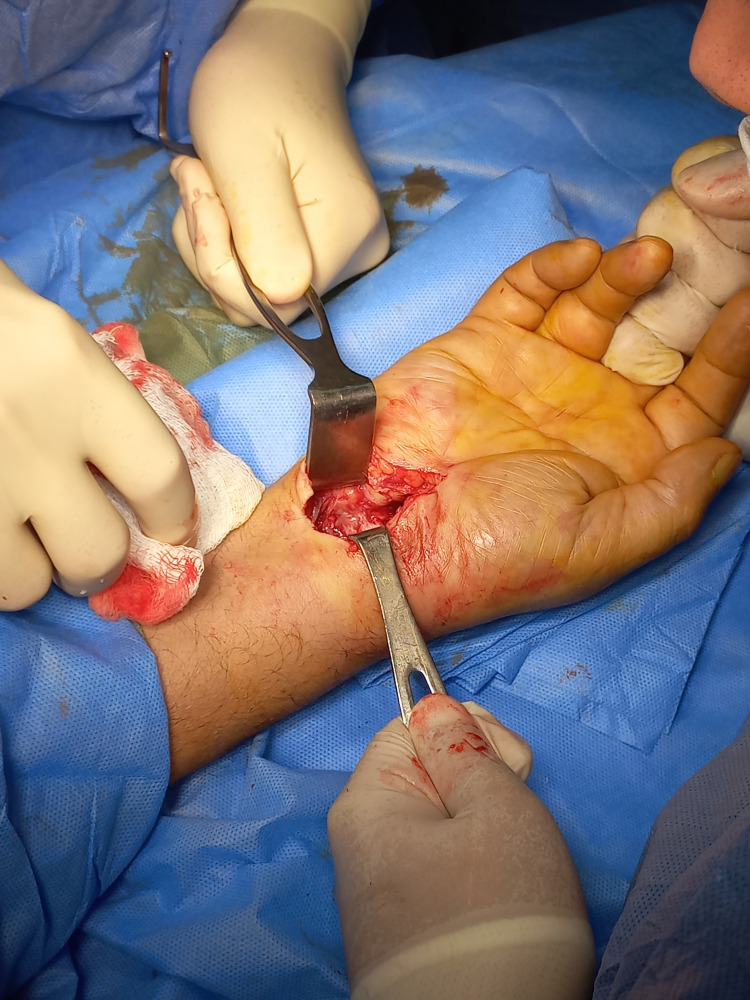 Figure 2
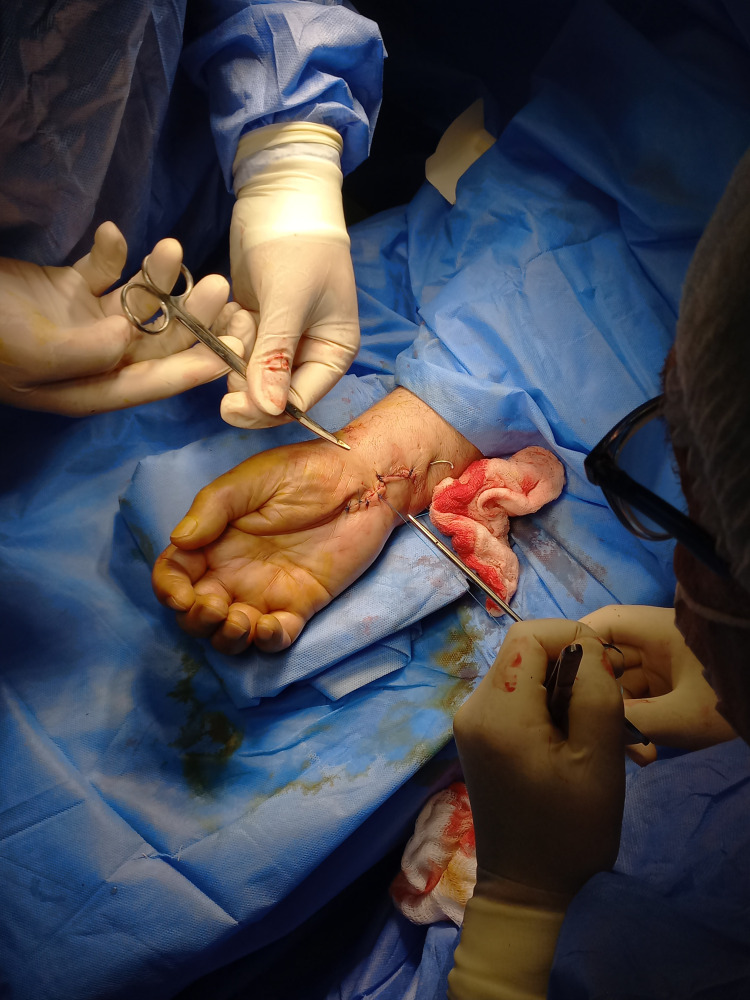 Figure 3
Peer Reviews
No public reviews on file for this paper yet. If you reviewed it on a platform where reviews are public (OpenReview, ICLR, NeurIPS, ICML), you can paste yours below so the community can read it here.
Videos
No videos yet. Explain this paper in a talk, walkthrough, or lecture? Add one.
Taxonomy
TopicsOrthopedic Surgery and Rehabilitation · Traumatic Ocular and Foreign Body Injuries · Facial Trauma and Fracture Management
Introduction
Lunate dislocations are relatively uncommon injuries in acute wrist trauma. Literature suggests that 7% of all carpal injuries involve the lunate, and only 3% are classified as volar lunate dislocations. Misdiagnosis occurs in approximately 25% of cases [1,2].
The typical mechanism involves a fall onto a hyperextended wrist with the forearm supinated. Mayfield et al. described a four-stage progression of carpal instability: beginning with scapholunate dissociation, followed by perilunate dislocation, midcarpal dislocation, and finally, lunate dislocation, the rarest and most severe stage [3].
Management of lunate dislocation remains controversial and largely dependent on physician preference. Options include closed reduction, ligamentous repair with open reduction and internal fixation (ORIF), proximal row carpectomy, and wrist arthrodesis in chronic cases [4,5].
Case presentation
A 65-year-old man presented with persistent wrist pain lasting three months following a fall onto an outstretched hand. Initially misdiagnosed in the emergency department, his primary complaint was ongoing wrist pain without noticeable limitations in movement. Clinical examination revealed tenderness but preserved range of motion.
The posteroanterior radiograph demonstrated a break in Gilula's arc and the lateral radiograph demonstrated the classic “spilled teacup” sign, indicative of a neglected lunate dislocation (Figure 1).
Preoperative posteroanterior radiograph showing disruption of Gilula’s arc, and lateral view demonstrating the “spilled teacup” sign.
The patient underwent ORIF under regional anesthesia due to comorbidities (Figure 2).
Intraoperative image during open reduction.
The lunate was anatomically repositioned and stabilized using Kirschner wires with minimal incision (Figure 3).
Postoperative image showing Kirschner wire fixation through a minimal incision.
The postoperative course was uneventful. The patient reported significant pain relief and improved wrist function. At 12-month follow-up, the patient had achieved satisfactory functional recovery, with an overall recovery time of approximately eight months. These outcomes are consistent with previous reports [6,7].
Discussion
Lunate dislocations are frequently misdiagnosed, with up to 25% of cases initially missed [1,2]. The most critical factor in the misdiagnosis is the lack of clinical experience; other contributing factors include inadequate radiographs and suboptimal imaging techniques [8].
Early diagnosis and intervention are essential, as neglected lunate dislocations can lead to complications such as median nerve compression, carpal instability, avascular necrosis, complex regional pain syndrome, post-traumatic arthritis, and poor functional outcomes [9,10].
Ligament restoration plays a crucial role in re-establishing wrist stability and preventing long-term instability [9]. In the present case, fortunately, no ligamentous injuries were identified. ORIF can be performed using either a volar, dorsal, or combined (dual) approach [10]. In this case, a volar approach was utilized.
Despite delayed presentation, ORIF with Kirschner wires can yield favorable results. In our case, the procedure performed six months post-injury led to significant improvement, reaffirming the importance of anatomical reduction and stabilization in achieving functional recovery. Excellent outcomes following delayed presentation have also been documented in several other studies [6,7].
Alternative treatment modalities for chronic lunate dislocation include, firstly, staged external fixation, which facilitates realignment and soft tissue stretching prior to definitive surgery. Another option is proximal row carpectomy, considered when reduction is unfeasible or in the presence of arthritis, provided joint surfaces are preserved. A further option is wrist arthrodesis, which offers pain relief and joint stability but results in loss of mobility, making it less acceptable to some patients [6,7,10].
Conclusions
Volar lunate dislocations are rare and frequently misdiagnosed injuries that require a high index of suspicion and proper imaging for timely diagnosis. Even in delayed cases, surgical management with ORIF can achieve favorable functional outcomes. This case highlights the importance of individualized surgical planning and reinforces the viability of ORIF in chronic lunate dislocations. Volar lunate dislocations are rare and frequently misdiagnosed injuries that require a high index of suspicion and proper imaging for timely diagnosis. Even in delayed cases, surgical management with open reduction and internal fixation can achieve favorable functional outcomes. This case highlights the importance of individualized surgical planning and reinforces the viability of ORIF in chronic lunate dislocations.
The reference list from the paper itself. Each links out to its DOI / PubMed record.
- 1An unusual localization of lunate in a transcaphoid volar lunate dislocation: current concepts Case Rep Orthop Kastanis G Velivasakis G Pantouvaki A Spyrantis M 7207856201920193138013410.1155/2019/7207856 PMC 6657645 · doi ↗ · pubmed ↗
- 2Perilunate injuries Hand (N Y) Najarian R Nourbakhsh A Capo J Tan V 17620112237943210.1007/s 11552-010-9293-5PMC 3041883 · doi ↗ · pubmed ↗
- 3Carpal dislocations: pathomechanics and progressive perilunar instability J Hand Surg Am Mayfield JK Johnson RP Kilcoyne RK 22624151980740056010.1016/s 0363-5023(80)80007-4 · doi ↗ · pubmed ↗
- 4Trans-scaphoid lunate dislocation: a case series Radiol Case Rep Gjeluci A Raskind A Dwan B Yasin L Allam E 5145201720223497625610.1016/j.radcr.2021.11.033PMC 8688966 · doi ↗ · pubmed ↗
- 5Lunate dislocation with avulsed triquetral fracture: a case report World J Clin Cases Li LY Lin CJ Ko CY 3313371020223507153610.12998/wjcc.v 10.i 1.331PMC 8727270 · doi ↗ · pubmed ↗
- 6Functional outcome of neglected perilunate dislocations treated with open reduction and internal fixation Indian J Orthop Dhillon MS Prabhakar S Bali K Chouhan D Kumar V 4274314520112188692410.4103/0019-5413.83138 PMC 3162679 · doi ↗ · pubmed ↗
- 7A novel surgical technique for neglected volar dislocation of the lunate: cases report and literature review Orthop Surg Kang SH Park HW Im JH 192019251520233725425110.1111/os.13760 PMC 10350377 · doi ↗ · pubmed ↗
- 8Lack of experience is a significant factor in the missed diagnosis of perilunate fracture dislocation or isolated dislocation Acta Orthop Traumatol Turc Çolak I Bekler HI Bulut G Eceviz E Gülabi D Çeçen GS 32365220182919854610.1016/j.aott.2017.04.002PMC 6136336 · doi ↗ · pubmed ↗