Paradoxical psoriasiform alopecia secondary to secukinumab: a case report
Inés Segovia Rodríguez, María Castillo Gutiérrez, Fernando Pinedo-Moraleda, Beatriz Aranegui Arteaga

Abstract
Genes, proteins, chemicals, diseases, species, mutations and cell lines named across the full text — each resolved to its canonical identifier and authoritative record.
Click any figure to enlarge with its caption.
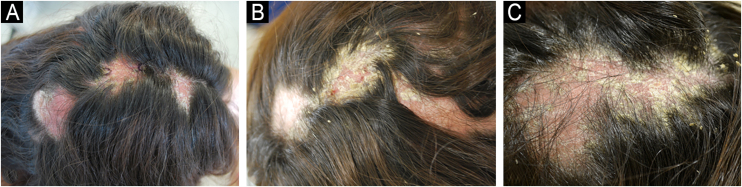 Figure 1
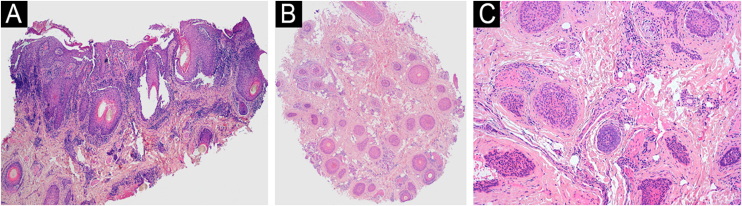 Figure 2
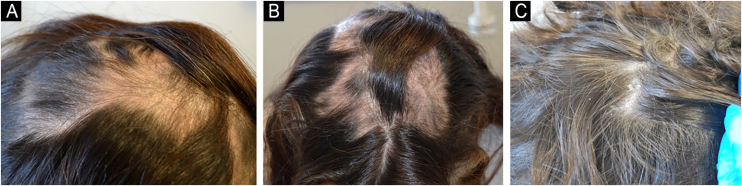 Figure 3
Peer Reviews
No public reviews on file for this paper yet. If you reviewed it on a platform where reviews are public (OpenReview, ICLR, NeurIPS, ICML), you can paste yours below so the community can read it here.
Videos
No videos yet. Explain this paper in a talk, walkthrough, or lecture? Add one.
Taxonomy
TopicsPsoriasis: Treatment and Pathogenesis · Autoimmune and Inflammatory Disorders · Hair Growth and Disorders
Dear Editor,
Psoriasis is a chronic immune-mediated disease that can often be associated with other immune-regulated pathologies. One of these is hidradenitis suppurativa, which has been observed to increase the risk of psoriasis by 3.24 times compared to the general population (95% IC 2.27‒4.62).1
The development of biological therapies has enabled the treatment of both conditions. Currently, adalimumab, a monoclonal antibody against Tumor Necrosis Factor-alfa (TNF-α), and secukinumab, an antibody targeting Interleukin (IL) 17A, is approved for the treatment of both diseases. Both are generally safe and well-tolerated, but they may cause adverse effects, such as paradoxical reactions.
We present the case of a 42-year-old woman diagnosed with Hurley II stage hidradenitis suppurativa and long-standing plaque psoriasis affecting the scalp, armpits, inframammary folds, and genital area. She had received multiple systemic treatments for hidradenitis control with insufficient results, including antibiotics (doxycycline and rifampicin-clindamycin combination) and retinoids (isotretinoin and acitretin). Psoriasis lesions were primarily managed with topical treatments, achieving partial control.
To address both conditions, biological therapy with adalimumab was initiated, achieving a good initial response. However, after a year, the treatment lost effectiveness in controlling hidradenitis suppurativa, prompting a switch to secukinumab in December 2022.
Three months after starting secukinumab, the patient experienced a significant worsening of psoriasis, with widespread lesions and two large erythematous and keratotic plaques on the scalp (occipital and parietal regions) with follicular pustules and areas suggesting fluctuation. Differential diagnosis included folliculitis decalvans, dissecting cellulitis, and other causes of cicatricial alopecia (Fig. 1). Biopsies were performed on both plaques, and samples were taken for bacterial and fungal cultures.Figure 1. Large plaques on the scalp, in the occipital and parietal regions, initially more erythematous (A), which developed significant hyperkeratosis (B and C).Figure 1
Given this clinical deterioration, secukinumab was discontinued, and therapy was switched to guselkumab, an IL-23 inhibitor. Additionally, treatment with fluocinolone acetonide and framycetin cream, as well as oral doxycycline for three months, was prescribed.
Histopathological analysis of the biopsies, processed in vertical and horizontal sections, revealed a significant increase in the telogen and vellus indices. Loss and atrophy of sebaceous glands, infundibular dilation with thinning of the follicular epithelium, and a dense perifollicular lymphocytic inflammatory infiltrate were observed without interface involvement. The epidermis exhibited psoriasiform acanthosis and parakeratosis. These histological findings were consistent with psoriatic alopecia (Fig. 2). Cultures were negative.Figure 2. Hematoxylin & eosin histopathology: (A) Vertical section showing psoriasiform hyperplasia, parakeratosis, and a dense lymphoplasmacytic inflammatory infiltrate (×40); (B) Horizontal section showing preservation of follicular units and an increase in the telogen index (×40); (C) Atrophy of sebaceous glands (×100).Figure 2
After the treatment, the patient showed significant improvement in both conditions, including complete regrowth of alopecic plaques on the scalp, with no signs of psoriasis except for minimal residual scaling (Fig. 3).Figure 3. Partial regrowth of psoriatic alopecia plaques after 2 months of guselkumab treatment (A and B). Complete regrowth after 5 months of treatment (C).Figure 3
Paradoxical reactions involve the onset or worsening of immune-mediated diseases due to the use of monoclonal antibodies. The main paradoxical psoriasiform reactions to biological treatment include palmoplantar psoriasis (42.9%), plaque psoriasis (14.7%) and scalp psoriasis (7%).2
Paradoxical psoriasiform alopecia is an emerging and poorly understood type of paradoxical reaction described in recent years. It has been reported more frequently with anti-TNF-α drugs, with few cases documented with IL-17 and IL-12/23 inhibitors.3, 4, 5, 6, 7 Psoriasiform alopecia can be histologically distinguished from other types of alopecia by sebaceous gland atrophy.8 This is a controversial issue, as some authors accept it might be possible to distinguish this condition from primary psoriatic alopecia by the presence of eosinophils and plasma cells in the inflammatory infiltrate. Meanwhile, other authors stand up for the same spectrum of diseases, with similar histopathological findings on skin biopsies.9 Cases of permanent alopecia have been described in patients with paradoxical scalp psoriasis.5, 8
It is recommended to consider discontinuing the causative drug to prevent progression to cicatricial alopecia, especially in severe cases unresponsive to conservative measures.10 However, the decision to suspend treatment should be individualized based on the risk-benefit ratio and the severity of the alopecia.
In this case, the temporal sequence, clinical findings, and histopathological features led us to a paradoxical psoriasiform alopecia diagnosis induced by IL-17 inhibitors (secukinumab). This is one of the few cases reported in the literature, demonstrating a very good response after discontinuing secukinumab and initiating guselkumab therapy.
Financial support
None declared.
Authors' contributions
Inés Segovia Rodríguez: Original draft preparation, review, editing, read and agreed to the published version of the manuscript.
María Castillo Gutiérrez: Original draft preparation, review and editing, read and agreed to the published version of the manuscript.
Fernando Pinedo Moraleda: Original draft preparation, supervision, review and editing, read and agreed to the published version of the manuscript.
Beatriz Aranegui Arteaga: Conceptualization, methodology, supervision, review, editing, read and agreed to the published version of the manuscript.
Conflicts of interest
None declared.
The reference list from the paper itself. Each links out to its DOI / PubMed record.
- 1Gau S.Y.Preclaro I.A.C.Wei J.C.Lee C.Y.Kuan Y.H.Hsiao Y.P.Risk of psoriasis in people with hidradenitis suppurativa: a systematic review and meta-analysis Front Immunol 132022103384410.3389/fimmu.2022.1033844 PMC 975204636532043 · doi ↗ · pubmed ↗
- 2Megna M.De Lucia M.Gallo L.Lauro W.Picone V.Fabbrocini G.Psoriatic alopecia and paradoxical psoriasis induced by adalimumab successfully treated with certolizumab: clinical, trichoscopic, and in vivo reflectance confocal microscopy features Skin Appendage Disord 920232072103732528210.1159/000527985 PMC 10264901 · doi ↗ · pubmed ↗
- 3Munera-Campos M.Ballesca F.Carrascosa J.M.Paradoxical reactions to biologic therapy in psoriasis: a review of the literature Actas Dermosifiliogr (Engl Ed)10920187918002990346410.1016/j.ad.2018.04.003 · doi ↗ · pubmed ↗
- 4Yajima M.Akeda T.Kondo M.Habe K.Yamanaka K.Alopecia diffusa while using interleukin-17 inhibitors against psoriasis vulgaris Case Rep Dermatol 11201982853109793410.1159/000499030 PMC 6489098 · doi ↗ · pubmed ↗
- 5Tan T.L.Taglia L.Yazdan P.Drug-induced psoriasiform alopecia associated with interleukin- 17 inhibitor therapy J Cutan Pathol 4820217717743338976710.1111/cup.13952 · doi ↗ · pubmed ↗
- 6Tirelli L.L.Alfaro A.Citera G.Echeverría C.M.Nonscarring alopecia secondary to secukinumab Actas Dermosifiliogr 1132022101110133546185310.1016/j.ad.2022.01.036 · doi ↗ · pubmed ↗
- 7Mihailescu M.Cibull T.Joyce J.Development of drug-induced psoriasiform alopecia in a pediatric patient on ustekinumab J Cutan Pathol 482021152315253441814410.1111/cup.14122 · doi ↗ · pubmed ↗
- 8Afanasiev O.K.Zhang C.Z.Ruhoy S.M.TNF-inhibitor associated psoriatic alopecia: diagnostic utility of sebaceous lobule atrophy J Cutan Pathol 4420175635692833223310.1111/cup.12932 · doi ↗ · pubmed ↗