Correction to: Functional connectivity signatures of political ideology

Abstract
Click any figure to enlarge with its caption.
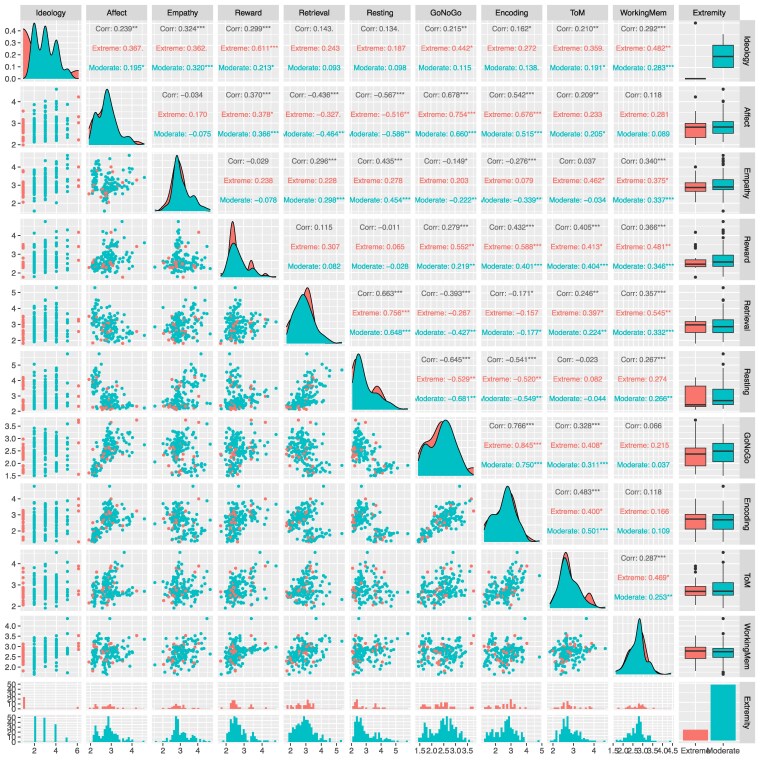 Figure 1
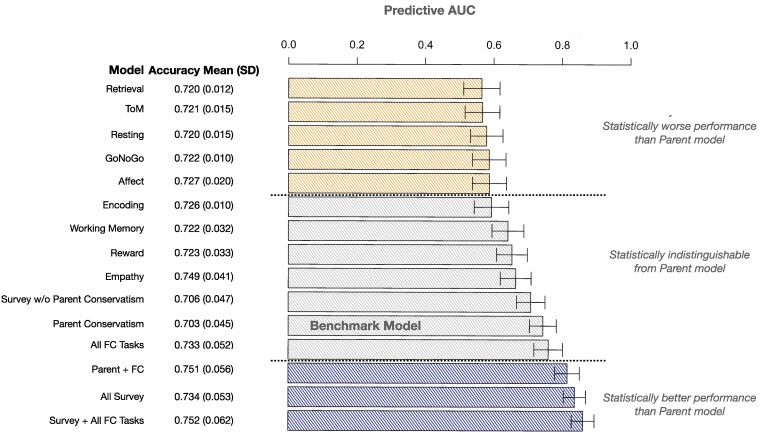 Figure 2
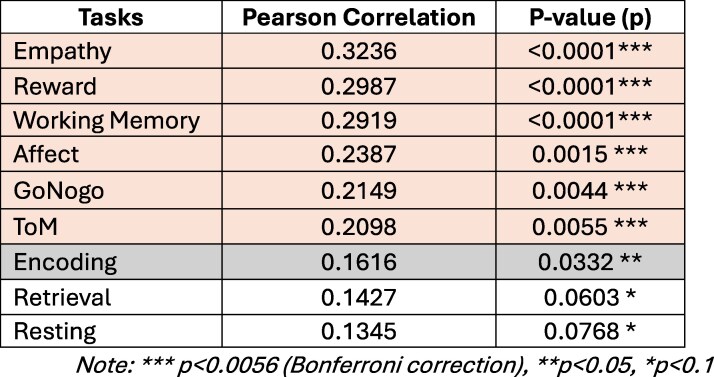 Figure 3
Peer Reviews
No public reviews on file for this paper yet. If you reviewed it on a platform where reviews are public (OpenReview, ICLR, NeurIPS, ICML), you can paste yours below so the community can read it here.
Videos
No videos yet. Explain this paper in a talk, walkthrough, or lecture? Add one.
Taxonomy
TopicsSociopolitical Dynamics in Russia
This is a correction to: Seo Eun Yang, James D Wilson, Zhong-Lin Lu, Skyler Cranmer, Functional connectivity signatures of political ideology, PNAS Nexus, Volume 1, Issue 3, July 2022, pgac066, https://doi.org/10.1093/pnasnexus/pgac066.
After publication, a reader alerted us to an error in our original code and a needed clarification of our cross-validation approach. We have corrected the errors and discuss their implications below. After a re-analysis, we found that the result of our study - that some functional connectivity tasks are highly correlated to and predictive of political ideology - remains unaltered when the code has been corrected.
Hyperparameter Tuning Error Corrected: Revised Results
Our article had an error in hyperparameter turning. Initially, we had mistakenly tuned hyperparameters for our Brain-Net CNN architecture using the test set in each fold of the cross validation. We have corrected this error in tuning, while keeping the model, architecture, and implementation the same as originally published. We have updated the publicly available code on Github (https://github.com/jdwilson4/ThePoliticalBrain) to reflect these changes. After fixing this error, we updated Fig. 1 and Fig. 3.
The Reward task and the Empathy task remain the most strongly correlated with ideology and they are statistically correlated with moderate and extreme ideologies (See Table 1). After re-analysis and Bonferroni correction for multiple comparisons over nine tasks, we reaffirm the statistical significance of six of these key tasks at significance level 0.05 — Empathy, Reward, Working Memory, Affect, GoNogo, and ToM (See Table 1) — highlighting their predictive relevance in linking functional connectivity with political ideology.
The comparisons of predictive accuracies and AUCs in Fig. 3 for the corrected analysis against the original analysis are similar to the findings of Fig. 1. The Retrieval task is no longer considered statistically indistinguishable in prediction performance from the Parent benchmark model. However, the number of FC tasks that are considered statistically indistinguishable in predictive performance to the Parent model is consistent with the original analysis (4 individual tasks + all tasks combined). Furthermore, the Reward and Empathy tasks are the most accurate and have the highest AUC among individual tasks like our findings in the original paper. Finally, the re-analysis upholds our finding that the addition of FC tasks to the parent conservatism data statistically improves the prediction of political ideology.
Clarification of Cross-Validation Approach
We would like to clarify a typographical error: our analysis used 4-fold cross-validation, not 10-fold cross-validation as written. Additionally, our approach differs from what is often seen as a standard cross-validation framework. In each fold, hyperparameters were re-optimized rather than being held constant across folds. That is, for every split, we selected hyperparameters based on a separate validation set within that fold and then evaluated performance on the corresponding test set. In this way, our approach is closer to conducting four separate validation set analyses, resulting in four models (with potentially different hyperparameters) and four predicted scores for the corresponding test sets. We then concatenate the predicted political ideology scores from all four test sets and compute the Pearson correlation between these aggregated predictions and the corresponding self-identified political ideology scores.