Corythoichthysquattuordecim, a new pipefish (Teleostei, Syngnathidae) from the Coral Sea

Abstract
Genes, proteins, chemicals, diseases, species, mutations and cell lines named across the full text — each resolved to its canonical identifier and authoritative record.
Click any figure to enlarge with its caption.
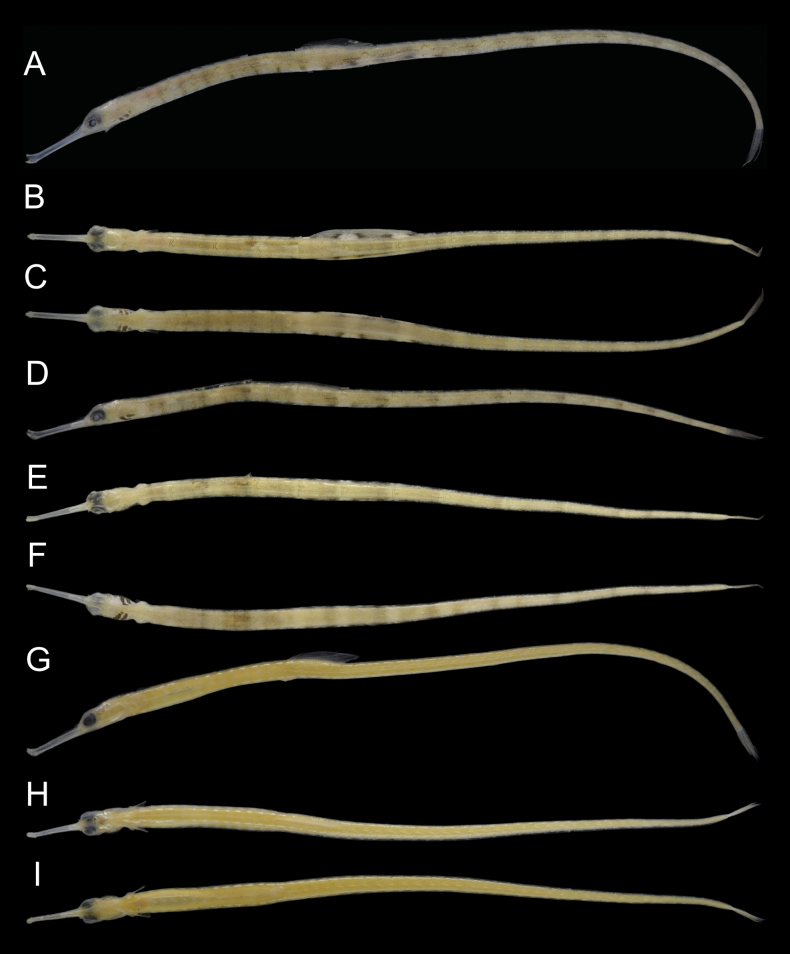 Figure 1
| Holotype | Paratypes | ||||
|---|---|---|---|---|---|
| Standard length (mm; SL) | 68.3 | 80.2 | 57.4 | 86.8 | 70.0 |
| Sex | male | female | male | male | female |
| Counts | |||||
| Dorsal-fin rays | 27 | 27 | 27 | 27 | 27 |
| Pectoral-fin rays (left/right) | 16/16 | 16/16 | 16/17 | 17/17 | 16/16 |
| Anal-fin rays | 4 | 4 | 4 | 4 | 4 |
| Caudal-fin rays | 10 | 10 | 10 | 10 | 10 |
| Subdorsal rings | 5 | 5.75 | 5.25 | 5.5 | 5.25 |
| Subdorsal trunk rings | 0.5 | 0.5 | 1.0 | 0.5 | 0.5 |
| Trunk rings | 14 | 14 | 14 | 14 | 14 |
| Tail rings | 37 | 38 | 37 | 37 | 37 |
| Measurements (% SL) | |||||
| Head length (HL) | 14.9 | 14.1 | 15.9 | 14.6 | 17.4 |
| Trunk length | 21.6 | 22.4 | 21.8 | 21.9 | 35.4 |
| Tail length | 62.1 | 62.5 | 61.7 | 63.9 | 53.6 |
| Snout length | 8.6 | 8.0 | 9.4 | 9.2 | 10.3 |
| Snout depth | 0.8 | 5.2 | 0.8 | 1.2 | 1.6 |
| Orbit diameter | 2.7 | 2.7 | 2.9 | 2.5 | 2.7 |
| Postorbital length | 3.9 | 3.8 | 3.9 | 3.3 | 3.9 |
| Distance from posterior margin of orbit to central pectoral-fin base (DPP) | 5.2 | 5.2 | 5.5 | 4.6 | 6.1 |
| Head width | 3.5 | 3.6 | 3.4 | 3.1 | 3.6 |
| Body depth | 2.7 | 2.5 | 2.4 | 2.4 | 3.0 |
| Dorsal-fin base length | 7.6 | 7.4 | 7.7 | 8.0 | 7.9 |
| Pectoral-fin base length | 1.4 | 1.5 | 1.4 | 1.3 | 1.6 |
| Measurements (% HL) | |||||
| Snout length | 57.5 | 56.5 | 59.0 | 62.9 | 59.0 |
| Snout depth | 5.6 | 5.8 | 4.9 | 7.8 | 9.0 |
| Orbit diameter | 18.2 | 19.4 | 18.5 | 18.1 | 15.6 |
| Postorbital length | 25.9 | 26.9 | 24.6 | 22.8 | 22.1 |
| DPP | 35.1 | 36.9 | 34.3 | 31.4 | 35.2 |
| Head width | 23.1 | 25.5 | 21.6 | 21.2 | 20.5 |
| Body depth | 17.9 | 17.6 | 15.1 | 16.5 | 19.1 |
| Dorsal-fin base length | 51.2 | 52.4 | 48.3 | 53.1 | 54.9 |
| Pectoral-fin base length | 9.2 | 10.7 | 8.8 | 8.7 | 10.7 |
| Measurements (% snout length) | |||||
| Snout depth | 9.7 | 10.3 | 8.3 | 12.5 | 15.3 |
| DPP | 61.0 | 65.3 | 58.1 | 53.0 | 59.7 |
Peer Reviews
No public reviews on file for this paper yet. If you reviewed it on a platform where reviews are public (OpenReview, ICLR, NeurIPS, ICML), you can paste yours below so the community can read it here.
Videos
No videos yet. Explain this paper in a talk, walkthrough, or lecture? Add one.
Taxonomy
TopicsAquatic life and conservation · Ichthyology and Marine Biology · Identification and Quantification in Food
Introduction
Corythoichthys Kaup, 1853 (Syngnathidae) is a genus of reef-associated pipefish comprising at least 11 recognized species (Dawson 1977; Allen and Erdmann 2008): C.amplexus Dawson & Randall, 1975, C.benedetto Allen & Erdmann, 2008, C.flavofasciatus (Rüppell, 1838), C.haematopterus (Bleeker, 1851), C.insularis Dawson, 1977, C.intestinalis (Ramsay, 1881), C.nigripectus Herald, 1953, C.ocellatus Herald, 1953, C.paxtoni Dawson, 1977, C.polynotatus Dawson, 1977, and C.schultzi Herald, 1953. Members of the genus are broadly distributed across the tropical Indo-Pacific, ranging from the coast of East Africa to the islands of French Polynesia. An additional, yet undescribed species of Corythoichthys from Vanuatu was previously reported by Fricke et al. (2011). In the present study, all Corythoichthys specimens held in the Muséum national d’Histoire naturelle, Paris (MNHN), were examined, revealing three individuals that correspond to this undescribed taxon from Vanuatu and the Chesterfield Islands. Furthermore, two additional specimens from the Chesterfield Islands, previously reported as C.nigripectus by Fricke (2004) and deposited in Staatliches Museum für Naturkunde Stuttgart, were re-examined and found to be conspecific with the MNHN specimens. These five specimens are herein described as a new species.
Materials and methods
Counts and measurements followed Dawson (1977) and Yuki et al. (2024). Type specimens are deposited at Systématique et évolution, Laboratoire d’Ichthyologie générale et appliquée, Muséum national d’Histoire naturelle, Paris, France (MNHN-IC) and Staatliches Museum für Naturkunde Stuttgart, Stuttgart, Germany (SMNS).
Results
Corythoichthys
quattuordecim
sp. nov.
Taxon classificationAnimaliaSyngnathiformesSyngnathidae
684DBCF8-215F-571B-A8C1-76DB44A0B503
https://zoobank.org/4E26D87A-84C0-4632-9A52-31DC3DADECED
Fig. 1 ; Table 1 New English name: Coral Sea Pipefish
Corythoichthys nigripectus : Fricke 2004: 16 (Chesterfield Islands, New Caledonia). Corythoichthys sp.: Fricke et al. 2011: 388 (Vanuatu).
Types.
Holotype. • MNHN-IC-2010-0773, 68.3 mm SL, off Mavéa Island, Santo, Vanuatu, 15°22'22.8"S, 167°12'36"E, 57–81 m depth, 27 Sept. 2006, RV Alis, Campagne Santo 6, St. at39.
Paratypes. • 4 specimens: MNHN-IC-2004-2018, 80.2 mm SL, Chesterfield Islands, New Caledonia, 19°25'00"S, 158°24'36"E, 56 m depth, 28 July 1988, RV Coriolis, Campagne Corail 2, St. DW119; • MNHN-IC-2010-0774, 57.4 mm SL, collected with holotype; SMNS 21754, 86.8 mm SL, collected with the holotype; • SMNS 21773, 70.0 mm SL, northern lagoon, west of Île Squeleton, Chesterfield Islands, New Caledonia, 19°17'32"S, 158°34'09"E, 65–68 m depth, 18 July 1984, RV Coriolis, Campagne Chalcal 84, St. CP 7.
Diagnosis.
Trunk rings 14; total rings 51 or 52; pectoral fin rays 16 or 17 usually 16; dorsal fin origin behind posterior margin of anal ring; opercle with a denticulate longitudinal ridge; opercle with two or three black lines; dorsal fin without rows of pale spots; venter of anterior trunk rings without blotches, spots, or lines; venter of anal ring without black blotch.
Description.
Counts and measurements listed in Table 1. Body elongated, slightly compressed; body transverse section trapezoidal, dorsal section shorter than ventral section; trunk shorter than tail; first trunk ring longer than second; superior ridges entirely to minutely denticulate; superior trunk ridges indented to distinctly notched between rings, usually elevated well above level of dorsum; no dermal flaps or keeled scutella present, principal body ridges distinct; superior trunk and tail ridges discontinuous; lateral trunk ridge straight, end tips of anal ring; inferior trunk and tail ridges continuous; snout slender, with low, denticulate, median dorsal ridge but without median lateral ridge, spines or spinules; eye slightly prominent, orbital margin not expanded laterally above or below; supraorbital and paired interorbital ridges denticulate, distinct; opercle with a denticulate longitudinal ridge; supraopercular ridge short, inconspicuous; pectoral-fin base with two distinct ridges, lower ridge denticulate. Dorsal-fin base slightly raised; posterior margin of pectoral fin rounded; anal fin very small; caudal fin rounded, membranes between each soft ray with slit. Brood pouch on ventral surface from first to 16^th^ tail rings in males, with fleshy folds but lacking protective plates.
Color of preserved specimens (Fig. 1). Interorbital and dorsum of head without stripes or somewhat reticulate pattern of black or dark brown lines; melanophores scattered; median dorsal snout ridges without dark brown spots. Side of snout with melanophores on posterior one-third; dorsum transparent with melanophores or a single spot on either side of median ridge; postorbital and opercle above opercular ridge with melanophores, below opercular ridge with two or three vertical stripes extending ventrally. Dorsum and sides of trunk and tail with indistinct reticulate bands and scattered melanophores; lower part of trunk without 1–3 irregular rows of small brown spots; first trunk ring with small number of melanophores ventrally, without stripes, blotches, bars, or shaded or lined pattern; second to 14^th^ trunk rings with melanophores ventrally. First to 20^th^ tail rings with many melanophores ventrally; behind 21^st^ tail ring, a low number of melanophores ventrally. Dorsal, anal, and caudal fins with melanophores. Pectoral fins transparent. A faded specimen (MNHN-IC-2004-2018) lacked all melanophores.
Preserved specimens of Corythoichthysquattuordecim sp. nov. A–C.MNHN-IC-2010-0773, male, 68.3 mm SL; D–F.MNHN-IC-2010-0774, male, 57.4 mm SL; G–I.MNHN-IC-2004-2018, female, 80.2 mm SL. A, D, G. Lateral views; B, E, H. Dorsal views; C, F, I. Ventral views.
Distribution.
Currently known only from Vanuatu and New Caledonia.
Etymology.
The specific name ‘‘quattuordecim’’, derived from Latin, refers to the 14 trunk rings in the new species.
Remarks.
The new species was identified as belonging to Corythoichthys based on the diagnosis for the genus, given its possession of superior trunk and discontinuous tail ridges; inferior trunk and continuous tail ridges; lateral trunk ridge discontinuous near the end of the anal ring; dorsum somewhat depressed between superior body ridges; dorsal-fin base not distinctly elevated; opercle with low longitudinal keel; a brood pouch under the tail; trunk rings 14; tail rings 37 or 38; subdorsal rings 5.0–5.75, dorsal-fin rays 27; pectoral-fin rays 16 or 17; anal-fin rays 4; and caudal-fin rays 10 (Dawson 1977, 1985).
Corythoichthysquattuordecim possesses 14 trunk rings, whereas the modal trunk ring count of Corythoichthys is 15–18 (Dawson 1977; Fricke 2004; Allen and Erdmann 2008; Yuki et al. 2024) [but 14 trunk rings in C.amplexus and Corythoichthys sp. sensu Fricke, 2004 (Dawson 1977; Fricke 2004; Allen and Erdmann 2008; Yuki et al. 2024)]. Corythoichthysquattuordecim is clearly distinguished from C.amplexus in having 16 or 17 pectoral-fin rays (vs 12–15 in C.amplexus), the snout length 56.5–62.9% HL (35.7–47.6%), snout depth 8.3–15.3% snout length (18.5–27.0%), and body without broad dark bands crossing the sides and dorsum (with such broad dark bands, sometimes divided to form two close-set bands) (Dawson 1977, 1985; Allen and Erdmann 2008). Corythoichthysquattuordecim is distinguished from Corythoichthys sp. sensu Fricke, 2004 in having the head length 14.1–17.4% SL (vs 9.7–10.6%), body depth 2.4–3.0% SL (vs 3.0–3.4%), snout length 56.5–62.9% HL (vs 35.7–38.5%), 5.0–5.75 subdorsal rings (vs 6.0–7.0), the opercle with a denticulate longitudinal ridge (vs longitudinal ridge not denticulate), and body without broad dark brown bars (vs with broad dark-brown bars) (Fricke 2004). The new species is similar to C.ocellatus and C.schultzi in snout length (56.5–62.9% of head length in C.quattuordecim, 50.0–58.8% in C.ocellatus, 50.0–66.7% in C.schultzi) (Dawson 1985), but it is distinguished from both species in having 14 trunk rings (15 or 16 in C.ocellatus, 15–17 in C.schultzi), 27 dorsal-fin rays (22–25 in C.ocellatus), 37 or 38 tail rings (29–32 in C.ocellatus), and the opercle with a denticulate longitudinal ridge (longitudinal ridge not denticulate in either) (Dawson 1985).
Members of Corythoichthys typically inhabits waters shallower than 40 m depth (Dawson 1985), although the deepest recorded occurrence is at 125–128 m for C.nigripectus (Fricke 2004). Collected at depths of 56–81 m, C.quattuordecim occupies relatively deeper habitats compared to most congeners. The paratypes (MNHN-IC-2004-2018, SMNS 21754, and SMNS 21773) were previously reported as C.nigripectus by Fricke (2004, in part, Chesterfield Islands).
Supplementary Material
XML Treatment for Corythoichthys quattuordecim
The reference list from the paper itself. Each links out to its DOI / PubMed record.
- 1Allen GR Erdmann MV (2008) Corythoichthysbenedetto, a new pipefish (Pisces: Syngnathidae) from Indonesia and Papua New Guinea. Aqua.International Journal of Ichthyology 13: 121–126.
- 2Dawson CE (1977) Review of the pipefish genus Corythoichthys with description of three new species.Copeia 1977(2): 295–338. 10.2307/1443912 · doi ↗
- 3Dawson CE (1985) Indo-Pacific Pipefishes (Red Sea to the Americas). The Gulf Coast Research Laboratory, Ocean Springs, [vi +] 230 pp.
- 4Fricke R (2004) Review of the pipefishes and seahorses (Teleostei: Syngnathidae) of New Caledonia, with descriptions of five new species.Stuttgarter Beiträge zur Naturkunde, Serie A, Biologie 668: 1–66.
- 5Fricke R Kulbicki M Wantiez L (2011) Checklist of the fishes of New Caledonia, and their distribution in the Southwest Pacific Ocean (Pisces).Stuttgarter Beiträge zur Naturkunde A, Neue Serie 4: 341–463.
- 6Yuki D Endo H Motomura H (2024) First Japanese record of Corythoichthysintestinalis (Teleostei: Syngnathidae) from the Ryukyu Islands.Species Diversity: An International Journal for Taxonomy, Systematics, Speciation, Biogeography, and Life History Research of Animals 29(2): 247–253. 10.12782/specdiv.29.247 · doi ↗