Predicting lithium metal anode failure at an early stage
Jian Liang Cheong, Zhi Wei Seh

Abstract
Genes, proteins, chemicals, diseases, species, mutations and cell lines named across the full text — each resolved to its canonical identifier and authoritative record.
Click any figure to enlarge with its caption.
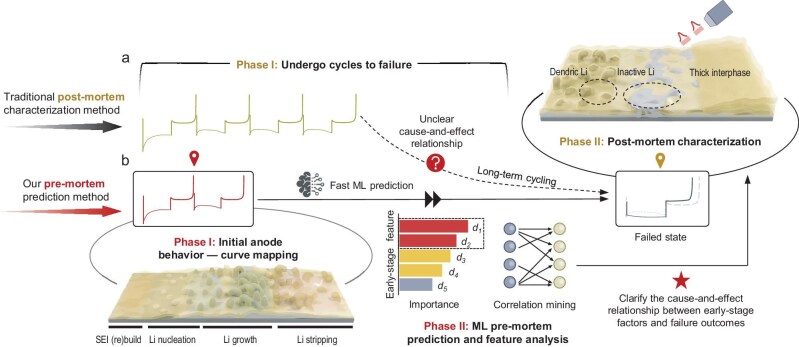 Figure 1
Peer Reviews
No public reviews on file for this paper yet. If you reviewed it on a platform where reviews are public (OpenReview, ICLR, NeurIPS, ICML), you can paste yours below so the community can read it here.
Videos
No videos yet. Explain this paper in a talk, walkthrough, or lecture? Add one.
Taxonomy
TopicsAdvancements in Battery Materials · Advanced Battery Technologies Research · Fuel Cells and Related Materials
Electrochemical curve fingerprints, coupled with machine learning (ML), offer a powerful new approach to understanding and predicting the failure mechanisms in lithium metal anodes—a critical component for advancing lithium metal batteries [1,2]. Unlike traditional post-mortem analysis, which only reveals the end state of failure, Guangmin Zhou et al. reported a novel pre-mortem prediction method that led to the identification of the degradation root cause of early-stage electrochemical behaviours (Fig. 1) [3]. Leveraging on a vast dataset of >18 000 cycles and 12 million data points from failed battery cells, a correlation between the initial lithium plating/stripping behaviour and subsequent anode changes was established. The correlation was manifested as an ML model, which accurately predicts failure types by using data from only the first two cycles (<2% of the total data), enabling the early identification of failure indicators and accelerating electrolyte optimization. The study categorizes failures into kinetics degradation failure (KDF), reversibility degradation failure (RDF), and co-degradation failure (CDF) based on changes in the overpotential (α) and coulombic efficiency, with each type exhibiting a unique curve evolution pattern. Building on this classification, analysis of the feature importance ranking from the ML model revealed that highly ranked features encompass the lithium nucleation and thickening processes. Analysis of the feature importance of the ML model revealed that lithium nucleation and thickening processes are critical to the failure type. Highly ranked nucleation kinetics features (d1, d4, d6) are linked to solid–electrolyte interphase (SEI) properties [3]. For example, KDF-type failures showed significantly lower relative nucleation overpotential (d1), consistently with better SEI ionic conductivity and lower Young's modulus. The study also detailed how SEI properties (composition, mechanical strength) influence initial plating/stripping behaviours [3]. For instance, a CDF-type SEI, rich in organic components, showed poor ion transport and mechanical strength, while the RDF type, with high LiF content, exhibited high mechanical strength but suboptimal ion conductivity. Additionally, finite element analysis and scanning electron microscopy allow observation of the lithium-thickening-process transitions from porous vertical to dense lateral growth, leading to an increase in the local current density and SEI impedance. This raises overpotential and can be attributed to changes in the effective lithium-ion transfer area within the SEI. Taken together, these insights directly connect early-stage electrochemical fingerprints to underlying SEI properties and their influence on battery-failure mechanisms. Post-failure structural analysis, carried out by using electron microscopic techniques [3], determined that CDF involved inactive lithium and irreversible SEI impedance from dendritic growth. The high SEI modulus of the RDF caused fracture, porous ineffective SEI and surface inactive lithium. KDF, having a moderate SEI modulus, formed dense ineffective SEI, hence increasing the migration impedance. These results confirm that early-stage factors dictate these pathways, impacting charge transport.
To conclude, the pre-mortem prediction method developed by Guangmin Zhou et al. offers significant advantages over traditional post-mortem analysis, enabling faster battery reliability assessment and accelerating electrolyte development by uncovering degradation root causes from initial cycles. This allows informed decisions on battery suitability, streamlining the development of advanced electrolyte formulations for high-performance lithium metal batteries. The methodology also holds potential for extension to other metallic anodes such as sodium [4] and zinc [5].
The reference list from the paper itself. Each links out to its DOI / PubMed record.
- 1Yao Z, Lum Y, Johnston A et al. Nat Rev Mater 2023; 8: 202–15.10.1038/s 41578-022-00490-536277083 PMC 9579620 · doi ↗ · pubmed ↗
- 2Eng AYS, Soni CB, Lum Y et al. Sci Adv 2022; 8: eabm 2422.10.1126/sciadv.abm 242235544561 PMC 9094674 · doi ↗ · pubmed ↗
- 3Piao Z, Han Z, Tao S et al. Natl Sci Rev 2025; 12: nwaf 158.10.1093/nsr/nwaf 15840511368 PMC 12153722 · doi ↗ · pubmed ↗
- 4Li H, Wu F, Wang J et al. Energy Environ Sci 2025; 18: 3887–916.10.1039/D 5EE 00136 F · doi ↗
- 5Zhang B, Yao J, Wu C et al. Nat Commun 2025; 16: 71.10.1038/s 41467-024-55657-139747912 PMC 11695615 · doi ↗ · pubmed ↗