A novel impact-tip crusher catheter enhances mechanical lithotripsy for large common bile duct stones
Akihiro Maruyama, Makoto Kobayashi, Ryota Tagawa, Junya Yamada, Hiroki Kato, Shintaro Tominaga

Abstract
Genes, proteins, chemicals, diseases, species, mutations and cell lines named across the full text — each resolved to its canonical identifier and authoritative record.
Click any figure to enlarge with its caption.
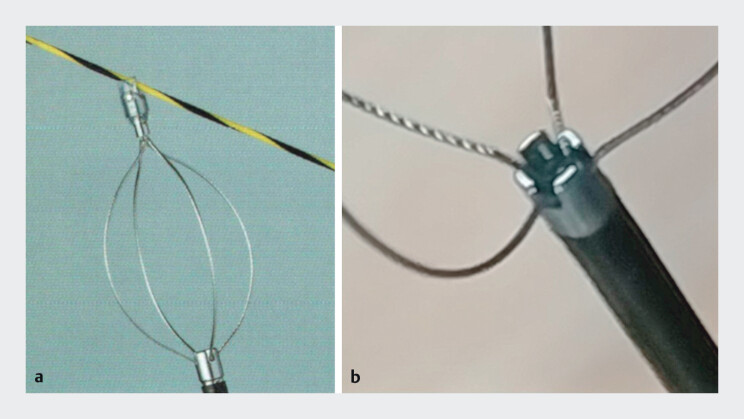 Fig. 1
Peer Reviews
No public reviews on file for this paper yet. If you reviewed it on a platform where reviews are public (OpenReview, ICLR, NeurIPS, ICML), you can paste yours below so the community can read it here.
Videos
No videos yet. Explain this paper in a talk, walkthrough, or lecture? Add one.
Taxonomy
TopicsGallbladder and Bile Duct Disorders · Pediatric Hepatobiliary Diseases and Treatments · Pancreatic and Hepatic Oncology Research
Mechanical lithotripsy is commonly used for large common bile duct (CBD) stones; however, fragmentation can be difficult, especially in cases of hard or large stones 1 2 3 . We evaluated the utility of a novel crusher catheter, Stone Smash (Boston Scientific, Marlborough, MA, USA), which is equipped with a distal impact tip that doubles as a basket guide ( Fig. 1 ). This device was jointly developed by our institution and Lake R&D Co., Ltd. (Okaya, Nagano, Japan). Conventional basket catheters apply circumferential compression to the entire stone, leading to a crushing pattern in which the stone is flattened and fractured 4 . In contrast, the impact tip on Stone Smash enables direct, longitudinal force application at a single point, causing the stone to split along its vertical axis. Additionally, to improve ductal insertion, the sheath is short and flexible, with a preshaped bendable tip that allows easy advancement even without a guidewire. We conducted a bench test comparing Stone Smash and a standard crusher catheter without an impact tip. Five calcium sulfate blocks of similar size were used for each device, and the average crushing force required for fragmentation was measured. Stone Smash required a mean force of 5.6 kgf, significantly less than the 8.2 kgf needed with the conventional catheter ( p < 0.05). We performed lithotripsy using the Stone Smash in a 78-year-old man with CBD stones measuring 22 and 14 mm. The procedure was completed successfully without any complications ( Video 1 ). This novel catheter demonstrated superior crushing force compared to standard devices and provided excellent maneuverability due to its flexible sheath and short-type guidewire compatibility. These features enabled smooth bile duct insertion, even in tortuous anatomy or in the absence of a guidewire. Stone Smash appears to be a valuable tool in the endoscopic management of difficult CBD stones.
a Basket with high expansion force prevents stone escape. b Claw-equipped metallic tip allows effective and concentrated lithotripsy.
Demonstration of the Stone Smash catheter used for endoscopic lithotripsy of a common bile duct stone. The catheter is inserted into the bile duct over a guidewire or directly without it. After capturing the stone within the basket, the gradual closure of the claw-equipped metallic tip enables effective fragmentation.Video 1
Endoscopy_UCTN_Code_TTT_1AR_2AH
The reference list from the paper itself. Each links out to its DOI / PubMed record.
- 1Yasuda I Itoi T Recent advances in endoscopic management of difficult bile duct stones Dig Endosc 20132537638510.1111/den.1211823650878 · doi ↗ · pubmed ↗
- 2Chang WH Chu CH Wang TE Outcome of simple use of mechanical lithotripsy of difficult common bile duct stones World J Gastroenterol 20051159359610.3748/wjg.v 11.i 4.59315641153 PMC 4250818 · doi ↗ · pubmed ↗
- 3Syed IA Hanif MF Malik AK Cholangioscope-Guided Electrohydraulic Lithotripsy as a Rescue Technique for an Impacted Dormia Basket With Large Common Bile Duct Stone ACG Case Rep J 202310 e 0098110.14309/crj.000000000000098136846355 PMC 9946427 · doi ↗ · pubmed ↗
- 4Angsuwatcharakon P Rerknimitr R Cracking Difficult Biliary Stones Clin Endosc 20215466066810.5946/ce.2020.256-IDEN 33721976 PMC 8505192 · doi ↗ · pubmed ↗