Taguchi orthogonal optimization for the oxidative degradation of 2-chlorophenol using zero valent iron-activated persulfate
Nikka Mae Macalde Buenaobra, Chenju Liang, Xuyen Thi Hong Luong, Khyle Glainmer Nagtalon Quiton

TL;DR
This study uses zero-valent iron and persulfate to efficiently degrade 2-chlorophenol in groundwater, achieving full degradation in 10 minutes.
Contribution
The novel application of Taguchi optimization identifies optimal conditions for 2-chlorophenol degradation using zero-valent iron-activated persulfate.
Findings
SPS concentration was the most significant factor affecting 2-CP degradation.
100% degradation of 2-CP was achieved in 10 minutes under optimal conditions.
Groundwater constituents affected degradation efficiency, with 75% and 67% total organic carbon removal in reverse osmosis and groundwater samples.
Abstract
Chlorophenols (CPs) are persistent toxicants and major groundwater pollutants due to their carcinogenic properties. This study focused on optimizing the degradation of 2-chlorophenol (2-CP) in the aqueous phase using zero-valent iron (ZVI)-activated sodium persulfate (SPS). The Taguchi Design of Experiment methodology (L9 orthogonal array) and ANOVA statistical analysis were applied to identify optimal conditions, with key parameters including initial pH, SPS concentration, and ZVI concentration. Results indicated that SPS concentration had the most significant impact on 2-CP degradation. Confirmation tests conducted at the optimal conditions (pH = 6, SPS = 60 mM, ZVI = 60 mM) achieved 100% 2-CP degradation within 10 min, characterized by rapid 2-CP degradation, SPS decomposition, and 2-CP mineralization. Experiments with 2-CP spiked reverse osmosis water and groundwater samples showed…
Genes, proteins, chemicals, diseases, species, mutations and cell lines named across the full text — each resolved to its canonical identifier and authoritative record.
Click any figure to enlarge with its caption.
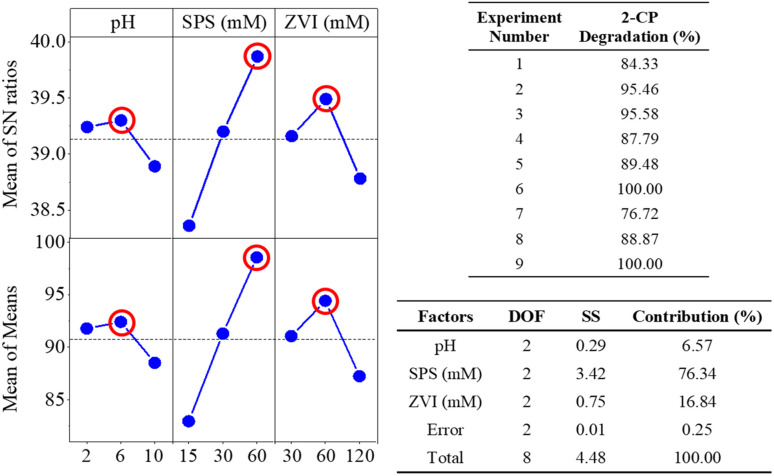 Figure 1
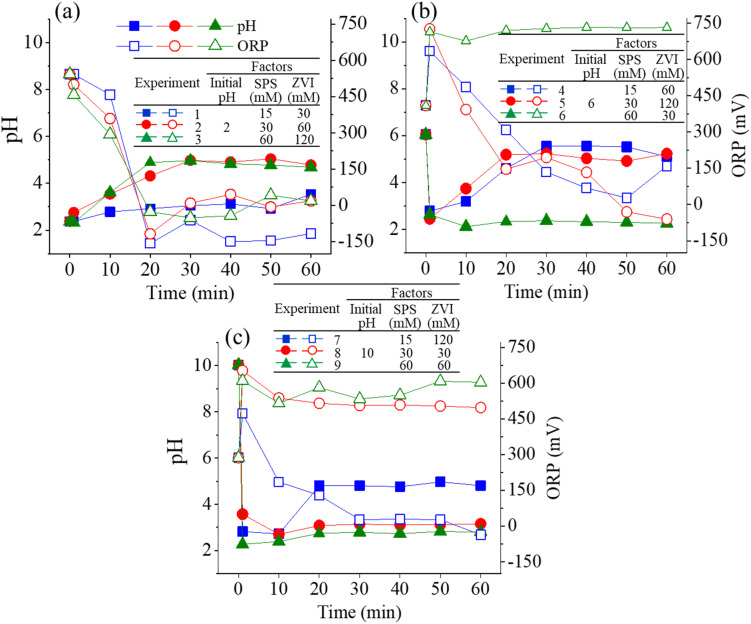 Figure 2
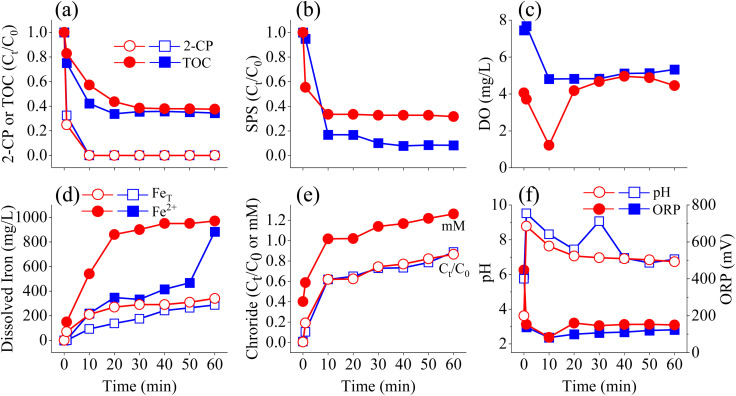 Figure 3
 Figure 4
 Figure 5
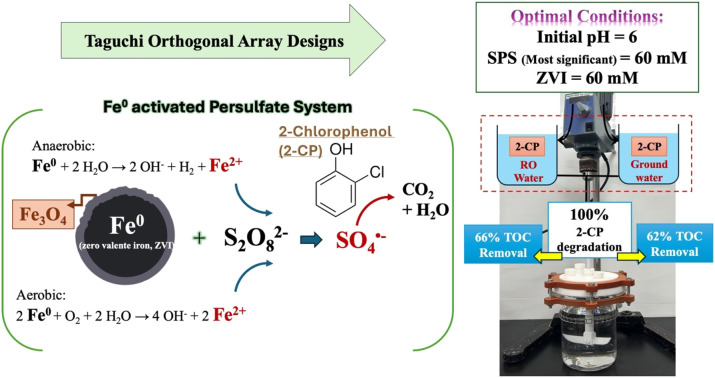 Figure 6
 Figure 7
 Figure 8
Peer Reviews
No public reviews on file for this paper yet. If you reviewed it on a platform where reviews are public (OpenReview, ICLR, NeurIPS, ICML), you can paste yours below so the community can read it here.
Videos
No videos yet. Explain this paper in a talk, walkthrough, or lecture? Add one.
Taxonomy
TopicsAdvanced oxidation water treatment · Arsenic contamination and mitigation · Electrochemical Analysis and Applications