Predicting individual hemoglobin abnormalities using longitudinal data in clinical practice
Maliheh Namazkhan, Karel Jan van Tuijn, Maurits Kaptein, Remco van Horssen

TL;DR
This study uses longitudinal data to predict when a person's hemoglobin levels might become abnormal, helping prevent health issues through early intervention.
Contribution
A novel approach using a Generalised Additive Model to predict individual hemoglobin trends and identify potential abnormalities.
Findings
The model accurately predicted hemoglobin trends for 88.47% of cases.
The method can help reduce unnecessary blood tests and enable preventive healthcare.
Early detection through this model may prevent the onset of abnormal hemoglobin levels.
Abstract
In preventive medicine, the promotion of health and well-being through early detection and intervention is crucial to preventing the development of diseases. This study aims to predict potential abnormalities in hemoglobin levels before they occur, using individualised observations within normal ranges. We utilise a dataset generated over seven years, comprising 30,000 patients. Multiple prediction models are employed to identify hemoglobin trends within individuals and predict their next-to-measure hemoglobin value based on past measurements. We focus on whether, at a specific point in time, the individual’s values are likely to run outside of the individual ‘normal’ bounds. A Generalised Additive Model is explored as a plausible approach for predicting future individual hemoglobin values. By calculating confidence intervals for predicted hemoglobin values, we evaluate prediction…
Genes, proteins, chemicals, diseases, species, mutations and cell lines named across the full text — each resolved to its canonical identifier and authoritative record.
Click any figure to enlarge with its caption.
 Figure 1
 Figure 2
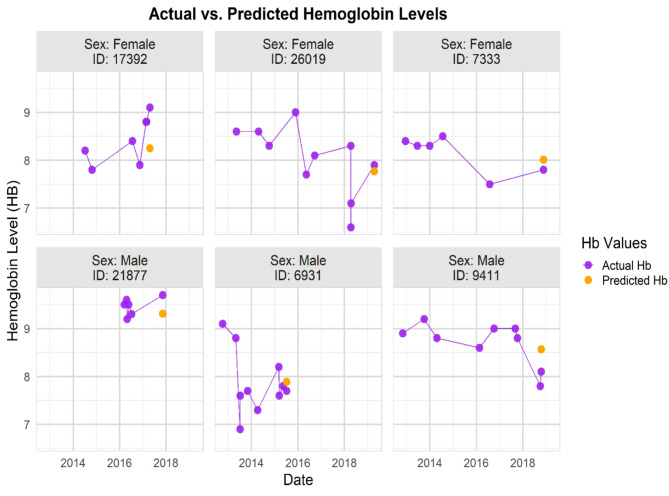 Figure 3
Peer Reviews
No public reviews on file for this paper yet. If you reviewed it on a platform where reviews are public (OpenReview, ICLR, NeurIPS, ICML), you can paste yours below so the community can read it here.
Videos
No videos yet. Explain this paper in a talk, walkthrough, or lecture? Add one.
Taxonomy
TopicsArtificial Intelligence in Healthcare · Statistical Methods in Epidemiology · Hemoglobinopathies and Related Disorders