The first complete chloroplast genome sequence of Sterculia foetida Linnaeus (Malvaceae) and a comparative phylogenetic analysis
Peisi Luo, Lijun Huang, Zhiluo Zhou, Jie Chen, Guangxuan Lin, You Wei, Zhenling Yan, Jing Zhou, Fangnan Kong, Juanjuan Jiang, Xuebin Zhang, Jing Zhao, Jingmei Tang, Meiying Lu, Caixia Zhou

TL;DR
This paper presents the first complete chloroplast genome sequence of Sterculia foetida and compares it with related species.
Contribution
The first complete chloroplast genome sequence of Sterculia foetida is reported and analyzed phylogenetically.
Findings
The complete chloroplast genome of S. foetida is 162,637 bp long with a GC content of 36.68%.
The genome contains 130 genes, including 85 protein-coding genes.
Phylogenetic analysis shows S. foetida is closely related to S. pexa.
Abstract
Sterculia foetida L. (1753), a tree species in the family Malvaceae, is widely cultivated in tropical regions for its applications in food, medicine, and biodiesel production. This study reports the first complete chloroplast genome sequence of S. foetida, which is 162,637 bp long with a GC content of 36.68%, containing a large single-copy region (91,324 bp), a small single-copy region (20,347 bp), and two inverted repeat regions (25,483 bp each). The genome encodes 130 genes: 85 protein-coding genes, eight rRNA genes, and 37 tRNA genes. Phylogenetic analysis shows S. foetida is closely related to S. pexa.
Genes, proteins, chemicals, diseases, species, mutations and cell lines named across the full text — each resolved to its canonical identifier and authoritative record.
Click any figure to enlarge with its caption.
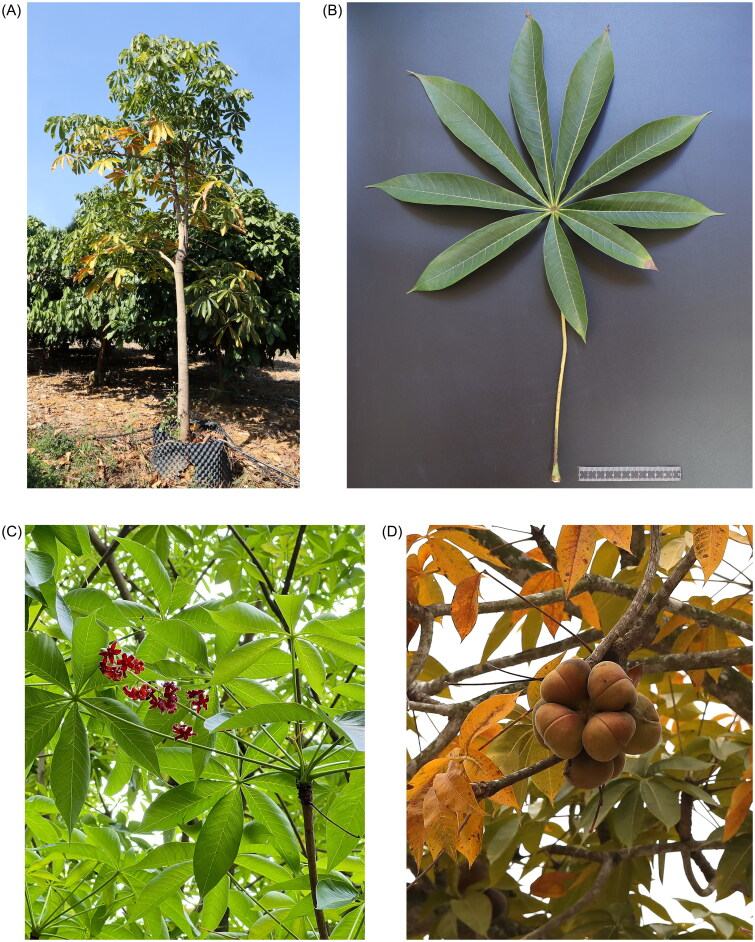 Figure 1
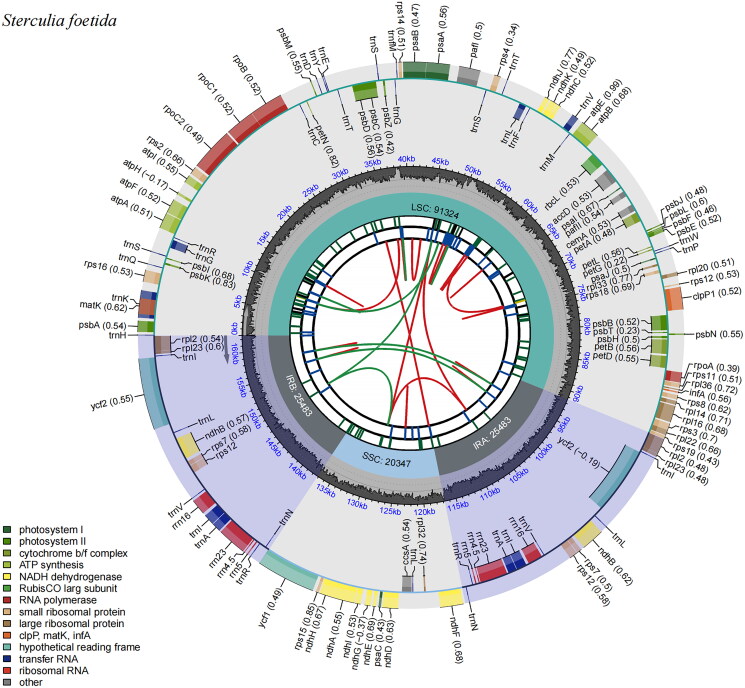 Figure 2
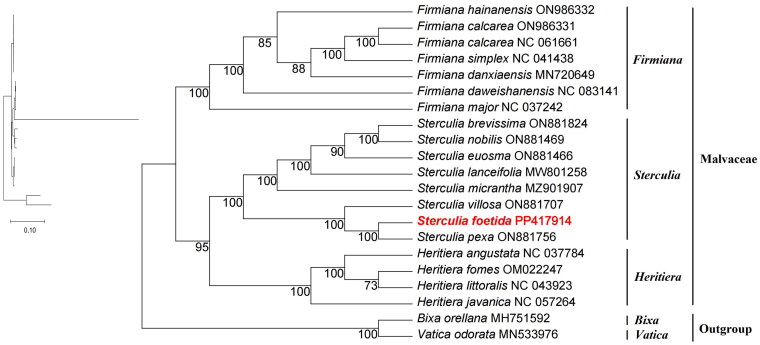 Figure 3
Peer Reviews
No public reviews on file for this paper yet. If you reviewed it on a platform where reviews are public (OpenReview, ICLR, NeurIPS, ICML), you can paste yours below so the community can read it here.
Videos
No videos yet. Explain this paper in a talk, walkthrough, or lecture? Add one.
Taxonomy
TopicsGenomics and Phylogenetic Studies · Genetic diversity and population structure · Plant Diversity and Evolution