Harnessing deep learning for proteome-scale detection of amyloid signaling motifs
Krzysztof Pysz, Jakub Gałązka, Witold Dyrka

TL;DR
This paper introduces deep learning models to detect amyloid signaling motifs in large protein datasets, improving detection accuracy and scalability.
Contribution
The study introduces tailored deep learning models for detecting amyloid signaling motifs at proteome scale, outperforming existing methods.
Findings
Bidirectional LSTM and BERT-based models effectively detect amyloid signaling motifs, including novel ones.
The models perform well on genome-scale datasets and identify motifs from remotely related families.
The developed models are available as open-source tools for broader use.
Abstract
Amyloid signaling sequences adopt the cross-β fold that is capable of self-replication in the templating process. Propagation of the amyloid fold from the receptor to the effector protein is used for signal transduction in the immune response pathways in animals, fungi, and bacteria. So far, a dozen of families of amyloid signaling motifs (ASMs) have been classified. Unfortunately, due to the wide variety of ASMs it is difficult to identify them in large protein databases available, which limits the possibility of conducting experimental studies. To date, various deep learning (DL) models have been applied across a range of protein-related tasks, including domain family classification and the prediction of protein structure and protein–protein interactions. In this study, we develop tailor-made bidirectional LSTM and BERT-based architectures to model ASM, and compare their performance…
Genes, proteins, chemicals, diseases, species, mutations and cell lines named across the full text — each resolved to its canonical identifier and authoritative record.
Click any figure to enlarge with its caption.
 Figure 1
 Figure 2
 Figure 3
 Figure 4
 Figure 5
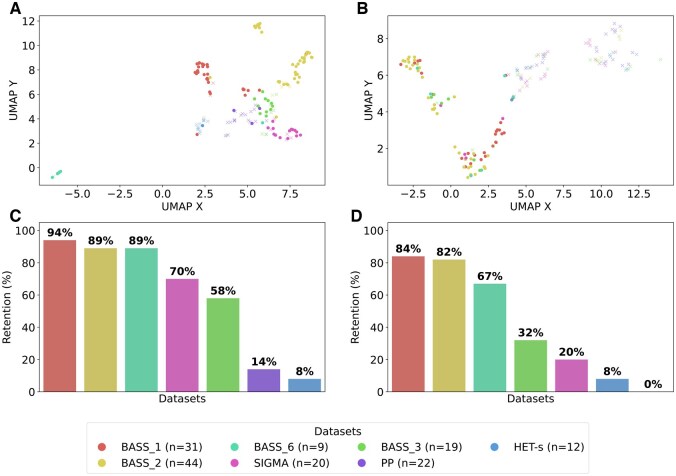 Figure 6
Peer Reviews
No public reviews on file for this paper yet. If you reviewed it on a platform where reviews are public (OpenReview, ICLR, NeurIPS, ICML), you can paste yours below so the community can read it here.
Videos
No videos yet. Explain this paper in a talk, walkthrough, or lecture? Add one.
Taxonomy
TopicsMachine Learning in Bioinformatics · Computational Drug Discovery Methods · Alzheimer's disease research and treatments