Iterative attack-and-defend framework for improving TCR-epitope binding prediction models
Pengfei Zhang, Hao Mei, Seojin Bang, Heewook Lee

TL;DR
This paper introduces a framework to improve TCR-epitope binding predictions by iteratively identifying and fixing model weaknesses.
Contribution
The novel contribution is an iterative attack-and-defend framework using reinforcement learning to enhance model robustness.
Findings
The framework significantly improves detection of adversarial false positives in TCR-epitope models.
A benchmark adversarial dataset is generated to evaluate and refine prediction models.
The method is effective across diverse model architectures and embedding strategies.
Abstract
Reliable TCR-epitope binding prediction models are essential for development of adoptive T cell therapy and vaccine design. These models often struggle with false positives, which can be attributed to the limited data coverage in existing negative sample datasets. Common strategies for generating negative samples, such as pairing with background T cell receptors (TCRs) or shuffling within pairs, fail to account for model-specific vulnerabilities or biologically implausible sequences. To address these challenges, we propose an iterative attack-and-defend framework that systematically identifies and mitigates weaknesses in TCR-epitope prediction models. During the attack phase, a reinforcement learning from AI feedback (RLAIF) framework is used to attack a prediction model by generating biologically implausible sequences that can easily deceive the model. During the defense phase, these…
Genes, proteins, chemicals, diseases, species, mutations and cell lines named across the full text — each resolved to its canonical identifier and authoritative record.
Click any figure to enlarge with its caption.
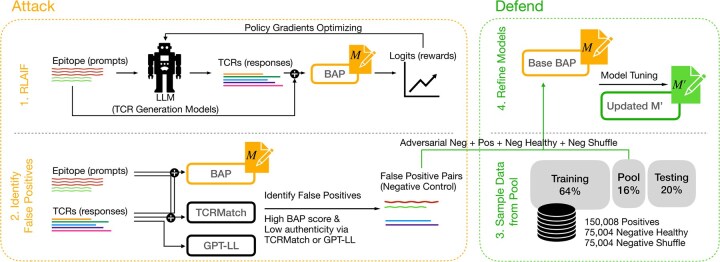 Figure 1
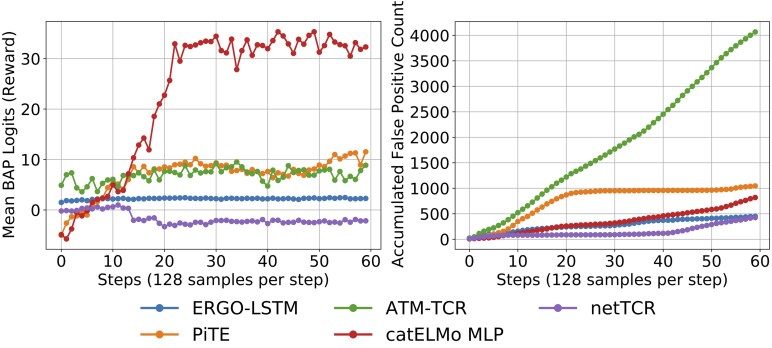 Figure 2
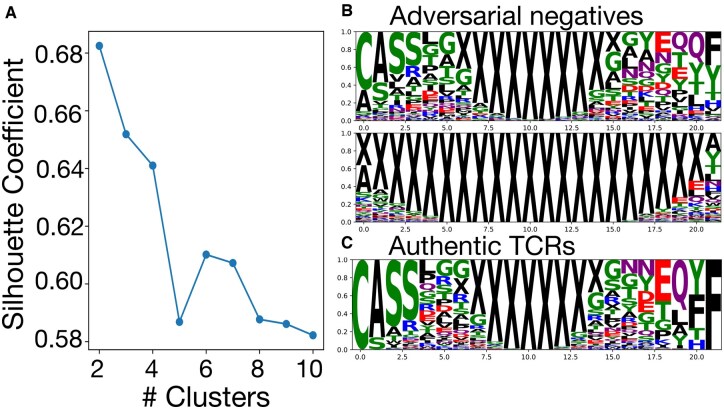 Figure 3
 Figure 4
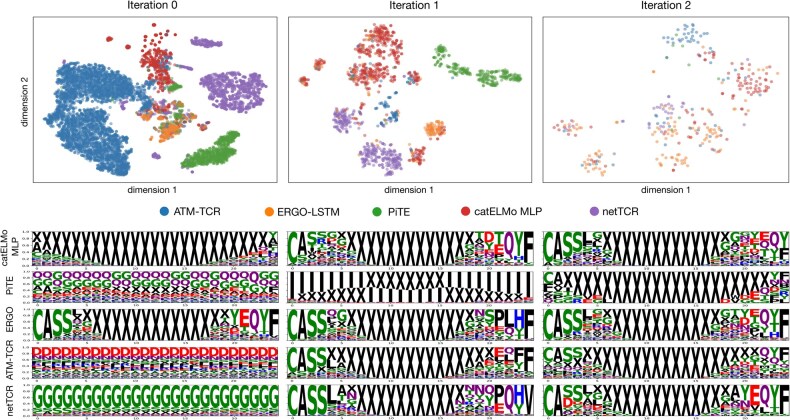 Figure 5
Peer Reviews
No public reviews on file for this paper yet. If you reviewed it on a platform where reviews are public (OpenReview, ICLR, NeurIPS, ICML), you can paste yours below so the community can read it here.
Videos
No videos yet. Explain this paper in a talk, walkthrough, or lecture? Add one.
Taxonomy
Topicsvaccines and immunoinformatics approaches · CAR-T cell therapy research · Bacillus and Francisella bacterial research