Exploiting uniqueness: seed-chain-extend alignment on elastic founder graphs
Nicola Rizzo, Manuel Cáceres, Veli Mäkinen

TL;DR
This paper introduces a new sequence-to-graph alignment method using elastic founder graphs for efficient and accurate genomic analysis.
Contribution
A complete seed-chain-extend workflow using indexable elastic founder graphs for scalable sequence-to-graph alignment.
Findings
iEFGs enable linear-time exact searches for sequence alignment.
The method scales to telomere-to-telomere human chromosomes.
High-quality seeds are efficiently found, chained, and extended.
Abstract
Sequence-to-graph alignment is a central challenge of computational pangenomics. To overcome the theoretical hardness of the problem, state-of-the-art tools use seed-and-extend or seed-chain-extend heuristics to alignment. We implement a complete seed-chain-extend alignment workflow based on indexable elastic founder graphs (iEFGs) that support linear-time exact searches unlike general graphs. We show how to construct iEFGs, find high-quality seeds, chain, and extend them at the scale of a telomere-to-telomere assembled human chromosome. Our sequence-to-graph alignment tool and the scripts to replicate our experiments are available in https://github.com/algbio/SRFAligner.
Genes, proteins, chemicals, diseases, species, mutations and cell lines named across the full text — each resolved to its canonical identifier and authoritative record.
Click any figure to enlarge with its caption.
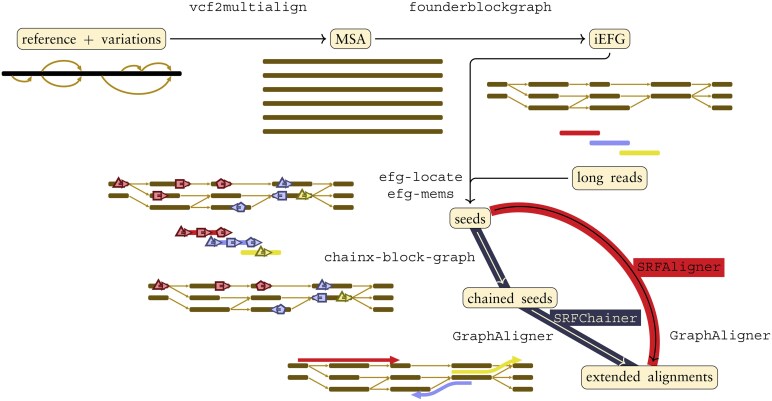 Figure 1
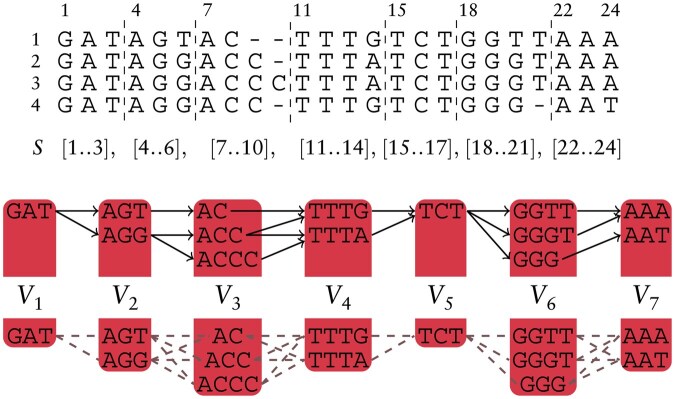 Figure 2
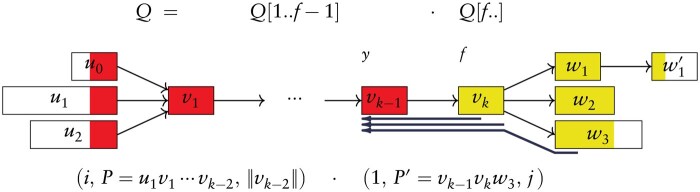 Figure 3
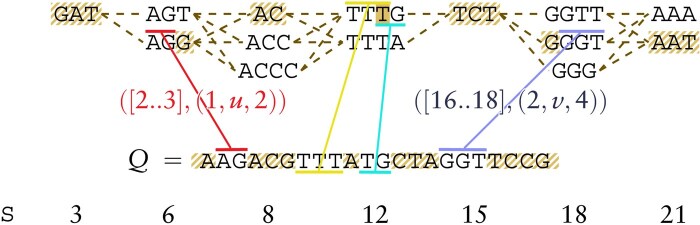 Figure 4
Peer Reviews
No public reviews on file for this paper yet. If you reviewed it on a platform where reviews are public (OpenReview, ICLR, NeurIPS, ICML), you can paste yours below so the community can read it here.
Videos
No videos yet. Explain this paper in a talk, walkthrough, or lecture? Add one.
Taxonomy
TopicsGenomics and Phylogenetic Studies · Genomics and Chromatin Dynamics · Single-cell and spatial transcriptomics