Prevalence and Determinants of Computer Vision Syndrome Among Healthcare Providers in Al Baha, Saudi Arabia: A Cross-Sectional Study
Osama S AlGhamdi, Mohammed H Alshehri, Mahadi A Bashir

TL;DR
This study finds that over half of healthcare workers at a Saudi hospital suffer from computer vision syndrome, with eyewear use and job type as key risk factors.
Contribution
Identifies specific occupational and demographic predictors of computer vision syndrome in healthcare providers using logistic regression analysis.
Findings
59.4% of healthcare providers at King Fahad Hospital reported computer vision syndrome symptoms.
Pharmacists had the highest prevalence (84.2%) of computer vision syndrome.
Regular breaks and ergonomic practices were associated with reduced risk of computer vision syndrome.
Abstract
Background The widespread adoption of digital technology in healthcare settings has led to prolonged screen exposure among healthcare providers, increasing their risk of developing computer vision syndrome (CVS). CVS encompasses a range of ocular and extraocular symptoms that significantly impact well-being and productivity. This study aimed to investigate the prevalence and determinants of CVS among healthcare providers at King Fahad Hospital (KFH) in Al Baha, Saudi Arabia. Methods A hospital-based, cross-sectional study was conducted, involving 192 healthcare providers selected through stratified random sampling. After their consent, data were collected using a validated questionnaire assessing CVS symptoms, determinants, and preventive practices. Statistical analysis, including logistic regression, was performed to identify the factors associated with CVS. Results The prevalence…
Genes, proteins, chemicals, diseases, species, mutations and cell lines named across the full text — each resolved to its canonical identifier and authoritative record.
Click any figure to enlarge with its caption.
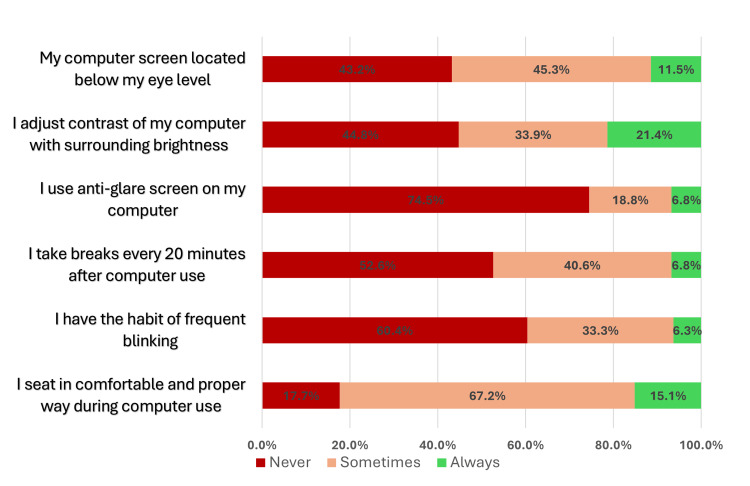 Figure 1
Peer Reviews
No public reviews on file for this paper yet. If you reviewed it on a platform where reviews are public (OpenReview, ICLR, NeurIPS, ICML), you can paste yours below so the community can read it here.
Videos
No videos yet. Explain this paper in a talk, walkthrough, or lecture? Add one.
Taxonomy
TopicsErgonomics and Musculoskeletal Disorders · Tactile and Sensory Interactions · Gaze Tracking and Assistive Technology